

The top software engineering careers in Nigeria now cover a wide range of technical specializations, from full-stack development and backend engineering to mobile development, cloud engineering, DevOps, artificial intelligence, and software security.
Software engineering involves the systematic design, development, testing, and maintenance of software systems.
For Nigerians considering a career in technology, understanding the different software engineering career paths in Nigeria is important before choosing what to learn. You do not have to become an expert in every area. Instead, you can build strong software development fundamentals and then specialize according to your interests, skills, and career goals.
This guide explores the top software engineering careers in Nigeria, the skills associated with each path, potential job opportunities, career progression, and practical steps beginners can take to become job-ready.
What Are the Top Software Engineering Careers in Nigeria?
The top software engineering careers in Nigeria are specialized roles involved in designing, developing, testing, deploying and maintaining software.
Some of the major paths include:
- Full-stack software development
- Frontend engineering
- Backend engineering
- Mobile application development
- Cloud engineering
- DevOps engineering
- AI and machine learning engineering
- Software security engineering
- Data-focused software engineering
- Software architecture
Software engineering is broader than simply writing code. Software development can involve requirements analysis, design, implementation, testing, deployment and maintenance.
This means aspiring software engineers should develop problem-solving, communication, testing and system-design skills alongside programming ability.
Top Software Engineering Careers in Nigeria
1. Full-Stack Software Developer
Full-stack development is one of the broadest software engineering careers in Nigeria.
Full-stack developers work on both the frontend and backend of applications. Depending on the project, they may build interfaces, APIs, databases, authentication systems and deployment workflows.
Common technologies include:
- HTML
- CSS
- JavaScript
- TypeScript
- React
- Node.js
- Python
- SQL
- Git
- GitHub
- REST APIs
A beginner could start with a simple website and gradually progress to a complete application containing authentication, a database, backend APIs and a professional user interface.
Full-stack development can be useful for people interested in startups, freelance development, product development and broad software engineering responsibilities.
2. Frontend Software Engineer
Frontend engineering focuses on the part of an application users interact with directly.
Frontend engineers may develop:
- Websites
- Web applications
- Dashboards
- E-commerce interfaces
- Administrative systems
- Interactive forms
Core technologies include HTML, CSS and JavaScript, followed by frameworks such as React.
However, becoming a strong frontend engineer involves more than learning a framework. Developers should understand responsive design, accessibility, performance, browser behavior, application architecture and API integration.
For someone looking at top software engineering careers in Nigeria, frontend engineering can be an entry point into the wider software development field.
3. Backend Software Engineer
Backend engineers develop the server-side components that power applications.
They can be responsible for:
- Business logic
- APIs
- Databases
- Authentication
- Server-side processing
- Application security
- Data management
Popular technologies include Python, Java, JavaScript/Node.js, PHP and C#.
Backend engineers should understand databases, APIs, data structures, algorithms, security and system architecture.
For example, when a user logs into an online banking or e-commerce application, backend systems may authenticate the user, retrieve information from databases and process application requests.
4. Mobile App Developer
Mobile development is another important software engineering career path.
Mobile developers create applications for smartphones and tablets, including applications used for:
- Banking
- Education
- E-commerce
- Transportation
- Communication
- Entertainment
- Business services
Developers can specialize in Android, iOS or cross-platform development.
Technologies can include Kotlin, Swift, Flutter and React Native.
A beginner can start with a simple mobile application before progressing to applications involving APIs, databases, authentication and cloud services.
5. Cloud Engineer
Cloud engineering is an increasingly important specialization for software professionals.
Cloud engineers work with computing infrastructure that allows applications and services to be deployed, managed and scaled.
Important areas include:
- Cloud computing
- Virtual machines
- Storage
- Networking
- Databases
- Containers
- Identity management
- Monitoring
- Infrastructure automation
Software engineers who understand cloud environments can contribute to the deployment and operation of applications beyond the local development environment.
6. DevOps Engineer
DevOps engineering focuses on improving software development and delivery processes.
A DevOps engineer may help development teams automate:
- Software testing
- Builds
- Deployments
- Infrastructure
- Monitoring
- Application releases
Important skills include:
- Linux
- Git
- CI/CD
- Docker
- Kubernetes
- Cloud platforms
- Infrastructure as code
- Automation
For example, a development team can create a CI/CD pipeline that automatically tests new code and prepares approved changes for deployment.
7. AI and Machine Learning Engineer
Artificial intelligence and machine learning provide another direction for software engineers.
AI engineers can develop or integrate systems that process information, generate predictions, automate tasks or provide intelligent features.
Relevant skills include:
- Python
- Mathematics
- Statistics
- Machine learning
- Data processing
- APIs
- Model evaluation
- Cloud computing
- AI development tools
AI can be applied to many Nigerian business and technology problems, including customer support, education, financial services, business automation and information systems.
A software engineer interested in AI should still develop strong programming and software development fundamentals.
8. Software Security Engineer
Software security is an important specialization because applications increasingly handle sensitive business and personal information.
Security-focused software engineers may work on:
- Secure application design
- Authentication
- Authorization
- Secure coding
- Vulnerability identification
- Security testing
- Data protection
Developers in this area need a strong understanding of how applications work and how security weaknesses can emerge during development.
Security knowledge is also useful for developers who do not specialize exclusively in cybersecurity.
9. Data-Focused Software Engineer
Data-focused software engineering combines programming with data processing and infrastructure.
These engineers may build systems for:
- Collecting data
- Processing data
- Moving data between systems
- Managing databases
- Building data pipelines
- Supporting analytics applications
Useful skills include Python, SQL, databases, APIs, cloud platforms and data-processing technologies.
This can be an interesting career path for people who enjoy programming while also working with large datasets and information systems.
10. Software Architect
Software architecture is a more advanced direction within the software engineering profession.
Software architects and experienced engineers may make decisions concerning:
- Application architecture
- Scalability
- Performance
- Security
- Technology selection
- System integration
- Engineering standards
This is normally a progression that comes after substantial practical software development experience.
A beginner should therefore focus first on learning how to build and maintain software before worrying about becoming a software architect.
Why Are Software Engineering Careers Important in Nigeria?
Software is used across many sectors of the Nigerian economy.
Potential areas of application include:
- Financial technology
- Banking
- Telecommunications
- E-commerce
- Education
- Healthcare
- Logistics
- Energy
- Professional services
- Government technology
- Media
- Agriculture
This creates different environments in which software engineers can apply their skills.
For example, a developer might build an inventory management platform for a local business, while another engineer could work on financial technology infrastructure or an international software product.
The top software engineering careers in Nigeria therefore should not be viewed as a single narrow profession. They represent multiple technical directions with different responsibilities and learning requirements.
Skills Needed for the Top Software Engineering Careers in Nigeria
Regardless of specialization, aspiring software engineers should develop several foundational skills.
Programming Fundamentals
Learn:
- Variables
- Data types
- Conditions
- Loops
- Functions
- Objects
- Arrays
- Error handling
- Modules
The goal is to understand programming concepts rather than memorize syntax.
Data Structures and Algorithms
Learn how common data structures work and how algorithms solve computational problems.
Examples include:
- Arrays
- Lists
- Stacks
- Queues
- Hash tables
- Trees
- Searching
- Sorting
These concepts become particularly important for technical interviews and more advanced engineering work.
Databases
Software engineers frequently interact with databases.
Learn:
- SQL
- Tables
- Relationships
- Queries
- Indexes
- Transactions
- Database design
You can later explore NoSQL databases when your projects require them.
Git and Version Control
Git helps developers track changes and collaborate on software projects.
Learn how to:
- Create repositories
- Commit changes
- Create branches
- Merge code
- Resolve conflicts
- Collaborate through GitHub
APIs
Understanding APIs is essential for modern application development.
Learn about:
- HTTP
- Requests
- Responses
- JSON
- REST APIs
- Authentication
- API errors
Testing and Debugging
Professional software engineering requires developers to test their work and investigate problems.
Learn:
- Debugging
- Unit testing
- Integration testing
- Error handling
- Code review
Communication
Software engineers frequently collaborate with designers, product managers, business teams and other developers.
Communication, documentation and teamwork can therefore be important parts of a successful software engineering career.
How to Choose Among the Top Software Engineering Careers in Nigeria
Choosing a specialization can be difficult when you are new to technology.
A simple approach is to explore your interests.
If You Enjoy Building Interfaces
Consider frontend development.
If You Enjoy Logic and Databases
Consider backend engineering.
If You Want to Build Complete Applications
Consider full-stack development.
If You Like Smartphones
Explore mobile development.
If You Like Infrastructure
Explore cloud engineering or DevOps.
If You Enjoy AI and Data
Explore AI, machine learning or data-focused engineering.
If You Are Interested in Protecting Applications
Explore software security.
You do not need to make a permanent decision at the beginning of your learning journey. Software engineering skills often overlap, and engineers can change specializations as they gain experience.
Software Engineering Jobs in Nigeria
People with software engineering skills can pursue different types of professional opportunities.
Potential roles include:
- Junior Software Developer
- Junior Software Engineer
- Frontend Developer
- Backend Developer
- Full-Stack Developer
- Mobile Developer
- Cloud Engineer
- DevOps Engineer
- AI Engineer
- Machine Learning Engineer
- Software Security Engineer
- Senior Software Engineer
- Software Architect
Software development also involves different professional roles beyond programming, including testing, documentation, product management and user support.
Software Engineering Opportunities in Port Harcourt
For learners in Port Harcourt, software engineering skills can be applied to local businesses and organizations as well as remote and international opportunities.
Port Harcourt’s business environment includes industries such as energy, professional services, education, commerce and logistics.
A developer can potentially use software skills to solve problems such as:
- Inventory management
- Business websites
- Booking systems
- School management
- Customer management
- E-commerce
- Financial tracking
- Logistics management
This is one reason practical project experience is valuable.
Instead of simply saying that you know JavaScript or Python, a portfolio can demonstrate what you have actually built with those technologies.
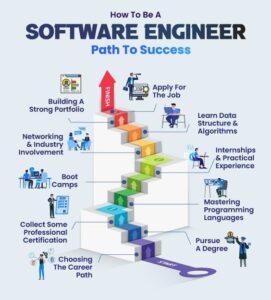
How to Become a Software Engineer in Nigeria
A beginner can follow a structured learning process.
1. Learn Programming
Choose a suitable programming language and learn the fundamentals.
2. Learn Development Tools
Learn Git, GitHub, code editors and basic command-line usage.
3. Learn Databases and APIs
Understand how applications store information and communicate with other systems.
4.Choose a Specialization
After learning the fundamentals, explore one of the major software engineering careers in Nigeria.
5. Build Real Projects
Move beyond tutorials.
Build applications that solve realistic problems.
6. Create a Portfolio
Document your projects and explain:
- The problem
- Your solution
- Technologies used
- Your contribution
- Challenges
- How you solved them
7. Prepare for Interviews
Practice technical questions, project explanations and behavioral interviews.
8. Start Applying
Look for internships, junior positions, freelance opportunities and other relevant professional experiences.
How Potenmunia Tech School Approaches Software Engineering Training
Potenmunia Tech School approaches software engineering education with an emphasis on practical application and career preparation.
Rather than relying entirely on lecture-based learning, the training approach emphasizes hands-on sessions and project development.
Learners can receive one-on-one instruction with a dedicated personal instructor, allowing them to receive individualized feedback and guidance. Learners who prefer collaborative environments can also use cohort-based learning.
As learners develop their technical abilities, practical projects can contribute to a professional portfolio.
Potenmunia also incorporates career preparation through CV and portfolio development, interview preparation and job application support. These areas connect technical education with the practical steps involved in pursuing software engineering opportunities.
The approach is designed around developing skills that learners can apply to real-world software problems rather than focusing only on completing theoretical lessons.
Building a Software Engineering Portfolio in Nigeria
A portfolio can be particularly useful when you are starting your career.
Instead of creating random projects, choose projects that demonstrate different technical abilities.
For example:
1. Business Website
Demonstrates:
- HTML
- CSS
- JavaScript
- Responsive design
2. Database Application
Demonstrates:
- Backend programming
- SQL
- APIs
- Authentication
3. Full-Stack Application
Demonstrates:
- Frontend
- Backend
- Database
- API integration
- Deployment
4. AI-Powered Application
Demonstrates:
- Programming
- APIs
- AI integration
- User interface
- Software architecture
These projects can give you practical examples to discuss during interviews.
AI and the Future of Software Engineering Careers in Nigeria
AI is changing how software developers work.
Modern developers can use AI tools to assist with:
- Code generation
- Debugging
- Documentation
- Testing
- Learning unfamiliar technologies
- Prototyping
However, developers still need fundamental software engineering knowledge.
A developer should be able to inspect generated code, identify problems, test functionality and make informed architectural decisions.
This means learning AI tools alongside programming fundamentals can be more useful than depending entirely on automatically generated code.
Common Mistakes When Starting a Software Engineering Career
Learning Too Many Languages
Start with one language and develop strong fundamentals.
Watching Tutorials Without Building
Learning should eventually result in independent projects.
Ignoring Git
Version control is an important professional development skill.
Focusing Only on Certificates
Certificates can demonstrate learning, but projects demonstrate practical application.
Copying Portfolio Projects
Only include projects you understand and can explain.
Trying to Master Everything
Software engineering is a large field. Choose a direction and gradually expand your knowledge.
Career Growth in Software Engineering
Software engineering can develop into several different professional directions.
A possible progression is:
Beginner → Junior Developer → Software Engineer → Mid-Level Engineer → Senior Engineer → Lead/Staff Engineer → Principal Engineer or Engineering Leadership
Other paths can include:
- Software architecture
- Cloud engineering
- DevOps
- AI engineering
- Security engineering
- Technical consulting
- Product development
- Entrepreneurship
- Engineering management
There is no single career progression that every engineer must follow.
Frequently Asked Questions About the Top Software Engineering Careers in Nigeria
What are the top software engineering careers in Nigeria?
Major career paths include full-stack development, frontend engineering, backend engineering, mobile development, cloud engineering, DevOps, AI and machine learning engineering, software security, data-focused engineering and software architecture.
Which software engineering career should a beginner choose?
Start with your interests. Beginners can first learn general programming and software development fundamentals before choosing a specialization.
Can I become a software engineer without a computer science degree?
A computer science or software engineering degree is one route into the profession, but people can also develop software skills through structured training, self-directed learning, practical projects and professional experience.
What programming language should I learn first?
Python and JavaScript are common starting choices, but the appropriate language depends on your career goals and the type of software you want to build.
Are software engineering jobs available in Port Harcourt?
Software skills can be applied across businesses and industries in Port Harcourt, while remote work and freelance arrangements can also allow developers to work with organizations outside their immediate location.
How can I prepare for a software engineering interview?
Study programming fundamentals, data structures and algorithms, practice coding problems, understand your projects thoroughly and prepare for behavioral questions.
Do I need to know AI to become a software engineer?
AI knowledge can be useful, but it should not replace fundamental programming, software design, testing and problem-solving skills.
How can I get software engineering experience as a beginner?
Build practical projects, contribute to appropriate open-source projects, pursue internships or entry-level opportunities and create a portfolio demonstrating your abilities.
Conclusion
The top software engineering careers in Nigeria cover a wide range of technical specializations. From frontend and backend engineering to full-stack development, mobile applications, cloud, DevOps, AI and security, aspiring developers have multiple directions they can explore.
The best starting point is not to attempt everything simultaneously. Build strong programming fundamentals, learn software development tools, create practical projects and gradually specialize.
For learners in Port Harcourt, structured practical training can provide an environment for developing technical skills, building projects, preparing a portfolio and becoming familiar with professional software development practices.
Whether your goal is local employment, remote work, freelancing, entrepreneurship or long-term technical specialization, the foundation remains the same: learn, build, test, improve and keep developing your skills.
For additional background reading on software engineering and related concepts, you can explore Wikipedia.