Machine Learning for Beginners is a practical starting point for anyone who wants to understand how computers can learn from data, identify patterns, and make predictions. Although machine learning is an important part of modern artificial intelligence, beginners do not need to start with complicated mathematics, advanced programming, or complex neural networks.
If you are searching for Machine Learning for Beginners, the most important thing to understand is that machine learning is a gradual learning process. You can start with basic programming, learn how data works, understand simple algorithms, and then progress toward more advanced artificial intelligence applications.
For a student, graduate, professional, entrepreneur, or aspiring technology specialist in Port Harcourt or elsewhere in Nigeria, learning machine learning can provide a useful foundation for exploring data science, artificial intelligence, and other technology fields.
This Machine Learning for Beginners guide explains what machine learning means, how it works, the major types of machine learning, what beginners should learn first, useful tools, practical projects, career opportunities, and how to develop machine learning skills through hands-on practice.
Machine learning is a field of artificial intelligence in which computer systems learn patterns from data and use those patterns to make predictions, classifications or decisions.
A traditional computer program generally follows instructions written by a programmer.
Machine learning works differently.
Instead of writing a separate rule for every possible situation, a developer can provide data and an appropriate learning algorithm. The algorithm can identify patterns in the data and produce a model that can be used with new information.
For a beginner, this can be simplified as:
Data → Algorithm → Training → Model → Prediction
According to Wikipedia, machine learning focuses on algorithms that can learn from data and generalise their behaviour to previously unseen data. You can read more about the subject on Wikipedia’s Machine Learning page.
A Simple Machine Learning Example
Imagine a business has several years of sales records.
The data may contain:
Product name
Product category
Price
Number of units sold
Date
Location
Promotion information
A machine learning model could learn relationships between these variables and sales.
The business could then use the model to help estimate future demand.
This is one of the easiest ways for Machine Learning for Beginners students to understand the concept: the computer learns from examples rather than relying entirely on manually written rules.
Why Should Beginners Learn Machine Learning?
There are several reasons people become interested in Machine Learning for Beginners training.
Machine learning is connected to:
Artificial intelligence
Data science
Data analytics
Software development
Business intelligence
Automation
Predictive analytics
Computer vision
Natural language processing
Machine learning is also increasingly relevant to how modern software applications process and interpret data.
For beginners, however, the goal should not simply be to learn a fashionable technology.
The goal should be to develop the ability to solve problems using data and computational methods.
One of the most important topics in Machine Learning for Beginners is understanding the major types of machine learning.
Supervised Learning
Supervised learning uses labelled examples.
The model receives input data together with known outcomes.
For example, suppose you have historical property data containing property characteristics and known selling prices.
The model can learn the relationship between the characteristics and the prices.
Two common supervised learning tasks are:
Regression
Classification
Regression
Regression is used when the target is a numerical value.
Examples include:
Predicting sales
Estimating property prices
Forecasting demand
Estimating delivery times
Classification
Classification is used when the model needs to assign observations to categories.
Examples include:
Spam or not spam
Customer churn or no churn
Approved or not approved
Category A, B or C
Unsupervised Learning
Unsupervised learning works with data without predefined target labels.
The objective may be to discover structures or groups within the data.
A common example is customer segmentation.
Suppose a business has thousands of customers.
A clustering algorithm could help identify groups of customers with similar purchasing patterns.
Scikit-learn describes clustering as the automatic grouping of similar objects into sets and provides several clustering algorithms.
Reinforcement Learning
Reinforcement learning involves an agent interacting with an environment and learning from feedback.
The agent receives rewards or penalties and attempts to improve its behaviour over time.
Reinforcement learning is more advanced than what most people need at the beginning of their Machine Learning for Beginners journey, so it is usually better to understand supervised and unsupervised learning first.
Machine Learning for Beginners: What Should You Learn First?
If you are starting Machine Learning for Beginners, you do not need to learn everything at once.
A structured learning path is much easier to manage.
Start With Computer Fundamentals
Understand:
Files and folders
Operating systems
Basic software concepts
Internet fundamentals
Basic troubleshooting
How programming environments work
If you already have these skills, you can move quickly to programming.
A beginner does not need hundreds of software tools.
A practical starting toolkit could include:
Python
Used for programming and machine learning development.
Jupyter Notebook
Useful for combining code, explanations, results and visualisations in an interactive environment.
NumPy
Useful for numerical computing.
Pandas
Useful for data manipulation and analysis.
Matplotlib
Useful for creating visualisations.
Scikit-learn
Scikit-learn provides many traditional machine learning algorithms as well as tools for preprocessing, model evaluation and model selection.
Git and GitHub
Version-control tools can help you organise projects and share your work.
For Machine Learning for Beginners, the important thing is not to install every tool available. Learn a small set properly and expand your toolkit when your projects require it.
Practical Machine Learning Projects for Beginners
Projects are one of the most effective ways to turn Machine Learning for Beginners theory into practical skills.
1. House Price Prediction
Use information such as:
Property size
Number of rooms
Location
Property age
Build a model that predicts a numerical price.
This introduces regression.
2. Customer Classification
Use customer information to predict whether a customer belongs to a particular category.
This introduces classification.
3. Customer Segmentation
Use purchasing behaviour to group customers.
This introduces clustering.
4. Sales Forecasting
Analyse historical sales information and build a model that attempts to estimate future sales.
This can help learners understand how machine learning can connect to business problems.
5. Student Performance Analysis
Use an appropriate educational dataset to investigate patterns related to student outcomes.
The emphasis should be on responsible interpretation rather than treating predictions as certain outcomes.
Machine Learning for Beginners in Nigeria
Machine learning education can be particularly interesting when learners connect technical concepts to Nigerian problems.
Nigeria has businesses and organisations working across many sectors, including:
Banking
Telecommunications
Agriculture
Logistics
Retail
Education
Energy
Healthcare
Financial technology
These sectors can generate large amounts of data.
For example, a learner could build a project around:
Retail: Predicting product demand.
Agriculture: Analysing crop or weather-related datasets.
Business: Segmenting customers based on purchasing behaviour.
The purpose of these projects is not necessarily to build a production system immediately. They provide a practical environment for learning how data, algorithms and decision-making fit together.
Machine Learning for Beginners in Port Harcourt
For learners in Port Harcourt, the same principles apply.
Whether you are a university student, recent graduate, professional or someone changing careers, start by developing a strong foundation.
Rather than focusing only on certificates, learners should also consider what they can actually demonstrate.
For example, after completing a beginner machine learning programme, you should ideally be able to explain:
What problem your project solves
Where the data came from
How you cleaned the data
Which algorithm you selected
Why you selected it
How you evaluated the model
What the results mean
What limitations the project has
That ability to explain your work is valuable.
How Potenmunia Tech School Approaches Machine Learning
Potenmunia Tech School approaches technology education with an emphasis on practical learning and career preparation.
For Machine Learning for Beginners, a practical approach means learners should not spend all their time listening to theory. They should have opportunities to work with data, practise programming, experiment with machine learning techniques and build projects.
The approach can include:
100% Practical, Hands-On Learning
Learners practise concepts through exercises and projects rather than relying exclusively on lectures.
Real-World Projects and Capstone Experience
Projects give learners an opportunity to connect machine learning concepts to realistic problems.
Portfolio Building
A completed project can be documented and added to a portfolio to demonstrate practical ability.
Mentorship
Guidance can help beginners understand difficult concepts, troubleshoot problems and develop better learning habits.
Career and Job Readiness
Machine learning skills can be developed alongside broader professional skills, helping learners understand how technical knowledge can translate into workplace opportunities.
AI Integration and Future Skills
Machine learning sits within the broader artificial intelligence ecosystem. Learners can gradually explore modern AI concepts after developing foundational skills.
Innovation and Entrepreneurship
Machine learning can also be approached as a problem-solving tool. Learners can explore how data and AI can contribute to products, services and technology-based solutions.
For anyone researching Machine Learning for Beginners in Port Harcourt, the key question should not only be where to study. Ask what you will actually practise and what evidence of your learning you will have when the programme ends.
Common Mistakes in Machine Learning for Beginners
1. Starting With Advanced AI
Many beginners immediately want to learn deep learning, generative AI or neural networks.
These are interesting fields, but fundamentals matter.
Start with Python, data and basic machine learning.
2. Ignoring Data Cleaning
A sophisticated algorithm cannot automatically fix every data-quality problem.
Learn how to inspect and prepare data properly.
3. Memorising Algorithms
Knowing the names of 30 algorithms is less useful than understanding when to use five appropriate ones.
4. Copying Tutorials
Tutorials are useful for learning.
However, after following a tutorial, modify the project or create your own project so you can demonstrate independent understanding.
5. Building Projects Without Explaining Them
A portfolio should not simply contain code.
Explain the problem, methodology, results and limitations.
6. Ignoring Model Evaluation
A prediction is not automatically reliable.
Learn how to select appropriate evaluation metrics and interpret the results.
Artificial intelligence is the broader field concerned with creating systems capable of performing tasks associated with intelligent behaviour.
Machine learning is one important approach within AI.
A simplified relationship is:
Artificial Intelligence → Machine Learning → Deep Learning
This is an oversimplification because AI includes approaches that are not machine learning, but it provides a useful starting point for beginners.
Why Practical Experience Matters
Reading about machine learning is useful.
Watching tutorials is useful.
Taking notes is useful.
But practical experience brings these pieces together.
Suppose you learn about classification.
You might understand the definition after reading it.
But building a classification project forces you to answer practical questions:
What is the target?
What are the features?
Is the data clean?
Which algorithm should I try?
How should I split the data?
Which metric should I use?
Why did the model make these predictions?
This is where Machine Learning for Beginners becomes a real technical skill rather than simply a collection of definitions.
Conclusion on Machine Learning for Beginners
Machine Learning for Beginners is not about becoming an artificial intelligence expert overnight.
It is about building a solid foundation.
Start with Python. Learn how data works. Understand statistics. Practise data analysis. Study fundamental machine learning algorithms. Build projects. Evaluate your models. Document your work. Then gradually move toward more advanced areas.
For learners in Port Harcourt and Nigeria, there is also an opportunity to apply machine learning to problems that are relevant to local businesses, organisations and communities.
If you are considering structured training, look for a programme that gives you opportunities to practise, build projects, receive mentorship and develop a portfolio.
Potenmunia Tech School in Port Harcourt provides a practical technology-learning environment where learners can develop technical competence through hands-on work, projects, mentorship and career-focused preparation.
You do not have to understand everything before you begin.
Start with the fundamentals, practise consistently and let each project teach you something new.
Frequently Asked Questions About Machine Learning for Beginners
What is Machine Learning for Beginners?
Machine Learning for Beginners is the study of basic machine learning concepts, programming skills, data preparation, algorithms and practical projects designed for people who are new to the field.
Can a complete beginner learn machine learning?
Yes. A complete beginner can learn machine learning by starting with programming and data fundamentals and gradually progressing toward machine learning algorithms and projects.
Do I need Python for machine learning?
Python is not the only programming language used for machine learning, but it is a very practical starting point because of its extensive ecosystem for data analysis and machine learning.
Do I need mathematics for Machine Learning for Beginners?
Basic mathematics and statistics are useful when starting. More advanced machine learning eventually requires deeper knowledge of areas such as probability, linear algebra and calculus.
What should I learn before machine learning?
A useful foundation includes Python programming, basic statistics, data analysis and data visualisation.
What machine learning algorithms should beginners learn?
Start with fundamental algorithms such as linear regression, logistic regression, decision trees, random forests, k-nearest neighbours and k-means clustering.
What is the best way to learn machine learning?
Combine theory with practice. Learn a concept, apply it to a dataset, build a small project and explain what you discovered.
Can I learn machine learning in Port Harcourt?
Yes. Learners in Port Harcourt can use self-study, online resources, structured training and project-based learning to develop machine learning skills.
What machine learning projects can beginners build?
Beginners can build projects involving sales prediction, customer segmentation, classification, house-price prediction, demand forecasting and other suitable datasets.
Is machine learning the same as AI?
No. Artificial intelligence is a broader field, while machine learning is one approach used within artificial intelligence.
Is machine learning the same as data science?
No. Data science covers a broader collection of activities involving data, including analysis, statistics, visualisation and sometimes machine learning.
Can machine learning skills lead to a technology career?
Machine learning knowledge can contribute to career paths such as data science, machine learning engineering, AI engineering, data analysis and other technology roles. The skills required vary by position.
What tools should Machine Learning for Beginners students learn?
A useful starting toolkit includes Python, NumPy, Pandas, Matplotlib, Jupyter Notebook and Scikit-learn. Scikit-learn provides tools for several common machine learning workflows, including classification, regression, clustering, preprocessing and model evaluation.
If you’ve been searching for the top project management programs in Nigeria, you’ve probably noticed the same problem everywhere: long lists of course names with no real explanation of what separates a good program from a forgettable one. This article looks at the top project management programs in Nigeria from a different angle not just naming them, but explaining what actually makes a project management program worth your time and money, so you can judge any option (including ones not listed here) for yourself.
According to Wikipedia, project management is the process of leading a team’s work to achieve project goals within defined constraints such as scope, time, and budget. That definition is simple, but the gap between knowing it and being able to do it is exactly what separates weak training from strong training and it’s the main thing to evaluate when comparing the top project management programs in Nigeria.
The strongest project management programs in Nigeria build three layers of competence, not just one:
Technical knowledge — scoping a project, building a timeline, managing a budget, and using tools like Trello, Asana, Jira or Microsoft Project.
Methodology fluency — understanding Agile, Scrum, Waterfall, and PRINCE2, and knowing when each applies.
Soft skills under pressure — stakeholder communication, conflict resolution, and decision-making when a project starts to slip.
Many courses that market themselves among the top project management programs in Nigeria focus almost entirely on the first layer. That’s a large part of why some certified project managers still struggle in their first real role — they know the theory but haven’t practiced running an actual project from kickoff to delivery.
Why Project Management Is a Growing Career Path in Nigeria
Nigerian employers across construction, telecoms, logistics, tech startups and NGOs increasingly need people who can own a project end-to-end. Remote and hybrid work has also opened international project management roles to Nigerians who can demonstrate real capability — which is part of why interest in the top project management programs in Nigeria keeps climbing year over year.
What to Look for When Comparing Programs
Before ranking any program among the top project management programs in Nigeria, check it against these four things:
Practical, project-based learning
Look for programs where you actually plan and run a project even a simulated one rather than only studying case studies.
Recognized certifications vs. skills-based training
Certifications like PMP and CAPM from the Project Management Institute carry global recognition, but PMP requires documented project hours, and both are exam-heavy with limited hands-on practice. Skills-based training focuses on building your ability to actually do the job, which matters more if you’re starting without prior project experience.
Mentorship and career support
A program with CV review, interview preparation and job application guidance shortens the gap between finishing a course and getting hired.
Cohort vs. one-on-one learning
Cohort learning offers peer interaction and shared momentum. One-on-one learning offers pacing tailored to your background and direct feedback on your specific weak points.
Types of Programs You’ll Find Among the Top Project Management Programs in Nigeria
University and postgraduate diploma programs
Thorough but time-intensive (often a year or more), and generally more theoretical than practical.
Global certification-prep courses (PMP, CAPM, PRINCE2)
Best suited to people who already have project experience and want formal validation, not to complete beginners.
Practical, career-focused training schools
Prioritize hands-on project work, portfolio building and job readiness over exam preparation — usually the better fit for beginners and career-changers.
Free and low-cost online options
Useful for exploring the field, but they rarely include the mentorship or job-readiness support that turns knowledge into an actual offer.
At Potenmunia Tech School in Port Harcourt, project management training is built around the idea that you should leave able to run a project, not just describe one. Each learner is paired with a dedicated instructor, so the pace and focus adjust to your background — someone moving from an admin role works through different examples than someone from a technical field.
Sessions are hands-on rather than lecture-first: learners work through real project scenarios, practice using tools like Trello and Asana, and build a portfolio piece that demonstrates their planning and execution skills to employers. The program includes structured interview preparation and CV support, and learners can choose either the one-on-one path or a cohort setting depending on what suits them.
A Simple Framework for Choosing Among the Top Project Management Programs in Nigeria
Do I already have project experience, or am I starting from zero? If from zero, prioritize practical, project-based training over exam-prep courses.
Do I need a specific certification for my target role or industry? Check the exact prerequisites (PMP requires documented project hours) before committing time.
How much individual feedback do I need to build confidence? If you learn best with direct correction, look for one-on-one options.
Does the program help me get hired, or just help me finish a course? Ask specifically whether CV support, interview prep and job application guidance are included.
Frequently Asked Questions
What makes a program one of the top project management programs in Nigeria?
A combination of hands-on project work, credible methodology training, and real career support — not just a certificate at the end.
Do I need a certification like PMP to work as a project manager in Nigeria?
Not always. Many employers prioritize demonstrated ability over formal certification, particularly for entry-level and mid-level roles.
Can I become a project manager without a technical background?
Yes. Project management is a transferable skill set built on organization, communication and decision-making.
How long does it take to become job-ready in project management?
It varies, but a practical, project-based course focused on job readiness can typically prepare a motivated beginner in a few months.
Is one-on-one training better than cohort-based training?
Neither is universally better — it depends on your learning style and how much individual feedback you need.
If you are learning SQL and want to build practical data analytics skills, SQL Data Analysis Projects are one of the best ways to move beyond tutorials and start solving realistic problems.
Learning SQL syntax is important, but knowing how to use SQL to answer business questions is even more valuable. A well-designed SQL Data Analysis Project gives you an opportunity to work with datasets, investigate patterns, clean information, combine tables, calculate metrics, and communicate findings.
For beginners, SQL Data Analysis Projects can cover simple areas such as sales and customers before progressing to more advanced topics such as financial transactions, e-commerce, marketing, employee performance, customer segmentation, and business intelligence.
You do not need a massive database to begin. A small, well-structured dataset can provide enough information to create a meaningful SQL Data Analysis Project.
This guide explores practical SQL Data Analysis Projects for beginners, the SQL skills they develop, how to structure them, and how to turn your projects into portfolio pieces that demonstrate your data analysis ability.
SQL Data Analysis Projects are practical projects where SQL is used to investigate and analyze data stored in relational databases.
Instead of learning SQL commands separately, you use them together to answer specific analytical questions.
For example, a sales SQL Data Analysis Project might ask:
What is the company’s total revenue?
Which products generate the most revenue?
Which products sell the most units?
Which customers spend the most?
Which locations generate the highest sales?
What are the monthly sales trends?
Which months perform better than others?
The purpose of a SQL Data Analysis Project is not simply to produce SQL queries. The purpose is to use SQL to transform raw records into useful information.
A typical project follows this process:
Business problem → Dataset → SQL queries → Analysis → Findings → Recommendations
That workflow makes SQL Data Analysis Projects particularly useful for people preparing for data analyst careers.
Why SQL Data Analysis Projects Matter for Beginners
There is a major difference between knowing SQL commands and being able to use SQL for analysis.
A beginner may know how to write:
SELECT *
FROM sales;
But a data analyst needs to answer questions such as:
Which products generated the most revenue during the last six months, and what does that tell the business?
That requires more than basic syntax.
SQL Data Analysis Projects Build Practical Skills
When you build SQL Data Analysis Projects, you repeatedly practice:
Data exploration
Data filtering
Aggregation
Sorting
Grouping
Table joins
Conditional logic
Date analysis
Data cleaning
Subqueries
CTEs
Window functions
Business interpretation
The more projects you complete, the easier it becomes to recognize which SQL technique is appropriate for a particular problem.
SQL Data Analysis Projects Strengthen Your Portfolio
One of the biggest benefits of SQL Data Analysis Projects is that they can become evidence of your practical skills.
Instead of simply writing:
“I know SQL.”
You can show:
“I used SQL to analyze customer transactions, identify high-value customers, calculate monthly revenue, and generate business recommendations.”
That difference can make your portfolio more informative.
SQL Data Analysis Projects Improve Analytical Thinking
Data analysis is not just about writing code.
You need to decide:
What problem needs to be solved?
What information is required?
Which tables contain that information?
How should the data be transformed?
What patterns are important?
What do the results actually mean?
SQL Data Analysis Projects give you repeated opportunities to practice this way of thinking.
Below are practical SQL Data Analysis Projects that beginners can use to develop their skills.
1. SQL Sales Data Analysis Project
A sales analysis project is one of the most useful SQL Data Analysis Projects for beginners.
Imagine a company has a database containing:
Order ID
Customer ID
Product ID
Product name
Quantity
Unit price
Order date
Sales location
Your objective is to understand the company’s sales performance.
Questions for the SQL Data Analysis Project
You could investigate:
What is the total revenue?
What are the top-selling products?
Which products generate the most revenue?
Which customers spend the most?
Which locations generate the highest revenue?
What are monthly sales?
What is the average order value?
How many orders were completed?
Which products have declining sales?
A simple query might be:
SELECT
    product_name,
    SUM(quantity * unit_price) AS total_revenue
FROM sales
GROUP BY product_name
ORDER BY total_revenue DESC;
This SQL Data Analysis Project teaches you how to combine calculations with aggregation and grouping.
Skills Practiced
You can practice:
SELECT
SUM()
GROUP BY
ORDER BY
Calculated columns
Business metrics
Date analysis
Nigerian Example
You could create a fictional sales database for a Nigerian retail business operating in Port Harcourt, Lagos, Abuja, and other cities.
You could then investigate which locations and products generate the most revenue.
2. SQL Customer Analysis Project
Customer analysis is another excellent category of SQL Data Analysis Projects.
Suppose you have a database containing customer information and transaction history.
You can investigate customer purchasing behavior.
Questions to Explore
Your SQL Data Analysis Project could answer:
Who are the highest-value customers?
How much has each customer spent?
How many orders has each customer made?
Which customers purchase most frequently?
Which customers have not purchased recently?
What is the average customer spending?
Which customer segments generate the most revenue?
For example:
SELECT
    customer_id,
    COUNT(order_id) AS total_orders,
    SUM(amount) AS total_spent
FROM orders
GROUP BY customer_id
ORDER BY total_spent DESC;
This project can later be expanded into customer segmentation.
Customer Segmentation
You could classify customers into categories such as:
High-value
Medium-value
Low-value
New customers
Returning customers
This introduces more advanced SQL Data Analysis Project techniques such as CASE, CTEs, and window functions.
3. SQL E-Commerce Data Analysis Project
E-commerce provides excellent opportunities for SQL Data Analysis Projects because an online store can have several connected tables.
For example:
Customers
Contains:
Customer ID
Name
Location
Registration date
Products
Contains:
Product ID
Product name
Category
Price
Orders
Contains:
Order ID
Customer ID
Order date
Order status
Order Items
Contains:
Order ID
Product ID
Quantity
Unit price
This structure gives you opportunities to practice SQL JOINs.
Questions for the Project
You can investigate:
Which products are most popular?
Which categories generate the most revenue?
Which customers purchase most frequently?
What is the average order value?
Which products are rarely purchased?
Which months have the highest order volume?
Which categories are growing?
Example:
SELECT
    p.category,
    SUM(oi.quantity * oi.unit_price) AS revenue
FROM order_items oi
JOIN products p
    ON oi.product_id = p.product_id
GROUP BY p.category
ORDER BY revenue DESC;
This is a strong SQL Data Analysis Project because it demonstrates that you understand relationships between tables.
4. SQL Employee Data Analysis Project
Employee data can be used to create a practical SQL Data Analysis Project around workforce analytics.
Imagine an employee database containing:
Employee ID
Department
Job title
Salary
Location
Employment date
Performance score
Questions to Analyze
You could investigate:
How many employees work in each department?
What is the average salary by department?
Which departments have the highest average performance?
How many employees joined each year?
Which roles have the highest average salary?
Which departments have the highest employee turnover?
For example:
SELECT
    department,
    AVG(salary) AS average_salary,
    COUNT(employee_id) AS employee_count
FROM employees
GROUP BY department
ORDER BY average_salary DESC;
This project demonstrates how SQL can be used for human resources analytics.
5. SQL Financial Data Analysis Project
Financial transactions can provide another strong SQL Data Analysis Project.
You could create a fictional transaction database containing:
Transaction ID
Customer ID
Transaction date
Transaction type
Amount
Branch
Account type
Transaction status
Questions to Answer
Your project could investigate:
What is the total transaction value?
What is the average transaction amount?
Which transaction types are most common?
Which branches process the most transactions?
How many transactions occur each month?
What percentage of transactions fail?
How does transaction activity change over time?
This can help beginners practice aggregation, filtering, conditional calculations, and date-based analysis.
For Nigerian learners, a fictional fintech or retail-payment dataset can make the SQL Data Analysis Project more familiar while avoiding the use of private financial information.
6. SQL Marketing Data Analysis Project
Marketing data can be transformed into another useful SQL Data Analysis Project.
Imagine a marketing database containing:
Campaign ID
Campaign name
Channel
Date
Impressions
Clicks
Conversions
Revenue
You can analyze campaign performance.
Questions to Answer
Which campaign generated the most conversions?
Which channel generated the highest revenue?
What is the conversion rate?
Which campaigns performed poorly?
Which campaign generated the highest revenue?
How did performance change over time?
A basic analysis might look like:
SELECT
    campaign_name,
    SUM(impressions) AS impressions,
    SUM(clicks) AS clicks,
    SUM(conversions) AS conversions,
    SUM(revenue) AS revenue
FROM campaigns
GROUP BY campaign_name
ORDER BY revenue DESC;
You can make the SQL Data Analysis Project more advanced by calculating conversion rates and comparing marketing channels.
7. SQL Inventory Data Analysis Project
Inventory management is another realistic business problem.
A fictional inventory database could contain:
Product ID
Product name
Category
Quantity in stock
Reorder level
Supplier
Unit cost
Last restock date
Questions for Your SQL Data Analysis Project
You could investigate:
Which products are running low?
Which products have excess inventory?
Which suppliers provide the most products?
What is the total inventory value?
Which products require immediate restocking?
Which categories have the highest inventory value?
For example:
SELECT
    product_name,
    quantity_in_stock,
    reorder_level
FROM inventory
WHERE quantity_in_stock <= reorder_level;
This project introduces beginners to SQL filtering and business decision-making.
8. SQL Healthcare Data Analysis Project
Healthcare data can also provide a meaningful SQL Data Analysis Project when using fictional or appropriately public datasets.
You might create tables containing:
Patient ID
Age group
Gender
Visit date
Department
Diagnosis category
Treatment type
Possible Questions
How many patients visited each department?
Which departments received the most visits?
What are the most common diagnosis categories?
How does patient volume change monthly?
Which age groups have the highest number of visits?
For educational projects, use fictional or properly anonymized datasets and avoid including personally identifiable information.
9. SQL Student Performance Analysis Project
Students learning SQL can create a database representing an educational institution.
Tables might include:
Student ID
Course
Department
Score
Semester
Attendance
Grade
Questions to Analyze
What is the average score by course?
Which courses have the highest failure rates?
Which students have the highest overall performance?
Does performance vary by semester?
Which departments have the highest average scores?
This is a straightforward SQL Data Analysis Project for beginners because the business questions are easy to understand.
10. SQL Customer Retention Analysis Project
Once you have completed basic SQL Data Analysis Projects, customer retention is a good next challenge.
The goal is to determine whether customers continue using a product or service over time.
You might investigate:
Number of new customers
Returning customers
Repeat purchase rate
Customer activity by month
Customer retention patterns
Customers who became inactive
This type of SQL Data Analysis Project introduces more advanced analytical thinking.
You may need:
Date functions
CTEs
Subqueries
Window functions
Conditional logic
SQL Data Analysis Projects Using Different SQL Techniques
A strong SQL portfolio should demonstrate more than basic SELECT statements.
SQL Data Analysis Projects With GROUP BY
GROUP BY is one of the most important SQL techniques for analytics.
For example:
SELECT
    city,
    SUM(revenue) AS total_revenue
FROM sales
GROUP BY city;
This allows you to compare business performance across cities.
You can use this technique in SQL Data Analysis Projects involving:
Sales
Customers
Employees
Products
Marketing
Finance
SQL Data Analysis Projects Using JOINs
JOINs become important when your data is stored in multiple related tables.
For example:
SELECT
    c.customer_name,
    o.order_date,
    o.amount
FROM customers c
JOIN orders o
    ON c.customer_id = o.customer_id;
Projects using JOINs can demonstrate that you understand relational databases rather than only single-table analysis.
Good SQL Data Analysis Projects for practicing JOINs include:
E-commerce analysis
Customer analysis
Sales analysis
Banking analysis
Inventory analysis
Employee analysis
SQL Data Analysis Projects Using CASE Statements
CASE statements allow you to create categories based on conditions.
For example:
SELECT
    customer_id,
    total_spent,
    CASE
        WHEN total_spent >= 500000 THEN 'High Value'
        WHEN total_spent >= 200000 THEN 'Medium Value'
        ELSE 'Low Value'
    END AS customer_segment
FROM customer_summary;
This can be useful in SQL Data Analysis Projects involving:
Customer segmentation
Employee performance
Sales classification
Product performance
Financial analysis
SQL Data Analysis Projects Using CTEs
Common Table Expressions can make complex SQL Data Analysis Projects easier to organize.
For example:
WITH customer_sales AS (
    SELECT
        customer_id,
        SUM(amount) AS total_spent
    FROM sales
    GROUP BY customer_id
)
SELECT
    customer_id,
    total_spent
FROM customer_sales
WHERE total_spent > 200000
ORDER BY total_spent DESC;
CTEs can make your SQL easier to read and explain.
SQL Data Analysis Projects Using Window Functions
Window functions are especially useful when you want to compare records without collapsing the result into a single row per group.
Useful functions include:
ROW_NUMBER()
RANK()
DENSE_RANK()
LAG()
LEAD()
SUM() OVER()
AVG() OVER()
For example:
SELECT
    product_name,
    revenue,
    RANK() OVER (ORDER BY revenue DESC) AS revenue_rank
FROM product_sales;
This can rank products according to revenue.
A beginner does not need to start with window functions. However, adding them to later SQL Data Analysis Projects can demonstrate progression toward intermediate SQL skills.
SQL Data Analysis Projects for Portfolio Development
One of the biggest reasons to build SQL Data Analysis Projects is to create evidence of your ability.
Your portfolio should not simply contain SQL files.
Each project should tell a clear story.
What to Include in a SQL Project
A good project can contain:
1. Project Overview
Explain what the project is about.
2. Business Problem
Explain the problem you are trying to solve.
3. Dataset
Describe the tables, columns, and source.
4. Analytical Questions
List the questions you want to answer.
5. SQL Queries
Organize the queries clearly.
6. Findings
Explain the most important results.
7. Recommendations
Explain what the findings could mean for the business.
8. Limitations
Explain anything that could affect your conclusions.
9. Future Analysis
Explain what you would investigate next.
How to Create a Strong SQL Data Analysis Project From Scratch
Follow this framework when creating your own SQL Data Analysis Projects.
1. Choose a Topic
Pick an area you understand.
For example:
E-commerce Sales Analysis
2. Define the Business Problem
Write one clear problem statement.
Example:
The business wants to understand which products, customers, and locations contribute most to revenue.
3. Create Analytical Questions
Turn the problem into smaller questions.
For example:
What is total revenue?
Which products generate the most revenue?
Which customers spend the most?
Which locations perform best?
What are the monthly trends?
4. Explore the Database
Before writing complex queries, inspect the tables.
Understand:
Columns
Data types
Primary keys
Foreign keys
Relationships
Missing values
Duplicate records
5. Clean the Data
Look for:
NULL values
Duplicates
Incorrect dates
Inconsistent categories
Invalid numbers
Incorrect relationships
6. Write SQL Queries
Start with simple exploratory queries.
Then progress toward more advanced analysis.
7. Interpret Your Results
Do not stop after getting query output.
Ask:
What does this result tell me?
8. Document Everything
Create a README that allows another person to understand the entire SQL Data Analysis Project.
How to Make Your SQL Data Analysis Projects More Advanced
Once you understand the basics, you can improve your projects in several ways.
Add More Tables
Instead of one table, create related tables for:
Customers
Products
Orders
Payments
Locations
This gives you more opportunities to practice JOINs.
Add More Business Questions
Instead of answering five questions, create 10–15 related analytical questions.
Add Time-Based Analysis
Analyze:
Daily performance
Weekly performance
Monthly performance
Quarterly performance
Yearly performance
Add Customer Segmentation
Group customers according to:
Spending
Frequency
Recency
Number of purchases
Add Rankings
Rank:
Products
Customers
Locations
Employees
Campaigns
Add Data Quality Checks
Demonstrate that you can identify problems in the data before analyzing it.
SQL Data Analysis Projects and Other Analytics Tools
SQL is an important data analysis tool, but it does not have to work alone.
A more advanced portfolio project could follow this workflow:
SQL → Excel → Power BI
For example:
SQL extracts and transforms the data.
Excel can be used for additional calculations or quick exploration.
Power BI presents the findings through an interactive dashboard.
Another workflow could be:
SQL → Python → Visualization
Python can be used for more advanced analysis and automation.
The goal is to show that you understand how different tools fit into the overall analytics process.
SQL Data Analysis Projects for Beginners in Nigeria
Learners in Nigeria can create projects around familiar industries and business situations.
Potential project topics include:
Nigerian retail sales analysis
E-commerce customer analysis
Fintech transaction analysis
Logistics delivery analysis
Supermarket inventory analysis
Restaurant sales analysis
Telecommunications customer analysis
School performance analysis
Real estate property analysis
Marketing campaign analysis
For example, a learner in Port Harcourt could build a fictional retail SQL Data Analysis Project comparing sales across different locations.
The project could investigate:
Total revenue by location
Top-selling products
Customer spending
Monthly sales
Inventory levels
Repeat purchases
Using familiar business scenarios can make it easier to understand why the analysis matters.
When learning about technical concepts, databases, analytics terminology, or related subjects, reference resources can help you develop background knowledge.
For general reference and further reading, learners can explore Wikipedia, a free collaborative encyclopedia maintained by volunteers.
However, when creating a professional SQL Data Analysis Project, do not rely on Wikipedia alone for technical documentation or business data. For database-specific questions, it is better to consult the official documentation for the SQL database system you are using and document your dataset source clearly.
At Potenmunia Tech School in Port Harcourt, SQL learning can be connected to practical data analytics rather than being limited to memorizing SQL commands.
A learner can progress through a project-based workflow such as:
SQL fundamentals → database exploration → data cleaning → SQL analysis → insights → project documentation → portfolio development
The one-on-one learning model also allows learners to work with a dedicated instructor who can provide individualized feedback while they develop their projects.
This can be particularly useful when a beginner becomes stuck on a JOIN, struggles to understand a query result, or needs help turning technical results into a clear business explanation.
The objective is to help learners understand not only how to write SQL, but also how SQL fits into the wider process of solving data problems.
Projects can then contribute to a portfolio that demonstrates practical work.
For learners preparing for employment, the project process can also connect with CV development, interview preparation, and job application support.
Common Mistakes in SQL Data Analysis Projects
1. Choosing a Project That Is Too Complex
Your first SQL Data Analysis Project does not need hundreds of tables.
Start small.
2. Writing Queries Without Questions
Do not create random queries simply to demonstrate SQL syntax.
Start with analytical questions.
3. Ignoring Data Quality
Always investigate missing, duplicated, and inconsistent records.
4. Focusing Only on Technical SQL
A technically correct query does not automatically produce a useful insight.
Explain the business meaning.
5. Copying Projects Without Understanding Them
A portfolio project should demonstrate what you understand.
If you use a tutorial or public project as inspiration, modify it, extend the analysis, and clearly understand every query you present.
6. Creating Too Many Similar Projects
Five nearly identical sales projects will not demonstrate as much range as several projects covering different business problems.
Before publishing a SQL Data Analysis Project, check the following.
Dataset
I understand the dataset.
I understand the table relationships.
I checked for missing data.
I checked for duplicate records.
I documented the data source.
SQL
I used filtering.
I used aggregation.
I used GROUP BY.
I understand JOINs.
I used conditional logic where appropriate.
I can explain my queries.
I tested my results.
Analysis
I defined a clear business problem.
I created specific analytical questions.
I identified important findings.
My conclusions are supported by the data.
My recommendations are reasonable.
Portfolio
My README is clear.
My SQL code is organized.
My project has a clear objective.
My findings are easy to understand.
I can explain the project during an interview.
How Many SQL Data Analysis Projects Should a Beginner Build?
There is no magic number.
However, three to five well-developed SQL Data Analysis Projects can provide a useful starting portfolio.
For example:
SQL Sales Data Analysis Project
SQL Customer Segmentation Project
SQL E-Commerce Analysis Project
SQL Financial Transactions Project
SQL Marketing Analysis Project
As your skills improve, you can create more sophisticated projects involving CTEs, window functions, advanced date analysis, customer retention, and performance optimization.
The goal should be progression.
Your fifth SQL Data Analysis Project should ideally demonstrate skills that were not present in your first.
What Should Your First SQL Data Analysis Project Be?
If you are completely new to SQL, start with sales data.
A sales database is easy to understand and gives you many opportunities to practice important analytical techniques.
Start with:
Total sales
Number of orders
Average order value
Top products
Top customers
Sales by location
Monthly sales
Then gradually introduce:
JOINs
CASE statements
Subqueries
CTEs
Window functions
This creates a natural learning path from beginner SQL Data Analysis Projects to more advanced analytical work.
Frequently Asked Questions About SQL Data Analysis Projects
What are SQL Data Analysis Projects?
SQL Data Analysis Projects are practical projects where SQL is used to explore, clean, transform, and analyze data stored in databases to answer business or analytical questions.
What is the best SQL Data Analysis Project for beginners?
A sales analysis project is an excellent starting point because it allows beginners to practice filtering, grouping, aggregation, sorting, calculations, and eventually JOINs.
How many SQL Data Analysis Projects should I have in my portfolio?
Three to five well-developed projects are a reasonable starting point. Focus on quality, variety, documentation, and your ability to explain the analysis.
Can SQL Data Analysis Projects help me become a data analyst?
Yes. Projects can demonstrate practical SQL and analytical skills. They are particularly useful when you clearly explain the business problem, methodology, findings, and recommendations.
What SQL skills should I demonstrate in my projects?
Begin with SELECT, WHERE, ORDER BY, GROUP BY, aggregate functions, and JOINs. Then progress to CASE statements, subqueries, CTEs, date functions, and window functions.
Can I create SQL Data Analysis Projects without professional experience?
Yes. You can use public or synthetic datasets to simulate realistic business problems. Clearly explain the project’s purpose and dataset source.
Can I use Nigerian business scenarios in SQL projects?
Yes. Nigerian retail, fintech, e-commerce, logistics, education, healthcare, and other business scenarios can provide useful project themes. Use public, synthetic, or appropriately anonymized data.
Should SQL Data Analysis Projects include dashboards?
A dashboard is not mandatory for a SQL project, but combining SQL analysis with Excel, Power BI, or another visualization tool can make a portfolio project more comprehensive.
Can SQL Data Analysis Projects be used during job interviews?
Yes. Employers may ask you to explain your projects, SQL queries, analytical decisions, findings, and recommendations. You should understand every part of the project you present.
Conclusion on SQL Data Analysis Projects
SQL Data Analysis Projects can transform the way you learn SQL.
Instead of treating SQL as a collection of commands to memorize, projects give you a reason to use those commands.
Start with a simple sales analysis. Then progress to customer segmentation, e-commerce, inventory, finance, marketing, employee analytics, and customer retention.
As your skills develop, introduce JOINs, CTEs, subqueries, CASE statements, date functions, and window functions.
Most importantly, learn to think beyond the query.
A strong SQL Data Analysis Project should answer three questions:
What problem are you solving?
What does the data tell you?
What should someone do with that information?
That mindset will help you develop from someone who simply knows SQL into someone who can use SQL as part of a genuine data analytics workflow.
For learners in Port Harcourt and across Nigeria, building several practical SQL Data Analysis Projects can also provide valuable material for a professional portfolio. With consistent practice, feedback, mentorship, and exposure to real-world analytical scenarios, you can continue progressing toward broader data analytics skills and career opportunities.
Explore related resources on SQL, Excel, Power BI, Python, data visualization, and data analyst career development as you continue building your portfolio.
The Data Analyst Career Path in Nigeria has become an increasingly relevant option for students, graduates, career changers, and professionals who want to build practical technology skills. As organisations generate more information from customers, transactions, websites, mobile applications and business operations, the ability to understand and interpret data has become increasingly useful.
But what does the Data Analyst Career Path in Nigeria actually look like?
Do you need a computer science degree? Which skills should you learn first? Should you start with Excel, SQL, Power BI or Python? How do you gain experience when you have never worked as a data analyst? And how can someone move from a beginner to a professional analyst?
This guide answers those questions step by step.
According to the general definition of data analysis, it involves inspecting, cleaning, transforming, and modelling data to discover useful information and support decision-making. You can learn more about the broader concept of data analysis through Wikipedia.
For Nigerian learners, the Data Analyst Career Path in Nigeria is not simply about learning software. It involves developing technical skills, analytical thinking, business understanding, communication skills and practical experience.
The journey can begin with Excel and gradually progress through SQL, Power BI, statistics, Python, portfolio development and professional workplace skills.
What Is the Data Analyst Career Path in Nigeria?
The Data Analyst Career Path in Nigeria is the progression a learner can follow from acquiring basic data skills to becoming capable of performing professional data analysis.
A typical progression can look like:
Beginner → Excel Analyst → SQL Analyst → BI/Data Visualization Analyst → Junior Data Analyst → Data Analyst → Senior Data Analyst → Analytics Specialist or Manager
However, this is not a rigid career ladder.
Some people move into business intelligence. Others specialise in product analytics, marketing analytics, financial analytics, operations analytics or data science.
The important thing is to develop skills progressively.
The Data Analyst Career Path in Nigeria can therefore be viewed as a combination of:
Data literacy
Excel and spreadsheet analysis
SQL
Statistics
Data visualisation
Power BI or another BI platform
Python
Data cleaning
Business understanding
Communication
Portfolio development
Workplace experience
Continuous learning
Recent Nigerian career guides similarly emphasise Excel, SQL, visualisation, Python, projects and communication as important parts of preparing for data analyst work.
Why Is the Data Analyst Career Path in Nigeria Important?
Businesses in Nigeria operate with data every day.
Consider the amount of information generated by:
Banks
Fintech companies
Telecommunications companies
Supermarkets
Hospitals
Universities
Logistics companies
E-commerce businesses
Oil and gas companies
Insurance companies
Government agencies
Non-governmental organisations
Small and medium-sized businesses
A business might collect information about sales, customers, payments, expenses, employees, inventory, marketing campaigns or service usage.
Raw data alone does not automatically create value.
Someone needs to organise it, analyse it, identify patterns and communicate what those patterns mean.
That is where data analysts come in.
The Data Analyst Career Path in Nigeria therefore connects technology with business decision-making.
What Does a Data Analyst Do in Nigeria?
A data analyst works with data to help answer business or organisational questions.
Typical responsibilities may include:
Collecting data
Cleaning data
Checking data quality
Writing SQL queries
Analysing spreadsheets
Creating reports
Building dashboards
Identifying trends
Calculating key performance indicators
Presenting findings
Supporting business decisions
Automating repetitive analytical tasks
For example, imagine a retail business in Port Harcourt.
Management might ask:
Which products generated the highest revenue this quarter?
The analyst could:
Extract the sales data.
Remove duplicate records.
Correct inconsistent product names.
Group sales by product.
Calculate revenue.
Compare different periods.
Build a visual report.
Explain the findings.
Recommend possible actions.
That is data analysis in practice.
The Data Analyst Career Path in Nigeria: Step-by-Step
Understanding the stages of the Data Analyst Career Path in Nigeria can prevent beginners from becoming overwhelmed.
You do not have to learn every technology simultaneously.
A structured progression is usually more effective.
1. Develop Basic Data Literacy
The first stage of the Data Analyst Career Path in Nigeria is understanding data itself.
Before learning complicated tools, understand concepts such as:
What is data?
What is a dataset?
What is a variable?
What is a database?
What is a record?
What is a metric?
What is a KPI?
What is a trend?
What is an outlier?
What is data quality?
You should also understand basic numerical concepts.
These include:
Percentages
Ratios
Averages
Minimum and maximum values
Median
Growth rates
Percent changes
For example, if a company’s revenue increases from ₦1 million to ₦1.2 million, an analyst should understand that the business experienced a 20% increase.
The ability to interpret numbers is more important than simply calculating them.
Once you have developed spreadsheet and SQL skills, data visualisation becomes an important next step.
Power BI is one option for creating interactive business intelligence reports.
Microsoft’s current Power BI Data Analyst certification framework covers preparing data, modelling data, visualising and analysing data, and managing Power BI environments.
A learner should understand more than how to create colourful charts.
You should learn:
Data importing
Power Query
Data cleaning
Relationships
Data modelling
DAX fundamentals
Measures
KPIs
Dashboard design
Filters
Data storytelling
Example Power BI Project
Imagine a fictional logistics company operating between:
Port Harcourt
Lagos
Abuja
Enugu
Benin City
You could create a dashboard showing:
Number of deliveries
Delivery success rate
Average delivery time
Revenue
Customer locations
Monthly performance
This would demonstrate practical analytical thinking.
Python is another useful stage of the Data Analyst Career Path in Nigeria.
It does not necessarily have to be your first technical skill.
After developing Excel and SQL knowledge, Python can help you handle more advanced analytical tasks.
Important Python concepts for data analysts include:
Variables
Lists
Dictionaries
Loops
Functions
Conditional statements
File handling
Data manipulation
For data analysis, learners commonly encounter libraries such as:
Pandas
NumPy
Matplotlib
Pandas, in particular, is widely used for manipulating and analysing tabular data.
Python can help with:
Data cleaning
Automation
Exploratory analysis
Repetitive workflows
Larger datasets
Data transformation
The goal is not to become a software engineer.
The goal is to use programming to make analytical work more efficient and flexible.
7. Learn Data Cleaning
Data cleaning is one of the most important but frequently underestimated parts of the Data Analyst Career Path in Nigeria.
Real datasets may contain:
Missing values
Duplicate records
Incorrect spellings
Inconsistent dates
Incorrect data types
Invalid entries
Outliers
Inconsistent categories
Imagine a customer location field contains:
Port Harcourt
Port-Harcourt
Port Harcourt City
PH
P/H
If these represent the same location, the analyst needs to determine how they should be standardised.
Poor data quality can produce poor analysis.
Therefore:
Good analysis begins with good data preparation.
8. Develop Business Understanding
A strong analyst understands that data exists for a reason.
The Data Analyst Career Path in Nigeria should therefore include business knowledge.
For example, a retail analyst should understand:
Revenue
Profit
Inventory
Customer acquisition
Average order value
Sales volume
A fintech analyst might encounter:
Transactions
Customer activity
Retention
Fraud indicators
Revenue
Customer acquisition
An operations analyst might study:
Delivery times
Costs
Productivity
Capacity
Efficiency
You become more valuable when you understand both the data and the business problem behind the data.
9. Build a Data Analytics Portfolio
Portfolio development is one of the most important stages of the Data Analyst Career Path in Nigeria.
A portfolio provides evidence of practical ability.
Instead of simply writing:
“I know Excel, SQL and Power BI.”
You can show:
“I used Excel to clean and analyse 5,000 sales records and built a Power BI dashboard identifying revenue trends and underperforming product categories.”
That is stronger evidence.
A beginner portfolio could contain three to five well-documented projects.
Each project should include:
Business problem
Dataset
Tools used
Data-cleaning process
Analysis
Visualisations
Findings
Recommendations
Lessons learned
Quality is more important than the number of projects.
Data Analyst Career Path in Nigeria: Portfolio Project Ideas
Here are practical project ideas Nigerian learners can use.
1. Nigerian Retail Sales Dashboard
Analyse fictional supermarket transactions.
Study:
Sales
Products
Locations
Customers
Monthly performance
Tools:
Excel + Power BI
2. Customer Analysis
Create a fictional customer dataset and investigate:
Customer frequency
Customer value
Repeat purchases
Customer segments
Tools:
SQL + Power BI
3. Logistics Performance
Analyse fictional delivery records.
Questions could include:
Which routes experience delays?
Which locations receive the most deliveries?
What is the average delivery time?
Which months experience higher demand?
Tools:
Excel + SQL + Power BI
4. Nigerian Business Expense Analysis
Analyse fictional business expenses.
Identify:
Highest expense categories
Monthly spending
Cost trends
Potential areas for efficiency
Tools:
Excel + Power BI
5. Student Performance Dashboard
Use fictional student information to analyse:
Attendance
Scores
Subjects
Performance trends
This can be particularly useful for learners because it connects data analysis with an environment they understand.
10. Develop Communication Skills
Technical knowledge is only part of the Data Analyst Career Path in Nigeria.
You also need to communicate findings.
Imagine that you discover that sales have fallen.
Simply saying:
“Sales declined by 15%.”
is not enough.
A stronger analyst asks:
When did the decline begin?
Which products were affected?
Which locations were affected?
Did customer numbers change?
Did prices change?
Was there a seasonal factor?
What action should management consider?
The ability to explain this clearly is known as data storytelling.
11. Learn How to Use AI in Data Analytics
AI is becoming increasingly relevant to the modern Data Analyst Career Path in Nigeria.
AI tools can assist with tasks such as:
Drafting SQL
Explaining formulas
Generating Python code
Summarising data
Suggesting analysis ideas
Automating repetitive work
Helping document analytical processes
However, analysts should not blindly trust AI-generated results.
You need enough technical knowledge to verify:
SQL queries
Calculations
Data transformations
Statistical interpretations
Business conclusions
The future data analyst will increasingly need both traditional analytical skills and AI literacy.
12. Prepare for Your First Data Analyst Job
After developing skills and projects, you can begin preparing for employment.
Potential entry-level roles include:
Junior Data Analyst
Data Analyst
Reporting Analyst
Business Intelligence Analyst
Operations Analyst
Marketing Analyst
Product Analyst
Business Analyst
The exact job title and requirements vary between organisations.
Recent Nigerian career resources commonly identify banking, fintech, telecommunications, e-commerce, logistics and other sectors as areas where data analysis skills can be relevant.
Data Analyst Career Path in Nigeria by Career Level
The career progression can be broadly understood as follows.
Beginner
At this stage, you are learning:
Excel
Basic statistics
Data cleaning
Basic SQL
Basic visualisation
Your priority is developing competence.
Junior Data Analyst
A junior analyst may work on:
Reports
Data cleaning
SQL queries
Dashboards
Recurring analysis
Basic business questions
Your priority is becoming reliable.
Mid-Level Data Analyst
At this level, you may:
Own analytical projects
Build more complex dashboards
Work directly with stakeholders
Analyse business performance
Automate repetitive tasks
Provide recommendations
Your priority is developing business impact.
Senior Data Analyst
A senior analyst may:
Lead analytical projects
Mentor junior analysts
Influence business decisions
Develop analytical strategies
Work with complex datasets
Communicate with senior stakeholders
Your priority becomes influence and strategic thinking.
Analytics Lead or Manager
At the leadership level, responsibilities can include:
Managing analytics teams
Setting analytical priorities
Developing reporting strategies
Working with executives
Improving data culture
Supporting organisation-wide decision-making
The exact career progression differs between organisations, so learners should view these levels as a framework rather than a guaranteed timetable.
Data Analyst Career Path in Nigeria: Alternative Career Directions
One advantage of developing data analysis skills is that the skills can lead to several related careers.
You could eventually explore:
Business Intelligence
Focuses heavily on reporting, dashboards and organisational decision-making.
Product Analytics
Focuses on how customers use digital products.
Marketing Analytics
Focuses on campaigns, customers and marketing performance.
Financial Analytics
Focuses on financial performance, costs, revenue and business planning.
Moves further into statistics, predictive modelling and machine learning.
Data Engineering
Focuses more heavily on building the systems and infrastructure used to collect and process data.
The Data Analyst Career Path in Nigeria can therefore become a foundation for several technology and business careers.
Data Analyst Career Path in Nigeria for Students
Students can begin building relevant skills before graduation.
A student might start with:
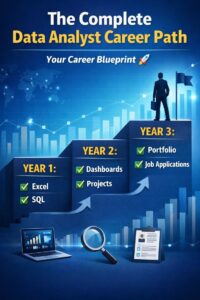
Year 1: Computer and Excel fundamentals
Year 2: Statistics and SQL
Year 3: Power BI and practical projects
Year 4: Python, portfolio and internship preparation
This is only an example.
The important principle is to avoid waiting until graduation before acquiring practical skills.
A student who graduates with a degree plus several well-documented analytics projects may have more evidence of practical ability than someone who only has academic coursework.
Data Analyst Career Path in Nigeria for Career Changers
You do not necessarily need to begin your career in technology to move toward analytics.
For example:
Accountant → Data Analyst
Existing knowledge of financial records can be useful.
Marketer → Marketing Analyst
Existing knowledge of campaigns and customers can complement analytics skills.
Business Administrator → Business Analyst
Existing business-process knowledge can support analytical work.
Teacher → Education Data Analyst
Experience in education can provide valuable domain knowledge.
Engineer → Data Analyst
Quantitative and problem-solving skills can provide a useful foundation.
The key is to combine your existing knowledge with data skills.
Data Analyst Career Path in Nigeria for Learners in Port Harcourt
Port Harcourt provides a useful environment for learning data analytics because the city has businesses and organisations across different sectors.
A learner can create projects around scenarios involving:
Oil and gas services
Retail
Logistics
Education
Healthcare
Hospitality
Small businesses
Financial services
For example, an aspiring analyst could create a fictional oil-and-gas services dashboard showing equipment maintenance records.
Another learner could analyse a fictional Port Harcourt retail dataset.
The purpose is not to pretend that these projects are real company projects.
The purpose is to demonstrate that you understand how analytical methods can be applied to realistic business situations.
Potenmunia Tech School in Port Harcourt approaches technology training with an emphasis on practical, hands-on learning.
For learners following the Data Analyst Career Path in Nigeria, this type of approach is important because analytics is a skill that becomes stronger through practice.
Rather than learning tools only as isolated topics, learners can benefit from connecting:
For example, instead of simply learning how PivotTables work, a learner could use them to investigate a realistic sales problem.
Instead of only learning SQL syntax, the learner could use SQL to answer business questions.
Instead of only learning Power BI buttons, the learner could build a dashboard around a specific analytical problem.
Potenmunia’s approach also places emphasis on:
Hands-on practical learning
Real-world projects
Capstone experience
Portfolio development
Mentorship
Career preparation
AI integration
Future-focused skills
Innovation and entrepreneurship
This approach is particularly useful for learners who want to move from knowing about data analytics to demonstrating what they can actually do.
Common Mistakes on the Data Analyst Career Path in Nigeria
1. Learning Too Many Tools
You do not need to master ten tools immediately.
Build depth gradually.
2. Ignoring Excel
Some beginners believe that professional analysts should immediately jump to Python.
Excel remains useful for many everyday analytical tasks.
3. Avoiding SQL
If you want to work with database-driven organisations, SQL is an important skill to develop.
4. Building Only Attractive Dashboards
A dashboard should answer a question.
A beautiful dashboard with no useful insight is still a weak analytical project.
5. Copying Tutorials Without Understanding Them
Following a YouTube tutorial can help you learn.
But after completing it, try rebuilding the project independently.
Change the dataset.
Change the questions.
Explain your findings in your own words.
6. Ignoring Communication
You may find an important pattern but still struggle professionally if you cannot explain it.
7. Depending Completely on AI
AI can accelerate your work, but you remain responsible for checking the accuracy of your analysis.
How Long Does the Data Analyst Career Path in Nigeria Take?
There is no fixed period.
A learner studying consistently might structure their development like this:
Months 1–2
Data fundamentals
Excel
Basic statistics
Months 3–4
SQL
Data cleaning
More advanced Excel
Months 5–6
Power BI
Data modelling
Dashboard development
Months 7–8
Python
Pandas
Portfolio projects
Months 9+
Advanced projects
Interview preparation
Applications
Specialisation
These are learning milestones rather than guarantees.
Your actual progress depends on your background, study time, practice, learning environment and ability to apply what you learn.
Data Analyst Career Path in Nigeria: A Practical Checklist
Use this checklist to monitor your progress.
Foundation
Understand basic data concepts
Learn percentages and averages
Understand basic statistics
Develop computer skills
Excel
Learn formulas
Learn lookup functions
Learn PivotTables
Learn charts
Practise data cleaning
Build a simple dashboard
SQL
SELECT
WHERE
GROUP BY
ORDER BY
JOIN
CASE
Subqueries
CTEs
Window functions
Power BI
Import data
Clean data
Create relationships
Build data models
Learn basic DAX
Create dashboards
Practise data storytelling
Python
Learn Python fundamentals
Learn Pandas
Learn NumPy basics
Explore data visualisation
Practise automation
Portfolio
Build a sales project
Build a customer project
Build a business dashboard
Document your findings
Explain recommendations
Career
Create a professional CV
Prepare a portfolio
Practise SQL interview questions
Practise explaining projects
Develop communication skills
Look for internships and entry-level opportunities
Frequently Asked Questions About the Data Analyst Career Path in Nigeria
Can I become a data analyst without a computer science degree?
Yes.
People enter data analytics from backgrounds including economics, accounting, mathematics, engineering, business, statistics and other disciplines.
What matters is developing the required analytical and technical competencies.
What should I learn first?
For many beginners, Excel and basic data concepts are a practical starting point.
You can then progress to SQL, Power BI and Python.
Is SQL important for the Data Analyst Career Path in Nigeria?
Yes.
SQL is particularly useful when working with data stored in relational databases.
Is Python compulsory?
Not necessarily for every entry-level role.
However, learning Python can expand your analytical capabilities, especially for automation and more advanced data work.
Is Power BI worth learning?
Power BI is a useful business-intelligence and visualisation platform and can be valuable for analysts who need to create interactive reports and dashboards.
Do I need advanced mathematics?
No.
You should understand basic quantitative concepts and gradually learn statistics that are relevant to your work.
How many portfolio projects should I build?
There is no magic number.
Three to five strong, well-documented projects can provide a useful starting portfolio.
Can I learn data analytics in Port Harcourt?
Yes.
You can combine self-study, online resources, academic education and structured practical training.
For learners who prefer face-to-face guidance and project-based learning, a technology school such as Potenmunia Tech School can provide a structured environment for developing practical skills.
Can data analytics lead to other careers?
Yes.
Data analytics can provide foundations for areas such as business intelligence, product analytics, financial analytics, marketing analytics, data science and analytics management.
Conclusion on the Data Analyst Career Path in Nigeria
The Data Analyst Career Path in Nigeria is best understood as a continuous learning journey rather than a single course.
You can start with basic data literacy and Excel.
Then progress to:
Excel → Statistics → SQL → Power BI → Python → Projects → Portfolio → Professional Experience → Specialisation
The order can change depending on your background, but the principle remains the same: develop skills progressively and apply them to realistic problems.
Do not focus only on collecting certificates.
Build evidence.
Do not focus only on learning software.
Learn how to solve problems.
Do not focus only on creating attractive dashboards.
Learn how to communicate insights.
And do not treat AI as a replacement for analytical thinking. Learn how to use AI responsibly while maintaining the ability to verify your results.
For learners in Port Harcourt, Potenmunia Tech School provides a practical environment for developing technology skills through hands-on learning, real-world projects, portfolio development, mentorship and career preparation.
If you are beginning the Data Analyst Career Path in Nigeria, you do not need to master everything at once.
Start with one skill.
Practise it.
Build a project.
Learn from it.
Then move to the next stage.
That is how a beginner gradually develops into a professional data analyst.
Excel Data Analysis Projects are practical projects where Microsoft Excel is used to organize, clean, analyze, visualize, and interpret data to answer business or real-world questions.
Rather than simply learning Excel formulas individually, an Excel Data Analysis Project allows you to combine several skills to solve a complete problem.
For example, instead of learning SUMIFS only as a formula, you could use it to determine which products generated the most revenue.
Instead of learning PivotTables simply because they are an Excel feature, you could use a PivotTable to analyze sales by product, month, location, or salesperson.
Instead of creating charts simply to make a spreadsheet attractive, you could use charts to communicate an important business trend.
This is what makes Excel Data Analysis Projects valuable for a portfolio.
They demonstrate how you apply Excel skills to a realistic problem.
Excel provides calculation capabilities, charts, PivotTables, and other tools that support data analysis and reporting.
Why Excel Data Analysis Projects Matter for Your Portfolio
Knowing Excel is useful, but employers and clients also want to see how you apply your skills.
A portfolio filled with practical Excel Data Analysis Projects can demonstrate your ability to work with data from beginning to end.
A strong Excel Data Analysis Project can show that you know how to:
Organize raw data
Clean inconsistent data
Remove duplicates
Handle missing values
Create calculated fields
Use Excel formulas
Use lookup functions
Build PivotTables
Create PivotCharts
Analyze trends
Calculate KPIs
Build dashboards
Communicate insights
Make recommendations
For example, someone can write “Excel” on a CV.
But a portfolio project can demonstrate:
“I cleaned a sales dataset, analyzed monthly revenue, identified the highest-performing products, created an interactive dashboard, and presented recommendations based on the findings.”
The second example provides much more evidence of practical ability.
There are many different Excel Data Analysis Projects you can create.
The best projects are those that give you an opportunity to solve realistic problems while demonstrating skills that are relevant to data analysis.
Here are 15 project ideas ranging from beginner-friendly projects to more advanced Excel Data Analysis Projects.
1. Sales Performance Analysis Project
A sales analysis project is one of the most practical Excel Data Analysis Projects you can add to a portfolio.
Imagine that a company has thousands of sales records but management does not know which products, locations, or salespeople are producing the strongest results.
Your task is to analyze the data and provide answers.
Dataset fields could include:
Order ID
Order date
Product
Product category
Customer
Location
Quantity
Unit price
Revenue
Salesperson
Profit
Questions your Excel Data Analysis Project could answer
What is total revenue?
Which products generate the most revenue?
Which products sell the most units?
Which salesperson generates the highest revenue?
Which month has the highest sales?
Which location performs best?
Which product categories are declining?
What is the average order value?
What percentage of revenue comes from each category?
Excel skills demonstrated
You could use:
SUM
SUMIFS
COUNTIFS
AVERAGEIFS
PivotTables
PivotCharts
Conditional formatting
Slicers
Charts
Dashboard design
Microsoft describes PivotTables as tools for summarizing, analyzing, exploring, filtering, and presenting data, making them particularly useful for this type of project.
2. Excel Sales Dashboard Project
A dedicated Excel Sales Dashboard Project can take your sales analysis to another level.
Instead of presenting dozens of worksheets, you can create one interactive dashboard that summarizes important information.
Your dashboard could include:
Total Revenue
Total Orders
Total Profit
Units Sold
Average Order Value
Then add visualizations such as:
Monthly revenue trend
Revenue by product
Sales by location
Top 10 products
Sales by salesperson
Profit by category
You can also add filters for:
Year
Month
Location
Product category
Salesperson
Excel supports PivotCharts and interactive filtering controls that can help users explore different subsets of data.
This makes an interactive dashboard one of the most useful Excel Data Analysis Projects for demonstrating both analytical and visualization skills.
3. Customer Analysis Excel Project
Customer analysis is another excellent choice for Excel Data Analysis Projects.
Create a dataset containing customer transactions.
Possible fields include:
Customer ID
Customer location
Order date
Product
Category
Quantity
Amount spent
Number of purchases
Then analyze customer behavior.
Your project could identify:
Highest-value customers
Most frequent customers
Average customer spending
Repeat customers
Customers with declining activity
Most popular products
Revenue by customer location
Example portfolio question
Which customers contribute the most revenue, and how frequently do they purchase?
You can then create a customer dashboard that allows the viewer to filter customers by location, category, or purchase period.
4. Inventory Analysis Project
Inventory management provides another realistic use case for Excel Data Analysis Projects.
Imagine a retailer with hundreds of products.
Management needs to know which products are selling quickly and which products have remained in stock for too long.
Dataset fields
Product ID
Product name
Category
Current stock
Units sold
Reorder level
Supplier
Unit cost
Inventory value
Questions to answer
Which products have low inventory?
Which products sell fastest?
Which products are slow-moving?
Which products need to be reordered?
What is the total inventory value?
Which category contains the most inventory?
You could use conditional formatting to highlight products below their reorder level.
This project demonstrates how Excel Data Analysis Projects can support operational decision-making.
5. Financial Analysis Excel Project
Financial analysis can make a strong addition to an intermediate or advanced portfolio.
Create a fictional company’s financial dataset containing:
Monthly revenue
Cost of goods sold
Operating expenses
Marketing expenses
Administrative expenses
Gross profit
Net profit
Profit margin
Then analyze financial performance over time.
Questions your Excel Data Analysis Project can answer
Is revenue increasing?
Are expenses growing faster than revenue?
Which month generated the highest profit?
What is the average profit margin?
Which expense category consumes the largest amount of money?
How has profitability changed over time?
You can turn the analysis into a financial dashboard.
6. Marketing Campaign Analysis Project
Marketing data is another excellent source for Excel Data Analysis Projects.
Create a dataset containing information about several marketing campaigns.
Example fields
Campaign name
Marketing channel
Impressions
Clicks
Leads
Conversions
Advertising cost
Revenue
You can calculate:
Click-through rate
Clicks ÷ Impressions × 100
Conversion rate
Conversions ÷ Leads × 100
Return on advertising spend
Revenue ÷ Advertising Cost
You can then compare campaigns.
For example:
Which campaign generated the most revenue relative to its advertising cost?
This gives your project a clear business question rather than making it simply a collection of Excel charts.
7. Employee Performance Analysis
Human resources data can also be used to create meaningful Excel Data Analysis Projects.
Create a fictional employee dataset containing:
Employee ID
Department
Job role
Monthly target
Actual performance
Attendance
Performance score
Years of experience
Then investigate employee and department performance.
Possible questions
Which department has the highest average performance?
Which employees exceed their targets?
What percentage of employees meet their targets?
Which departments have lower performance?
Is attendance associated with performance?
How does performance change over time?
You can present the findings using an HR analytics dashboard.
8. Student Performance Analysis
Student performance is another beginner-friendly topic for Excel Data Analysis Projects.
Create a fictional dataset containing:
Student ID
Course
Attendance
Assignment score
Test score
Examination score
Final grade
Then analyze the results.
Questions to investigate
What is the average score?
Which subject has the highest average performance?
What percentage of students passed?
Which students require additional academic support?
Is attendance associated with academic performance?
The project demonstrates that Excel Data Analysis Projects do not have to focus exclusively on sales.
You can apply data analysis to education, finance, healthcare, marketing, retail, HR, and many other areas.
9. E-Commerce Data Analysis Project
E-commerce provides a rich environment for Excel Data Analysis Projects.
Create a fictional online store dataset containing:
Order ID
Customer
Product
Category
Location
Order date
Quantity
Discount
Revenue
Shipping cost
Profit
Analyze:
Best-selling products
Most profitable products
Revenue by location
Monthly sales
Average order value
Discount patterns
Shipping costs
Profit by category
Your final deliverable could be an interactive e-commerce Excel dashboard.
10. Personal Finance Analysis Project
If you are a beginner, a personal finance project can be one of the easiest Excel Data Analysis Projects to start with.
Use fictional data containing monthly expenses.
Categories could include:
Food
Transportation
Education
Utilities
Housing
Entertainment
Savings
Other expenses
Then analyze:
Total monthly expenses
Average spending
Spending by category
Highest expense categories
Monthly spending trends
Percentage of income spent
You can use formulas, PivotTables and charts to create a simple financial dashboard.
11. Nigerian Business Sales Analysis Project
Learners in Nigeria can make their Excel Data Analysis Projects more locally relevant by using realistic Nigerian business scenarios.
For example, create a fictional retail company operating in:
Port Harcourt
Lagos
Abuja
Enugu
Ibadan
Benin City
Analyze:
Revenue by city
Product performance
Monthly sales
Customer demand
Profit margins
Operating costs
You could investigate a question such as:
Which locations generate the most revenue, and which locations have the highest operating costs?
The dataset should be clearly identified as fictional or synthetic if it does not represent an actual business.
This is an effective way to demonstrate that you understand how data analysis can be applied to business situations relevant to Nigeria.
12. Excel Power Query Data Cleaning Project
Not every Excel Data Analysis Project needs to focus on dashboards.
You can create a project specifically around data cleaning and transformation.
Start with a messy dataset containing:
Duplicate records
Missing values
Inconsistent names
Incorrect date formats
Extra spaces
Different spellings
Incorrect data types
Then use Power Query to transform the dataset.
Document your process
Raw Data → Cleaning → Transformation → Final Dataset
Explain each transformation and why it was necessary.
This is particularly valuable because a large part of practical data analysis involves preparing data before analyzing it.
13. Customer RFM Analysis Project
If you want to create a more advanced Excel Data Analysis Project, consider customer RFM analysis.
RFM stands for:
Recency — How recently the customer purchased
Frequency — How often the customer purchases
Monetary — How much the customer spends
You can use these measures to categorize customers.
For example:
High-value customers
Loyal customers
New customers
At-risk customers
Inactive customers
This project demonstrates analytical thinking beyond basic totals and averages.
It can also help you demonstrate your ability to create calculated metrics and customer segments in Excel.
14. HR Analytics Excel Project
Create an HR dataset containing:
Employee ID
Department
Job role
Years of experience
Salary
Attendance
Performance score
Employment status
Then analyze:
Employee turnover
Average salary
Workforce distribution
Performance by department
Attendance patterns
Employee retention
Create an HR dashboard that summarizes the most important findings.
This can become one of several Excel Data Analysis Projects showing that you can apply analytical techniques across different business functions.
15. Business KPI Dashboard Project
A comprehensive KPI dashboard can become a strong advanced Excel Data Analysis Project.
Instead of focusing on only one metric, combine several areas.
Sales KPIs
Revenue
Orders
Units sold
Average order value
Customer KPIs
Total customers
New customers
Repeat customers
Financial KPIs
Gross profit
Net profit
Profit margin
Operational KPIs
Inventory level
Orders fulfilled
Returns
The goal is to give a fictional management team a concise overview of business performance.
How to Choose the Right Excel Data Analysis Projects
You do not need to build every project on this list.
Instead, choose projects that demonstrate different abilities.
Beginner Portfolio
Start with:
Personal Finance Analysis
Student Performance Analysis
Basic Sales Analysis
Intermediate Portfolio
Progress to:
Customer Analysis
Inventory Analysis
Marketing Campaign Analysis
Sales Dashboard
Advanced Portfolio
Then consider:
Financial Performance Dashboard
RFM Customer Segmentation
Power Query Data Cleaning
Business KPI Dashboard
This progression makes your Excel Data Analysis Projects more meaningful because each project can demonstrate a different level of skill.
What Every Excel Data Analysis Project Should Include
A good project should not simply be an Excel file.
It should tell the reader what you did and why.
1. Project Title
Example:
Retail Sales Performance Analysis Using Excel
2. Business Problem
Explain the question you are trying to answer.
Example:
Management wants to understand which products and locations are responsible for changes in monthly revenue.
3. Dataset
Explain:
Where the data came from
Number of rows
Number of columns
Important variables
Whether the dataset is real or synthetic
4. Data Cleaning
Explain what you found and corrected.
Examples:
Missing values
Duplicate records
Incorrect dates
Inconsistent categories
5. Analysis
Explain the formulas, PivotTables, calculations, or other methods used.
6. Visualization
Show appropriate charts and dashboards.
7. Findings
Explain the most important discoveries.
8. Recommendations
Explain what a business could potentially do based on the results.
This structure turns your spreadsheet into a genuine Excel Data Analysis Project.
Different Excel Data Analysis Projects give you opportunities to demonstrate different formulas.
Basic functions
SUM
AVERAGE
COUNT
MIN
MAX
Conditional functions
IF
IFS
IFERROR
Conditional calculations
SUMIF
SUMIFS
COUNTIF
COUNTIFS
AVERAGEIF
AVERAGEIFS
Lookup functions
XLOOKUP
VLOOKUP
INDEX
MATCH
The goal is not to use as many formulas as possible.
The goal is to use the right formula to answer the question you are investigating.
Use PivotTables in Your Excel Data Analysis Projects
PivotTables are particularly useful when a dataset contains many records.
Suppose your sales data contains 20,000 transactions.
Instead of manually calculating sales for every product, you can summarize the information with a PivotTable.
For example:
Product Category
Revenue
Units Sold
Electronics
₦8,500,000
1,250
Accessories
₦4,200,000
2,400
Office Products
₦3,700,000
1,850
You could then filter the PivotTable by month, location, product, or salesperson.
Microsoft explains that PivotTables can summarize, filter, group, compare, and explore large amounts of data, while PivotCharts provide visual representations of those summaries.
Add Charts to Your Excel Data Analysis Projects
Charts help communicate patterns visually.
For example:
Line charts
Useful for:
Revenue over time
Monthly expenses
Customer growth
Sales trends
Column charts
Useful for:
Comparing products
Comparing departments
Comparing locations
Bar charts
Useful for:
Ranking products
Top customers
Salespeople
Pie or doughnut charts
Can be useful for simple composition comparisons when there are only a few categories.
PivotCharts
Useful when you want the chart to respond to PivotTable filtering.
Microsoft’s Excel guidance also supports combining charts, PivotTables, slicers and conditional formatting to create dashboard-style reports.
An interactive project can make your portfolio more impressive because the viewer can explore the data rather than only looking at a static screenshot.
For example, create an Excel sales dashboard with:
If you are completely new to Excel data analysis, do not start with the most complicated project.
Begin with a small dataset.
For example:
Project: Monthly Expense Analysis
Step 1
Create a table containing:
Date
Category
Description
Amount
Step 2
Clean the data.
Step 3
Calculate total expenses.
Step 4
Calculate spending by category.
Step 5
Create a monthly trend chart.
Step 6
Build a simple dashboard.
Step 7
Write three findings.
This small project teaches the basic workflow behind larger Excel Data Analysis Projects.
Excel Data Analysis Projects for Intermediate Learners
Once you understand basic formulas and charts, increase the complexity.
Good intermediate projects include:
Sales analysis
Customer analysis
Inventory analysis
Marketing campaign analysis
Employee performance analysis
Financial analysis
Introduce:
PivotTables
PivotCharts
Slicers
XLOOKUP
SUMIFS
COUNTIFS
Power Query
The goal should be to solve increasingly realistic problems.
Excel Data Analysis Projects for Advanced Learners
Advanced learners can create projects involving:
Multiple related datasets
Power Query
Data Models
Power Pivot
Complex KPIs
Customer segmentation
Forecasting
Scenario analysis
Interactive dashboards
Excel supports data analysis across multiple tables through its Data Model functionality, while Power Pivot can be used for more sophisticated data modeling and calculations.
You can therefore build projects that go beyond simple spreadsheet calculations.
At Potenmunia Tech School in Port Harcourt, practical learning can connect Excel concepts with realistic data analysis tasks.
Instead of treating Excel as a collection of formulas to memorize, learners can work through projects involving:
Data Cleaning → Excel Formulas → PivotTables → Analysis → Visualization → Dashboard → Business Insights
For example, a learner could begin with a raw sales dataset and gradually transform it into a structured analytical report.
The one-on-one learning model provides another practical element. Learners can work with a dedicated instructor who can provide individualized feedback while they develop their projects.
The focus can extend beyond completing the spreadsheet to understanding how to explain the project, document findings, present insights, and develop portfolio evidence.
For learners preparing for data analytics opportunities in Port Harcourt, Nigeria, this project-oriented approach can help connect Excel practice with broader data analyst skills.
Common Mistakes to Avoid in Excel Data Analysis Projects
1. Copying Tutorials Without Understanding Them
Tutorials are useful for learning.
But your portfolio should eventually demonstrate your own problem-solving ability.
After completing a tutorial, try applying the technique to a different dataset.
2. Creating Too Many Charts
A dashboard with 20 charts is not necessarily better than one with five useful visualizations.
3. Ignoring Data Cleaning
Do not immediately create charts from raw data.
Check for:
Duplicates
Missing values
Incorrect dates
Inconsistent categories
Incorrect data types
4. Focusing Only on Appearance
A beautiful dashboard with weak analysis is still a weak project.
The analysis should come first.
5. Not Explaining Your Findings
Do not expect the viewer to interpret everything themselves.
Write a short explanation of the most important discoveries.
6. Using Synthetic Data Without Saying So
If your dataset is fictional, clearly state that it is synthetic.
This makes your portfolio more transparent.
How Many Excel Data Analysis Projects Should You Have?
You do not need dozens.
Three to five well-developed Excel Data Analysis Projects can provide a strong starting point.
For example:
Project 1
Sales Performance Analysis
Project 2
Customer Analysis
Project 3
Financial Analysis
Project 4
Inventory Analysis
Project 5
Interactive Excel Dashboard
The projects should demonstrate different skills rather than repeating the same analysis five times.
Excel Data Analysis Projects and Your Broader Data Analytics Career
Excel can be a useful part of a broader data analytics learning path.
You may eventually combine Excel with:
Excel → SQL → Power BI → Python → Advanced Analytics
The exact tools required depend on the role.
However, Excel projects can help you develop foundational analytical habits:
Asking analytical questions
Cleaning data
Calculating metrics
Identifying patterns
Creating visualizations
Explaining findings
Making recommendations
Once you learn these concepts in Excel, you can begin applying similar thinking with other technologies.
Frequently Asked Questions About Excel Data Analysis Projects
What are the best Excel Data Analysis Projects for beginners?
Good beginner projects include personal finance analysis, student performance analysis, basic sales analysis, and simple inventory analysis.
These projects allow you to practice formulas, charts, PivotTables, and basic data visualization.
How many Excel Data Analysis Projects should I have in my portfolio?
Three to five strong projects are a good starting point. Focus on variety, clear documentation, realistic problems, and meaningful findings.
Can Excel Data Analysis Projects help me build a data analyst portfolio?
Yes. Practical projects can demonstrate your ability to clean, analyze, visualize, and communicate information using Excel.
What should an Excel Data Analysis Project contain?
A strong project should contain a problem statement, dataset description, data-cleaning process, analysis, visualizations, findings, and recommendations.
Can beginners create Excel Data Analysis Projects?
Absolutely. Start with simple datasets and gradually introduce more advanced formulas, PivotTables, dashboards, and Power Query.
Should I use real data for Excel projects?
You can use real public datasets when their licensing and usage terms permit it. Synthetic datasets can also work well, especially when you clearly label them as fictional.
What Excel skills should a data analyst learn?
Useful skills include formulas, lookup functions, conditional calculations, PivotTables, charts, data cleaning, dashboards, Power Query, and, for more advanced work, data modeling.
Can I create Excel Data Analysis Projects using Nigerian business scenarios?
Yes. You can create projects around fictional Nigerian retail, banking, education, logistics, marketing, telecommunications, or other business scenarios. Clearly distinguish synthetic data from real business data.
Is Excel still useful for data analysis?
Yes. Excel continues to provide tools for calculations, charts, PivotTables, data analysis, and dashboard-style reporting. Microsoft also provides dedicated analysis features and tools for exploring trends and patterns.
Where can I learn more about Microsoft Excel?
For general background information about Microsoft Excel, its development, capabilities, and history, you can explore Wikipedia.
Conclusion on Excel Data Analysis Projects
Excel Data Analysis Projects can transform your Excel knowledge from a list of skills into practical evidence of what you can actually do.
Instead of simply writing “Microsoft Excel” on your CV, create projects that show how you use Excel to solve problems.
Start with a simple project such as personal finance or sales analysis. Then progress to customer analysis, inventory management, financial reporting, Power Query transformations, customer segmentation, and interactive dashboards.
The strongest Excel Data Analysis Projects generally follow a clear analytical process:
Problem → Data → Cleaning → Analysis → Visualization → Insight → Recommendation
That process is more important than simply creating a complicated spreadsheet.
As your skills develop, combine your Excel projects with SQL, Power BI, Python, and other data analytics projects. This can help you build a portfolio that demonstrates not only your technical skills but also your ability to think about data, communicate findings, and solve practical problems.
For learners in Port Harcourt and across Nigeria, building practical Excel Data Analysis Projects can be a useful step toward developing a broader data analytics portfolio and preparing for real-world analytical work, click the link to learn more https://www.potenmuniatechschool.com
You want to become an ethical hacker in Port Harcourt. You have interest. But you do not know where to start. You ask, what are best cybersecurity skills to learn?
Many beginners make mistake. They jump to hacking tools. They download Kali Linux. They try random tricks from YouTube. They fail. They get confused.
Ethical hacking is not magic. It is skill. It is step by step. You need right best cybersecurity skills to learn in correct order. Then you can build career.
This guide explains best cybersecurity skills to learn in Port Harcourt for a career in ethical hacking. It uses simple English. Short sentences. Professional and easy to read. It is written for novice.
You will learn what each skill means. Why it matters in Port Harcourt. How Potenmunia Tech School teaches it with 100% practical labs. And how it leads to job.
Why best cybersecurity skills to learn Matter in Port Harcourt Now
10 best cybersecurity skills to learn for Ethical Hacking Career
How Potenmunia Tech School Teaches best cybersecurity skills to learn Practically
Table: best cybersecurity skills to learn Compared
Career Path After Learning best cybersecurity skills to learn
Frequently Asked Questions
What Are Cybersecurity Skills? Simple Explanation
Cybersecurity skills are abilities that help you protect computers and networks from hackers.
Think of house security. You need to know how door works. How lock works. How thief can enter. Then you can secure house.
Same for computers. You need to know how network works. How system works. How hacker can attack. Then you can protect it.
best cybersecurity skills to learn are the core skills that make you job ready for ethical hacking career in Port Harcourt.
Ethical hacking means you test systems with permission to find weakness and fix it. You think like hacker but act like protector.
To do that, you need specific best cybersecurity skills to learn.
Why best cybersecurity skills to learn Matter in Port Harcourt Now
Why should you learn best cybersecurity skills to learn in Port Harcourt now?
Port Harcourt is changing. It is no longer only oil and gas. Small businesses now have websites. Shops use POS. Companies use cloud. Banks need protection. Oil companies need SOC analysts.
But hackers are also increasing in Nigeria. Phishing messages are common. Business email compromise is common. Websites get hacked daily in Port Harcourt.
Businesses now look for people with best cybersecurity skills to learn. They want someone who can protect their data, train staff, secure WiFi, and write professional security report.
If you learn best cybersecurity skills to learn with practical portfolio, you can work in Port Harcourt, Lagos, or remotely for foreign companies while living in Port Harcourt.
Learning best cybersecurity skills to learn now puts you ahead. Many people only talk about hacking. Few have practical skills with portfolio proof.
10 best cybersecurity skills to learn for Ethical Hacking Career
Here are top 10 best cybersecurity skills to learn for ethical hacking career. All are beginner friendly. Arranged in order. You learn one before next.
At Potenmunia Tech School in Port Harcourt, every skill is taught with 100% practical session based learning and one-on-one dedicated instructor.
1. Networking Skills – best cybersecurity skills to learn Foundation
This is first and most important of best cybersecurity skills to learn.
What it is: Understanding how internet works. IP address, ports, protocols like TCP, UDP, HTTP, DNS. How routers and switches work. How data moves from one computer to another.
Why it matters for ethical hacking: You cannot hack or protect what you do not understand. If you do not know what port 80 means, you cannot understand web attack. Networking is foundation.
How Potenmunia Tech School teaches it: At Potenmunia Tech School, you learn networking with simple diagrams for small business in Port Harcourt. You do labs. You use ping, traceroute, ipconfig. Your dedicated personal instructor explains in simple English and checks your lab.
This is core of best cybersecurity skills to learn.
2. Linux Operating System – best cybersecurity skills to learn for Hackers
Second of best cybersecurity skills to learn.
What it is: Ability to use Linux, especially Kali Linux and Ubuntu. Most hacking tools run on Linux. You need to know basic commands like ls, cd, cat, chmod, and how to navigate terminal.
Why it matters for ethical hacking: 90% of ethical hacking tools are built for Linux. If you only know Windows, you are limited. Linux gives you power.
How Potenmunia Tech School teaches it: At Potenmunia Tech School, you get hands-on Linux labs from day one. You practice commands every session. No theory only. Your instructor guides you one-on-one. You build confidence with terminal. This is essential best cybersecurity skills to learn for Port Harcourt learners who are new to Linux.
3. Vulnerability Assessment – best cybersecurity skills to learn for Beginners
Third of best cybersecurity skills to learn.
What it is: Ability to find weak points in systems. Open ports, weak passwords, outdated software, misconfigurations. You learn to scan and list vulnerabilities ethically in safe lab.
Why it matters for ethical hacking: Companies in Port Harcourt want to know where they are weak before real hackers find it. If you can find weakness and explain it, you are valuable.
How Potenmunia Tech School teaches it: At Potenmunia Tech School, you learn vulnerability assessment in isolated lab network that mirrors small business in Port Harcourt. You use tools but focus on understanding risk. You document findings. This is practical best cybersecurity skills to learn that employers ask for.
4. Ethical Hacking with Nmap and Scanning – best cybersecurity skills to learn Practical
What it is: Ability to scan networks ethically with permission using Nmap to find open ports, services, and OS information.
Why it matters for ethical hacking: Scanning is first step of ethical hacking test. Before you can test, you must know what is open. Nmap is most used tool by ethical hackers worldwide.
How Potenmunia Tech School teaches it: At Potenmunia Tech School, you practice Nmap in safe lab. You scan lab network, not real business. You learn to read results, understand what open port means, and write simple report. Your dedicated instructor corrects you one-on-one. This is core practical best cybersecurity skills to learn.
5. Web Application Security – best cybersecurity skills to learn for Website Hacking
What it is: Understanding how websites work and common web attacks like SQL injection, Cross Site Scripting (XSS), broken authentication. And how to protect WordPress and small business sites common in Port Harcourt.
Why it matters for ethical hacking: Many businesses in Port Harcourt lose websites to hackers because of weak WordPress security. If you can test and secure websites, you can get many clients and jobs.
How Potenmunia Tech School teaches it: At Potenmunia Tech School, you practice web attacks on lab websites, not real businesses. You learn how SQL injection works in simple terms, how XSS works, and how to fix it. You build portfolio with website security hardening project. This is high demand best cybersecurity skills to learn in Nigeria.
6. Password Security and Cryptography Basics – best cybersecurity skills to learn Protection
Sixth of best cybersecurity skills to learn.
What it is: Understanding how passwords are stored, how hashing works, how to test password strength ethically, how encryption protects data. Tools like Hydra and John the Ripper in lab for education, and how to create strong password policy.
Why it matters for ethical hacking: Weak passwords are number one reason businesses in Nigeria get hacked. If you can teach businesses how to create strong password policy and enable 2FA, you protect them.
How Potenmunia Tech School teaches it: At Potenmunia Tech School, you test password strength ethically in lab with permission. You learn how to explain to non-technical business owner in Port Harcourt why strong password matters. You learn to write policy in simple English. This is ethical and professional best cybersecurity skills to learn.
7. Wireless Security and Social Engineering – best cybersecurity skills to learn in Nigeria Context
Seventh of best cybersecurity skills to learn.
What it is: Understanding how WiFi can be attacked and how to secure it. And understanding how phishing, fake alerts, and social engineering work in Nigeria context.
Why it matters for ethical hacking: Shops and offices in Port Harcourt use WiFi with weak passwords. Staff click phishing links daily. Businesses need someone who can secure WiFi and train staff to avoid scams. This skill is very relevant for Nigeria.
How Potenmunia Tech School teaches it: At Potenmunia Tech School, you learn wireless security in practical lab. You learn how to secure WiFi for shop and office. You learn how phishing messages look in Nigeria, how business email compromise works, and how to create awareness training for staff. Your instructor uses real examples from Port Harcourt. This is local and powerful best cybersecurity skills to learn.
8. Report Writing and Documentation – best cybersecurity skills to learn That Gets You Hired
Eighth of best cybersecurity skills to learn and most ignored by beginners.
What it is: Ability to write simple, professional security report. You must explain what you found, how risky it is, and how to fix it in language business owner can understand.
Why it matters for ethical hacking: Finding weakness is 50%. Explaining it is 50%. If you cannot write report, client cannot fix problem and will not pay you again. Good report writing is what separates amateur hacker from professional ethical hacker in Port Harcourt.
How Potenmunia Tech School teaches it: At Potenmunia Tech School, every lab ends with report. You learn how to document scanning results, vulnerability findings, and recommendations. Your dedicated personal instructor reviews your report one-on-one and corrects grammar and clarity. You build portfolio of professional reports. This is career defining best cybersecurity skills to learn.
9. Problem Solving and Analytical Thinking – best cybersecurity skills to learn Mindset
Ninth of best cybersecurity skills to learn.
What it is: Ability to think logically, analyze problem, and find solution step by step. Ethical hacking is not about memorizing tools. It is about thinking. If tool A fails, you try tool B. You analyze logs, you connect dots.
Why it matters for ethical hacking: Hackers are creative. To stop them, you must think creatively too. Employers in Port Harcourt want someone who can solve real problems, not someone who only knows tool names.
How Potenmunia Tech School teaches it: At Potenmunia Tech School, you are given real world business problems that mirror problems businesses in Port Harcourt face. Your instructor does not give you answer immediately. He mentors you to think, try, fail, and try again. This builds problem solving mindset. This is deep best cybersecurity skills to learn that makes you job ready.
10. Capstone Project Skills – best cybersecurity skills to learn with Portfolio at Potenmunia Tech School
Tenth and final of best cybersecurity skills to learn.
What it is: Ability to combine all skills into one final project. You test a complete small business network ethically, find vulnerabilities, secure it, and present professional report with portfolio proof.
Why it matters for ethical hacking: Portfolio is what gets you hired in Port Harcourt. Certificate alone is not enough. When employer asks, “Show me what you have done,” your capstone project is your answer.
How Potenmunia Tech School teaches it: At Potenmunia Tech School, capstone is compulsory. You are given lab small business network that mirrors real business in Port Harcourt. You do full assessment with guidance from dedicated personal instructor. You build portfolio, you get CV and portfolio building support, structured interview preparation, and job application support. You also get innovation and entrepreneurship orientation.
This capstone skill combines all best cybersecurity skills to learn into job ready proof.
How Potenmunia Tech School Teaches best cybersecurity skills to learn Practically
Many schools in Nigeria teach theory. Potenmunia Tech School teaches practical.
At Potenmunia Tech School in Port Harcourt, here is how you learn best cybersecurity skills to learn:
100% Practical and Session Based Learning:Every session you do lab. Not just lecture. You practice networking, Linux, Nmap, vulnerability assessment, web security, wireless security every class.
One-on-One Learning with Dedicated Personal Instructor:You are not left in large class. Your instructor knows your name, your level, your gaps. He checks your labs, corrects you, mentors you throughout journey.
Both One-on-One and Cohort Learning Options:You can choose personal one-on-one or cohort group with same practical standard.
Real World Projects and Capstone Experience:You work on projects that mirror real problems businesses in Port Harcourt face. Not fake tasks. Real business network labs.
Mentorship Throughout Your Journey:Learning does not end in classroom. Your instructor provides guidance, direction, support as you develop technical and professional capabilities.
Career and Job Readiness Focus:You get CV and portfolio building support, structured interview preparation, job application support, innovation orientation. Potenmunia builds competence not just certificate.
This is why Potenmunia Tech School is best place to learn best cybersecurity skills to learn in Port Harcourt for ethical hacking career.
Table: best cybersecurity skills to learn Compared by Tools and Jobs
This table helps you compare best cybersecurity skills to learn quickly, all taught practically at Potenmunia Tech School in Port Harcourt.
best cybersecurity skills to learn Track at Potenmunia
Tools You Learn at Potenmunia
Best For
Jobs It Helps
Portfolio You Build at Potenmunia
Networking Skills – best cybersecurity skills to learn Foundation
ping, traceroute, Wireshark basics, IP tools
Absolute beginners
IT Support, Network Support, Security foundation
Network diagram and scanning report for small business
Linux OS – best cybersecurity skills to learn for Hackers
Kali Linux, Ubuntu, terminal commands
Beginners wanting hacker environment
Ethical Hacker Junior, SOC Analyst
Linux command practice logs and hardening report
Vulnerability Assessment – best cybersecurity skills to learn for Beginners
OpenVAS basics, manual checks, report template
Finding weakness
Vulnerability Assessor, Junior Security Analyst
Vulnerability assessment report for lab business
Nmap Scanning – best cybersecurity skills to learn Practical
Nmap, Zenmap
Ethical scanning
Ethical Hacker, Pen Tester Junior
Nmap scan results with professional interpretation
Web Application Security – best cybersecurity skills to learn for Websites
Burp Suite Community, DVWA lab, WordPress security
Website protection
Web Security Analyst, Freelance Consultant
Website security hardening project for PH business
Password Security and Cryptography – best cybersecurity skills to learn Protection
Hydra lab (ethical), password policy template
Protection and awareness
Security Consultant, IT Security Support
Password policy document for business in Port Harcourt
Wireless Security and Social Engineering – best cybersecurity skills to learn in Nigeria
WiFi security checklist, phishing awareness training
Nigeria context security
Security Awareness Trainer, Support Technician
Staff training guide for phishing avoidance in Nigeria
Report Writing – best cybersecurity skills to learn That Gets You Hired
Professional report template, CV template
Professional career
All cybersecurity jobs – key differentiator
8 to 10 professional reports + CV + LinkedIn portfolio
Problem Solving – best cybersecurity skills to learn Mindset
Real business case studies from Port Harcourt
Career growth
All jobs – makes you stand out
Case study solutions portfolio
Capstone Project – best cybersecurity skills to learn with Portfolio
Combined tools + capstone lab
Job readiness
SOC Analyst, Ethical Hacker, Consultant
Full capstone project + portfolio + interview prep
Career Path After Learning best cybersecurity skills to learn in Port Harcourt
After you learn best cybersecurity skills to learn at Potenmunia Tech School with portfolio, you can apply for:
1. SOC Analyst: You monitor security alerts. Banks and fintechs need SOC analysts. Networking + Nmap + vulnerability assessment skills help.
2. Ethical Hacker / Penetration Tester Junior: You test systems ethically with permission and write report. Web security + scanning + report writing skills help.
3. IT Support with Security Skills: You support businesses in Port Harcourt with security hardening, WiFi security, and staff training. Networking + wireless + password policy skills help.
4. Freelance Website Security Consultant: You help small businesses in Port Harcourt secure WordPress sites and train staff to avoid phishing. Web security + social engineering awareness skills help.
5. Remote Security Jobs: You can work remotely for foreign companies while living in Port Harcourt. Portfolio from Potenmunia Tech School + best cybersecurity skills to learn helps you get remote roles.
Entry salaries in Port Harcourt for beginners with practical portfolio can start from N120k to N350k, and remote roles pay higher. Combination of practical labs and report writing makes you stand out.
Frequently Asked Questions About best cybersecurity skills to learn
What are the best cybersecurity skills to learn for beginners in Port Harcourt?
The best cybersecurity skills to learn for beginners are networking, Linux basics, vulnerability assessment, Nmap scanning, and report writing. Start with foundation, then move to web security and wireless security. At Potenmunia Tech School, you learn them in correct order with one-on-one dedicated instructor.
Do I need coding to learn best cybersecurity skills to learn for ethical hacking?
No, you do not need coding to start. You need Linux basics and networking. At Potenmunia Tech School, you start as beginner and instructor teaches you from scratch in simple English. Coding basics like Python can come later after you master best cybersecurity skills to learn listed here.
How long does it take to learn best cybersecurity skills to learn in Port Harcourt?
With practical training at Potenmunia Tech School, you can become competent in best cybersecurity skills to learn within 3 to 4 months of session based labs, real projects, capstone, and mentorship. You build portfolio during training.
Will I get job after learning best cybersecurity skills to learn at Potenmunia Tech School?
Potenmunia Tech School gives you CV and portfolio building support, structured interview preparation, job application support, and capstone project that you can show employers in Port Harcourt and Lagos. Portfolio plus best cybersecurity skills to learn makes you job ready, not just certificate ready.
Why is Potenmunia Tech School best for learning best cybersecurity skills to learn in Port Harcourt?
Because Potenmunia Tech School offers 100% practical and session based learning, one-on-one learning with dedicated personal instructor, both one-on-one and cohort options, real world projects and capstone experience that mirrors problems businesses in Port Harcourt face, mentorship throughout your journey, career and job readiness focus, not certificate alone.
You want to start a career in cybersecurity in Nigeria. You hear cybersecurity pays well. You want to know which jobs exist in Nigeria, what skills you need, and how much you can earn in Lagos, Port Harcourt, and remote roles while living in Nigeria.
Many beginners are confused. They think cybersecurity is only hacking. It is not. Real jobs include monitoring, analysis, compliance, training, and consulting. Businesses in Nigeria need all these roles.
This detailed guide explains top cybersecurity careers in Nigeria in simple English. Short sentences. Very educative. You will learn 10 real jobs that exist in Nigeria, skills needed for each job, salary potential in Nigeria and Port Harcourt, and how to prepare practically at Potenmunia Tech School in Port Harcourt with one-on-one dedicated instructor.
Why top cybersecurity careers in Nigeria Are Growing Fast Now
10 top cybersecurity careers in Nigeria Explained in Detail
How Potenmunia Tech School Prepares You for top cybersecurity careers in Nigeria
Table: top cybersecurity careers in Nigeria Compared by Skills and Salary
Salary Potential for top cybersecurity careers in Nigeria in Nigeria
How to Start Your Path to top cybersecurity careers in Nigeria
Frequently Asked Questions About top cybersecurity careers in Nigeria
What is a Cybersecurity Career?
Cybersecurity career means job that protects computers, networks, and data from hackers. You help businesses in Port Harcourt stay safe. You stop data theft. You stop website hacking. You train staff.
Cybersecurity career is not only hacking. It includes monitoring, analysis, compliance, training, and consulting. In Nigeria, businesses need all these roles. So career opportunities are wide and growing.
At Potenmunia Tech School in Port Harcourt, we teach you practical skills with real labs, not just theory. You get mentorship throughout your journey. You build portfolio that employers can see. So you become job ready for real career, not just certificate ready.
Why top cybersecurity careers in Nigeria Are Growing Fast Now
Why are top cybersecurity careers in Nigeria growing fast in Nigeria now? There are four reasons.
First, businesses in Port Harcourt and Lagos now have websites. Shops use POS. Companies use cloud and email. Banks face phishing daily. Oil companies need SOC teams. Small businesses lose WordPress sites daily to hackers.
Second, Nigeria has many cyber threats. Phishing messages are common. Business email compromise is common. Fake bank alerts are common. Companies lose money daily.
Third, law and compliance is growing. Companies must protect customer data. So they need people who can create policies and audit.
Fourth, remote work is growing. You can live in Port Harcourt and work for US or UK company. So top cybersecurity careers in Nigeria include both local jobs and remote jobs that pay in dollars.
Demand for skilled people is high. Supply of people with practical portfolio is low. That is why salary is good and competition is less than web development or graphics design.
If you learn practical skills with portfolio at Potenmunia Tech School, you can fill this gap and win big.
SOC Analyst – Entry Level
SOC means Security Operations Center. SOC analyst monitors security alerts daily. You watch logs. You detect suspicious activity. You respond fast. What you do daily: Check SIEM alerts, analyze suspicious login, report incident, escalate threat. Skills: networking foundation, Linux basics, vulnerability assessment, Nmap scanning, Wireshark basics, report writing, analytical thinking. Why good for beginners: SOC analyst is first line of defense. Many companies in Lagos and Port Harcourt hire junior SOC analysts. Salary: Entry N150k to N400k in Port Harcourt and Lagos. Remote SOC can pay $800 to $2000 monthly. How Potenmunia prepares: At Potenmunia Tech School, you do SOC labs with real logs that mirror small business and bank logs in Port Harcourt. Dedicated instructor mentors you one-on-one. You build portfolio of incident analysis reports. You learn to write professional report in simple English that business owner understands.
Ethical Hacker / Penetration Tester Junior
Ethical hacker tests systems with permission to find weakness before criminal hackers do. What you do daily: Scan networks ethically in safe lab, test websites ethically in lab, find vulnerabilities, write professional report with recommendations. Skills: networking, Linux, Nmap, Burp Suite basics, web application security like SQL injection and XSS in lab environment, password security, report writing. Why good: Companies in Nigeria want to know where they are weak before real hackers find it. If you can test and explain clearly, you are valuable. Salary: N200k to N600k locally. Freelance tests can pay per project N100k to N500k. Remote can earn $1000 to $3000 monthly. How Potenmunia prepares: At Potenmunia Tech School you practice ethical hacking in safe isolated lab, not on real businesses. You learn to think like attacker but act like protector. You build portfolio of ethical hacking reports.
Cybersecurity Analyst
Cybersecurity analyst is general defender. You analyze threats and protect systems daily. What you do daily: Analyze vulnerabilities, recommend fixes, monitor threats, help with security policies, train junior staff. Skills: networking, Linux, vulnerability assessment, risk analysis, report writing, problem solving. Salary: N180k to N500k in Nigeria. This role is stable and exists in many companies including banks and oil service companies in Port Harcourt. How Potenmunia prepares: At Potenmunia Tech School, you learn analyst skills with real world projects that mirror problems businesses in Port Harcourt face. You get CV and portfolio building support, interview prep, and job application support.
Information Security Analyst
Information security analyst protects company information. You create policies and ensure compliance. What you do daily: Create security policies, ensure staff follow rules, manage risk, handle data protection, audit access. Skills: networking basics, risk assessment, compliance basics, documentation, communication. Salary: N200k to N550k in Nigeria. Companies with sensitive data need this role. How Potenmunia prepares: At Potenmunia Tech School, you learn policy writing and risk analysis with practical templates. Your dedicated instructor reviews your policies one-on-one.
Cloud Security Analyst
Cloud security is fast growing area. Many companies in Nigeria now move to Google Cloud, AWS, and Microsoft 365. They need security for cloud. What you do daily: Secure cloud accounts, manage identity and access, monitor cloud threats, configure security settings, write cloud security report. Skills: networking, cloud basics, identity and access management, Microsoft security fundamentals track taught at Potenmunia Tech School. Salary: N250k to N700k locally, higher remotely. Cloud is high value skill globally and remote roles pay in dollars. How Potenmunia prepares: At Potenmunia Tech School, you learn cloud security fundamentals with practical labs and one-on-one mentorship and real world projects.
Network Security Engineer
Network security engineer is technical role. You secure networks and configure firewalls. What you do daily: Configure firewall rules, secure routers and switches, monitor network traffic with Wireshark, analyze threats, document network. Skills: deep networking, Wireshark, Nmap, vulnerability assessment, Linux basics. Salary: N250k to N650k in Nigeria. Oil companies and banks in Port Harcourt pay well for this skill because network is critical. How Potenmunia prepares: At Potenmunia Tech School, you practice network security in lab that mirrors office network in Port Harcourt. You get hands-on firewall configuration labs.
GRC Analyst – Governance Risk Compliance
GRC means Governance, Risk, Compliance. You help company follow regulations, assess risks, create compliance reports, audit policies. What you do daily: Assess risk, write compliance reports, audit access logs, create governance policies. Skills: report writing, risk analysis, policy writing, problem solving mindset, communication. Salary: N200k to N600k. Less competitive but growing fast in Nigeria because many companies now need compliance. How Potenmunia prepares: At Potenmunia Tech School, you learn GRC with practical case studies from Port Harcourt businesses. You learn to write simple policies business owners can understand.
Digital Forensics Analyst
Digital forensics analyst investigates after cyber attack. You find what happened, how hacker entered, and what data was stolen. What you do daily: Analyze logs, recover deleted files in lab, trace attack path, write forensic report for management. Skills: Linux, problem solving, analytical thinking, documentation, attention to detail. Salary: N200k to N600k locally. Specialized role with good growth in Nigeria as attacks increase. How Potenmunia prepares: At Potenmunia Tech School, you practice forensics in safe lab environment. You learn how to document findings professionally. Your instructor mentors you one-on-one.
Security Awareness Trainer / Consultant
Security awareness trainer trains staff in Port Harcourt businesses to avoid phishing and scams. This is local opportunity many people ignore but pays well. What you do daily: Train staff how to spot phishing messages, create awareness materials in simple English and Pidgin, test staff with simulated phishing in ethical way, write training report. Skills: wireless security basics, social engineering understanding, password security, report writing, good communication. Salary: N120k to N350k plus training fees per session. Good entry role. You can start freelance with small businesses in Port Harcourt. How Potenmunia prepares: At Potenmunia Tech School, you learn how to create awareness training that fits Nigeria context. You build portfolio of training materials.
Freelance Cybersecurity Consultant
Freelance consultant helps many small businesses secure WordPress sites, secure WiFi, train staff, write simple security policies. You work with many clients, not one company. What you do daily: Visit small businesses, audit website security, secure WiFi, train staff, write simple report. Skills: All best cybersecurity skills combined, especially web security, networking, Nmap, vulnerability assessment, report writing, capstone project skills from Potenmunia Tech School. Salary: Project based. Can earn N300k to N1M monthly if you have portfolio and 4 to 5 retainer clients in Port Harcourt. This path needs entrepreneurial mindset taught at Potenmunia Tech School. You also get innovation and entrepreneurship orientation.
How Potenmunia Tech School Prepares You for top cybersecurity careers in Nigeria
At Potenmunia Tech School in Port Harcourt, we prepare you practically for top cybersecurity careers in Nigeria, not just with certificate.
Our method:
100 percent practical and session based learning. Every session you do lab. Not just lecture. You practice networking, Linux, Nmap, vulnerability assessment, web security, wireless security every class.
One-on-one learning with dedicated personal instructor. You are not left in large crowded class. Your instructor knows your name, your level, your gaps. He checks your labs, corrects you, mentors you throughout your journey.
Both one-on-one and cohort learning options with same practical standard.
Real world projects and capstone experience that mirror real problems businesses in Port Harcourt face. You work on lab small business network that mimics real business in Port Harcourt.
Mentorship ecosystem throughout your journey. Learning does not end in classroom. You get guidance, direction, support.
Career and job readiness focus. You get CV and portfolio building support, structured interview preparation, job application support, innovation and entrepreneurship orientation.
You build portfolio of 8 to 10 professional reports that prove you can do jobs listed. This portfolio is what gets you hired.
Table: top cybersecurity careers in Nigeria Compared by Skills and Salary
This table helps you compare top cybersecurity careers in Nigeria quickly – all practical tracks prepared at Potenmunia Tech School in Port Harcourt with one-on-one mentorship and portfolio support.
Salary Potential for top cybersecurity careers in Nigeria in Nigeria
Many beginners ask about salary for top cybersecurity careers in Nigeria.
Entry level in Port Harcourt with practical portfolio from Potenmunia Tech School can be N120k to N250k monthly as IT Support with security or Junior Analyst. This is starting point for top cybersecurity careers in Nigeria.
Mid level after 1 to 2 years and portfolio can be N300k to N600k monthly in Lagos and Port Harcourt companies, banks, and oil service companies.
Remote roles for top cybersecurity careers in Nigeria can pay $800 to $3000 monthly depending on role and proof of skills. Cloud security and ethical hacking remote roles pay highest among top cybersecurity careers in Nigeria.
Best way to increase salary is portfolio plus global certification preparation done after practical training at Potenmunia Tech School. Employers pay for proof of work, not paper only.
How to Start Your Path to top cybersecurity careers in Nigeria
How do you start your path to top cybersecurity careers in Nigeria at Potenmunia Tech School?
Step 1: Start with foundation. Networking and Linux basics. Your dedicated instructor at Potenmunia Tech School teaches you from zero in simple English.
Step 2: Learn vulnerability assessment and Nmap scanning in safe lab. You scan lab network, not real business.
Step 3: Learn web application security and wireless security in lab that mirrors small business in Port Harcourt.
Step 4: Learn report writing and problem solving. Every lab ends with professional report. Instructor reviews one-on-one.
Step 5: Do capstone project. You test complete small business network ethically, find vulnerabilities, secure it, and present professional report with portfolio proof.
Step 6: Get CV and portfolio building support, interview preparation, job application support at Potenmunia Tech School.
This step by step path makes you job ready for top cybersecurity careers in Nigeria and helps you win big in your career.
Frequently Asked Questions About top cybersecurity careers in Nigeria
What are best top cybersecurity careers in Nigeria for beginners with no experience?
Best for beginners are SOC analyst, security awareness trainer, cybersecurity analyst junior, and freelance website security consultant. These need networking and Linux foundation first.
How long does it take to enter top cybersecurity careers in Nigeria in Port Harcourt?
With practical training at Potenmunia Tech School, you can become competent and job ready for entry level roles within 3 to 4 months of session based labs, real projects, capstone, and mentorship.
Do I need degree to enter top cybersecurity careers in Nigeria?
No. Companies in Port Harcourt hire based on practical skills and portfolio, not degree. If you can show portfolio of labs and reports from Potenmunia Tech School, you can get job in these cybersecurity careers in Nigeria.
Why is Potenmunia Tech School best for these cybersecurity careers in Nigeria?
Because Potenmunia Tech School offers 100 percent practical and session based learning, one-on-one learning with dedicated personal instructor, real world projects and capstone experience that mirrors problems businesses in Port Harcourt face, mentorship throughout your journey, career and job readiness focus, not certificate alone. That is why many choose Potenmunia for these cybersecurity careers in Nigeria.
Can I work remotely while living in Port Harcourt?
Yes. If you have portfolio plus practical skills, you can apply for remote SOC analyst and ethical hacker junior roles. Many Potenmunia learners work remotely after building portfolio for these cybersecurity careers in Nigeria.
Final Words
These career opportunities offer real chance for beginners in Nigeria in 2026. From SOC analyst to ethical hacker to cloud security to freelance consultant, there are many paths in these cybersecurity careers in Nigeria.
Choose one path. Learn practical skills with one-on-one mentorship at Potenmunia Tech School. Build portfolio. Then add global certification preparation if you want.
Your cybersecurity career starts with practical skills, not just certificate.
Extra Tips to Succeed in Cybersecurity Career in Port Harcourt
Learning skills is first step. But to succeed, you need right mindset.
Tip 1: Practice every day. At Potenmunia Tech School, you get daily labs. Do them. Do not skip.
Tip 2: Build portfolio as you learn. Every lab report goes to portfolio. Take screenshots. Write clear explanation.
Tip 3: Learn to explain in simple English. Business owners in Port Harcourt are not technical. If you can explain vulnerability in simple English, they will trust you.
Tip 4: Join community. At Potenmunia Tech School, you get cohort and mentorship. Ask questions. Help others.
Tip 5: Stay updated. Cybersecurity changes fast. Follow news, learn new tools, practice new labs at Potenmunia Tech School.
Tip 6: Focus on one career path first. Do not try to learn all 10 jobs at once. Start with SOC analyst or security awareness trainer, build portfolio, then add more skills.
Tip 7: Prepare for interview. At Potenmunia Tech School, you get structured interview preparation. You learn how to answer technical questions and how to present portfolio.
With these tips, you can build successful career in Port Harcourt and beyond while working with one-on-one dedicated instructor who guides you.
You are a beginner in Nigeria. You want to start tech career. You hear cybersecurity is good. But you do not know which path to follow. You search for best cybersecurity Career.
Many beginners make mistake. They jump to hacking tools without foundation. They watch random YouTube videos. They get confused and quit.
This guide explains best cybersecurity Career in simple, professional, and easy to read style. Short paragraphs. Well detailed. You will learn what cybersecurity career means, why it is good for beginners in Nigeria, 10 career paths you can start, skills needed, salary, and how Potenmunia Tech School in Port Harcourt prepares you practically with one-on-one dedicated instructor.
Why best cybersecurity Career is Good for Beginners in Nigeria
10 best cybersecurity Career Explained for Beginners
How Potenmunia Tech School Prepares You for best cybersecurity Career
Table: best cybersecurity Career Compared by Skills and Salary
How to Start Your best cybersecurity Career at Potenmunia
Salary Growth for best cybersecurity Career
Frequently Asked Questions
What is best cybersecurity Career?
best cybersecurity Career means professional path that helps you protect computers, networks, and data from hackers.
It is not only hacking. It includes monitoring threats. It includes analyzing vulnerabilities. It includes training staff. It includes writing security policies.
For beginners in Port Harcourt, best cybersecurity Career is good because you can start from zero. You do not need degree. You need practical skills and portfolio.
At Potenmunia Tech School, we teach you from scratch with simple English and practical labs.
Why best cybersecurity Career is Good for Beginners in Nigeria
Why is best cybersecurity Career good for beginners now in Nigeria?
First, demand is high. Businesses in Lagos and Port Harcourt have websites and POS. Banks face phishing daily. Oil companies need SOC analysts.
Second, supply is low. Few people have practical portfolio. So companies pay well for skilled beginners.
Third, remote work is possible. You can live in Port Harcourt and work for foreign company.
Fourth, you can start freelance. Small businesses need website security and staff training.
That is why best cybersecurity Career is one of most promising beginner tech careers in Nigeria in 2026.
10 best cybersecurity Career Explained for Beginners
Here are 10 best cybersecurity Career you can start at Potenmunia Tech School. Each path is beginner friendly.
1. SOC Analyst Path
SOC means Security Operations Center. SOC analyst monitors alerts daily.
What you do: Check alerts, analyze suspicious login, report incident.
Skills: Networking foundation, Linux basics, Nmap, Wireshark basics, report writing.
Salary: N150k to N400k entry in Nigeria. Remote $800 to $2000 monthly.
How Potenmunia prepares: Practical SOC labs with real logs. Dedicated instructor mentors you one-on-one. You build incident reports portfolio.
2. Cybersecurity Analyst Path
General defender role. You analyze threats and protect systems.
What you do: Analyze vulnerabilities, recommend fixes, monitor threats.
You train staff in Port Harcourt businesses to avoid phishing.
What you do: Train staff, create awareness materials, write training report.
Skills: Wireless security basics, social engineering understanding, communication.
Salary: N120k to N350k plus training fees.
10. Freelance Cybersecurity Consultant Path
Flexible path. You help many small businesses.
What you do: Audit website security, secure WiFi, train staff.
Skills: All best cybersecurity skills combined plus capstone.
Salary: Project based. Can earn N300k to N1M monthly with clients.
How Potenmunia Tech School Prepares You for best cybersecurity Career
At Potenmunia Tech School in Port Harcourt, we prepare you practically for best cybersecurity Career.
100 percent practical and session based learning. Every session you do lab.
One-on-one learning with dedicated personal instructor. Not large crowded class.
Both one-on-one and cohort learning options.
Real world projects and capstone experience that mirror real problems businesses in Port Harcourt face.
Mentorship ecosystem throughout your journey.
Career and job readiness focus. CV and portfolio building support, interview preparation, job application support, innovation and entrepreneurship orientation.
You build portfolio of 8 to 10 professional reports.
Table: best cybersecurity Career Compared
This table helps you compare best cybersecurity Career quickly, all practical tracks prepared at Potenmunia Tech School.
Career Role at Potenmunia
Best For
Key Skills at Potenmunia
Salary Nigeria
Remote Potential
SOC Analyst Track
Beginners who like monitoring
Networking, Linux, Nmap, Wireshark
N150k to N400k
High
Cybersecurity Analyst Track
General defender
Networking, Linux, Vulnerability Assessment
N180k to N500k
High
Ethical Hacker Junior Track
Beginners who love hacking
Networking, Linux, Nmap, Burp Suite
N200k to N600k
Very High
Information Security Analyst Track
Policy and data protection
Networking, Risk Assessment
N200k to N550k
High
Cloud Security Track
Cloud career
Networking, Cloud Basics, Identity
N250k to N700k
Very High
Network Security Track
Technical network protection
Deep Networking, Wireshark
N250k to N650k
High
GRC Analyst Track
Governance Risk Compliance
Report Writing, Risk Analysis
N200k to N600k
High
Digital Forensics Track
Investigation
Linux, Problem Solving
N200k to N600k
Medium High
Security Awareness Trainer Track
Training locally
Wireless Security, Social Engineering
N120k to N350k plus fees
Medium
Freelance Consultant Track
Entrepreneurial
All skills combined plus capstone
N300k to N1M project based
Very High
How to Start Your best cybersecurity Career at Potenmunia
Step 1: Start with foundation. Networking and Linux basics. Instructor teaches from zero.
Step 2: Learn vulnerability assessment and Nmap scanning in safe lab.
Step 3: Learn web security and wireless security in lab that mirrors small business in Port Harcourt.
Step 4: Learn report writing and problem solving. Every lab ends with professional report.
Step 5: Do capstone project. Test small business network ethically, find vulnerabilities, secure it, present report.
Step 6: Get CV and portfolio building support, interview preparation, job application support.
This path makes you job ready for best cybersecurity Career.
Salary Growth for best cybersecurity Career
Entry level in Port Harcourt with portfolio from Potenmunia can be N120k to N250k monthly.
Mid level after 1 to 2 years can be N300k to N600k monthly in Lagos and Port Harcourt.
Remote roles can pay $800 to $3000 monthly.
Best way to increase salary is portfolio plus global certification preparation after practical training at Potenmunia.
Extra Tips to Succeed
Tip 1: Practice daily. Do labs at Potenmunia.
Tip 2: Build portfolio as you learn. Every report goes to portfolio.
Tip 3: Explain in simple English. Business owners are not technical.
Tip 4: Join community and mentorship at Potenmunia.
Tip 5: Stay updated. Learn new tools.
Tip 6: Focus on one path first.
Tip 7: Prepare for interview with support from Potenmunia.
Deep Dive: Skills You Need for Any Career Path
Networking Skills: You must understand IP address, ports, protocols like TCP, UDP, HTTP, DNS. You must understand how data moves. This is foundation for all paths. At Potenmunia Tech School, you learn with simple diagrams and hands-on labs.
Linux Skills: Most security tools run on Linux. You must know basic commands. You must know how to navigate terminal. At Potenmunia Tech School, you practice Linux every session.
Vulnerability Assessment: You must know how to find weak points ethically in safe lab. Open ports, weak passwords, outdated software. You must know how to document findings.
Nmap Scanning: You must know how to scan ethically with permission. You must know how to read results. At Potenmunia Tech School, you practice Nmap in isolated lab.
Web Application Security: Many businesses in Port Harcourt have WordPress sites. You must know how SQL injection works in lab, how XSS works in lab, and how to fix it. You must know how to harden WordPress.
Wireless Security: Shops and offices in Port Harcourt use WiFi. You must know how to secure WiFi. You must know how to create strong password policy.
Report Writing: This is most important skill. Finding weakness is 50 percent. Explaining it in simple English is 50 percent. At Potenmunia Tech School, every lab ends with professional report. Instructor reviews one-on-one.
Problem Solving: Ethical hacking is not about memorizing tools. It is about thinking logically. If tool A fails, you try tool B. You analyze logs. You connect dots.
Capstone Project: You combine all skills into final project. You test complete small business network ethically. You secure it. You present report with portfolio proof. This is what gets you hired.
Why Practical Portfolio Matters More Than Certificate in Nigeria
Certificate shows you completed course. Portfolio shows what you can actually do.
Employers in Port Harcourt ask: Show me what you have done. If you have portfolio of 8 to 10 reports from Potenmunia Tech School, you can answer.
At Potenmunia Tech School, we focus on competence, not just certificate. You get CV and portfolio building support. You get structured interview preparation. You get job application support. You get mentorship throughout your journey.
Many schools in Nigeria give only videos and certificate. Potenmunia Tech School gives you practical labs, dedicated instructor, real world projects, capstone, and career support.
Common Mistakes Beginners Make
Mistake 1: Jumping to hacking tools without networking and Linux foundation. Fix: Start with foundation at Potenmunia Tech School.
Mistake 2: Learning theory without practical labs. Fix: Do hands-on labs every session at Potenmunia Tech School.
Mistake 3: Not building portfolio. Fix: Every lab report goes to portfolio at Potenmunia Tech School.
Mistake 4: Learning alone without mentorship. Fix: Get one-on-one dedicated instructor at Potenmunia Tech School who checks your labs and guides you.
Mistake 5: Trying to learn all career paths at once. Fix: Focus on one path first, like SOC analyst or security awareness trainer, build portfolio, then add more skills.
How to Choose Right Path for You
Ask yourself five questions:
What is your current level? If you are absolute beginner with zero experience, start with networking and Linux foundation at Potenmunia Tech School.
What do you enjoy? If you like monitoring and analysis, choose SOC analyst path. If you like testing and finding weakness, choose ethical hacker junior path. If you like teaching, choose security awareness trainer path.
What is your budget and time? If you want to start fast, start with support technician with security track at Potenmunia Tech School. Later move to SOC and ethical hacking tracks.
Do you want job or freelance? If you want job in bank or oil company, choose SOC analyst or network security path. If you want freelance with small businesses, choose awareness trainer or freelance consultant path.
Do you have mentorship? Good path includes one-on-one mentorship with dedicated instructor who guides you, checks your labs, and helps you prepare for interview. At Potenmunia Tech School, every learner gets this.
Choose path that matches your level, interest, and gives you practical skills plus portfolio.
Career Growth Timeline at Potenmunia Tech School
Month 1: Foundation. You learn networking and Linux basics. You practice ping, traceroute, ipconfig, ls, cd, cat. You build first lab reports.
Month 2: Core Skills. You learn vulnerability assessment and Nmap scanning in safe lab. You learn how to read scan results. You learn how to document findings in professional report.
Month 3: Applied Security. You learn web application security and wireless security in lab that mirrors small business in Port Harcourt. You learn how to secure WordPress site. You learn how to secure WiFi for shop and office. You learn how phishing messages look in Nigeria context.
Month 4: Capstone and Job Readiness. You do capstone project that combines all skills. You test complete small business network ethically. You find vulnerabilities. You secure it. You present professional report with portfolio proof. You get CV and portfolio building support. You get structured interview preparation. You get job application support.
After 4 months, you have portfolio of 8 to 10 professional reports, capstone project, CV, and interview preparation. You are job ready, not just certificate ready.
What Employers in Port Harcourt Look For
Employers in Port Harcourt look for three things:
Practical skills: Can you use Nmap, Wireshark, Burp Suite basics, and write report? At Potenmunia Tech School, you practice these tools every session.
Portfolio proof: Can you show what you have done? At Potenmunia Tech School, you build portfolio during training.
Communication: Can you explain vulnerability in simple English to business owner? At Potenmunia Tech School, you learn report writing and communication with one-on-one mentorship.
If you have these three, you stand out among many applicants who have only certificate.
Remote Opportunities While Living in Port Harcourt
Remote work has changed career possibilities. You can live in Port Harcourt and work for companies in Lagos, UK, US, Canada.
Remote SOC analyst roles pay $800 to $2000 monthly. Remote ethical hacker junior roles pay $1000 to $3000 monthly. Remote cloud security roles pay even higher.
To get remote roles, you need two things: portfolio and ability to communicate in simple English during interview. Both are taught at Potenmunia Tech School with CV building, portfolio building, and interview preparation.
Many learners at Potenmunia Tech School work remotely after building portfolio and completing capstone project.
Why Potenmunia Tech School is Different
At Potenmunia Tech School, we believe technology education should go beyond lectures, certificates, and theoretical knowledge.
Our approach is designed to help learners learn practical skills, build real experience, develop professional confidence, and become ready for opportunities in the digital economy.
Practical Technology Training: We focus on hands on learning. You practice tools used in real world environments.
Career and Income Readiness: We show you how to turn your skills into income through jobs, remote work, and freelancing.
Innovation and Entrepreneurship: We teach you to think beyond job. You learn how technology can help you create solutions and businesses.
Mentorship Ecosystem: Learning does not end in classroom. We provide guidance, direction, and support as you develop your technical and professional capabilities.
Real World Experience: We emphasize practical projects and real world applications. You work on projects that solve actual problems for businesses in Port Harcourt.
This is why Potenmunia Tech School is regarded as best tech school in Port Harcourt for practical cybersecurity training with one-on-one dedicated instructor and job readiness support.
Frequently Asked Questions
What is best best cybersecurity Career for beginners with no experience?
Best for beginners are SOC analyst, security awareness trainer, cybersecurity analyst junior, and freelance consultant.
How long does it take to start best cybersecurity Career in Port Harcourt?
With practical training at Potenmunia Tech School, 3 to 4 months to become job ready for entry level.
Do I need degree to start best cybersecurity Career?
No. Companies hire based on practical skills and portfolio from Potenmunia Tech School.
Why is Potenmunia Tech School best for best cybersecurity Career?
Because Potenmunia offers 100 percent practical, one-on-one dedicated instructor, real world projects and capstone that mirrors Port Harcourt businesses, mentorship, CV and portfolio support, interview prep.
Can I work remotely?
Yes. With portfolio plus practical skills, you can apply for remote roles while living in Port Harcourt.
Final Words
best cybersecurity Career offers real opportunity for beginners in Nigeria in 2026.
Choose one path. Learn practical skills with one-on-one mentorship at Potenmunia Tech School. Build portfolio.
Your cybersecurity career starts with practical skills, not just certificate.
You want to become ethical hacker in Nigeria. You want to know which skills to learn. You search for top ethical hacking skills.
Many beginners fail. They download Kali Linux. They try random tools from YouTube. They skip foundation. They get confused.
This guide explains top ethical hacking skills in simple English. You will learn 10 top ethical hacking skills that make you job ready in Port Harcourt, Nigeria, and for remote jobs.
Businesses in Port Harcourt and Lagos have websites. Shops use POS. Companies use cloud. Banks face phishing daily. Oil companies need SOC teams.
Hackers target these businesses. They use phishing, weak passwords, outdated WordPress, open ports.
Businesses need people with top ethical hacking skills who can test ethically and protect them.
If you learn top ethical hacking skills with portfolio at Potenmunia Tech School, you can get jobs in Port Harcourt, Lagos, and remote roles while living in Port Harcourt.
Demand is high. Supply of practical skilled people is low. So salary is good.
10 top ethical hacking skills Every Aspiring Professional Should Learn
Here are 10 top ethical hacking skills for beginners. Arranged in correct order. You learn one before next.
1. Networking Foundation – First of top ethical hacking skills
What it is: Understanding how internet works. IP address, ports, protocols like TCP, UDP, HTTP, DNS, how routers and switches work, how data moves.
Why it matters: You cannot hack or protect what you do not understand. Networking is foundation for all top ethical hacking skills.
How Potenmunia teaches: At Potenmunia Tech School, you learn networking with simple diagrams for small business in Port Harcourt. You do labs. You use ping, traceroute, ipconfig. Dedicated instructor explains in simple English and checks your lab.
2. Linux Operating System – Core of top ethical hacking skills
What it is: Ability to use Linux, especially Kali Linux and Ubuntu. Most hacking tools run on Linux. You need basic commands like ls, cd, cat, chmod, and terminal navigation.
Why it matters: 90 percent of ethical hacking tools are built for Linux. This is essential among top ethical hacking skills.
How Potenmunia teaches: At Potenmunia Tech School, you get hands-on Linux labs from day one. You practice commands every session. Instructor guides you one-on-one.
3. Nmap Scanning and Reconnaissance – Practical of top ethical hacking skills
What it is: Ability to scan networks ethically with permission using Nmap to find open ports, services, and OS information.
Why it matters: Scanning is first step of ethical hacking test. Before you can test, you must know what is open. Nmap is most used tool among top ethical hacking skills.
How Potenmunia teaches: At Potenmunia Tech School, you practice Nmap in safe isolated lab network that mirrors small business in Port Harcourt. You learn to read results and write simple report.
4. Vulnerability Assessment – Essential Among top ethical hacking skills
What it is: Ability to find weak points in systems ethically. Open ports, weak passwords, outdated software, misconfigurations.
Why it matters: Companies in Port Harcourt want to know where they are weak before real hackers find it. If you can find weakness and explain it, you are valuable. This is key among top ethical hacking skills.
How Potenmunia teaches: At Potenmunia Tech School, you learn vulnerability assessment in isolated lab that mirrors small business. You document findings with professional template.
5. Web Application Security – High Demand Among essential ethical hacking abilities
What it is: Understanding how websites work and common web attacks like SQL injection, Cross Site Scripting XSS, broken authentication, and how to protect WordPress sites common in Port Harcourt.
Why it matters: Many businesses in Port Harcourt lose websites to hackers because of weak WordPress security. If you can test and secure websites ethically, you can get many clients and jobs. This is high demand among essential ethical hacking abilities.
How Potenmunia teaches: At Potenmunia Tech School, you practice web attacks on lab websites, not real businesses. You learn how SQL injection works in simple terms, how XSS works, and how to fix it. You build portfolio with website security hardening project.
6. Password Security and Cryptography Basics – Protective Among essential ethical hacking abilities
What it is: Understanding how passwords are stored, how hashing works, how to test password strength ethically in lab, how encryption protects data. Tools like Hydra lab for education and John the Ripper in lab for education, and how to create strong password policy.
Why it matters: Weak passwords are number one reason businesses in Nigeria get hacked. If you can teach businesses how to create strong password policy and enable 2FA, you protect them. This is protective among essential ethical hacking abilities.
How Potenmunia teaches: At Potenmunia Tech School, you test password strength ethically in lab with permission. You learn how to explain to non-technical business owner why strong password matters. You write policy in simple English.
7. Wireless Security and Social Engineering Awareness – Local Among essential ethical hacking abilities
What it is: Understanding how WiFi can be attacked and how to secure it. And understanding how phishing, fake alerts, and social engineering work in Nigeria context.
Why it matters: Shops and offices in Port Harcourt use WiFi with weak passwords. Staff click phishing links daily. Businesses need someone who can secure WiFi and train staff to avoid scams. This skill is very relevant in Nigeria and important among essential ethical hacking abilities.
How Potenmunia teaches: At Potenmunia Tech School, you learn wireless security in practical lab. You learn how to secure WiFi for shop and office. You learn how phishing messages look in Nigeria. You create staff awareness training guide.
8. Burp Suite Basics and Web Testing – Advanced Among essential ethical hacking abilities
What it is: Ability to use Burp Suite Community Edition ethically in lab to intercept and analyze web requests and find vulnerabilities.
Why it matters: Professional ethical hackers use Burp Suite for web testing. Learning basics gives you professional edge among essential ethical hacking abilities.
How Potenmunia teaches: At Potenmunia Tech School, you practice Burp Suite basics in safe lab. Your dedicated instructor guides you one-on-one. You learn how to interpret results and write report.
9. Report Writing and Documentation – Career Defining Among essential ethical hacking abilities
What it is: Ability to write simple, professional security report. You must explain what you found, how risky it is, and how to fix it in language business owner can understand.
Why it matters: Finding weakness is 50 percent. Explaining it is 50 percent. If you cannot write report, client cannot fix problem and will not pay again. Good report writing is what separates amateur hacker from professional and is most ignored among essential ethical hacking abilities.
How Potenmunia teaches: At Potenmunia Tech School, every lab ends with report. You learn how to document scanning results, vulnerability findings, and recommendations. Your dedicated personal instructor reviews your report one-on-one and corrects clarity.
10. Problem Solving and Capstone Project Skills – Final Among essential ethical hacking abilities
What it is: Ability to think logically, analyze problem, and combine all skills into final capstone project that proves you are job ready.
Why it matters: Ethical hacking is not about memorizing tools. It is about thinking. If tool A fails, you try tool B. Capstone project shows you can do full ethical hacking test ethically and present professional report.
How Potenmunia teaches: At Potenmunia Tech School, capstone is compulsory. You are given lab small business network that mirrors real business in Port Harcourt. You do full assessment with guidance from dedicated personal instructor. You build portfolio, you get CV and portfolio building support, structured interview preparation, and job application support.
How Potenmunia Tech School Teaches top ethical hacking skills Practically
Many schools teach theory. Potenmunia Tech School teaches practical top ethical hacking skills with 100 percent practical and session based learning.
At Potenmunia Tech School in Port Harcourt, here is how you learn top ethical hacking skills:
100 percent practical session based learning. Every session you do lab.
One-on-one learning with dedicated personal instructor. Not large crowded class.
Both one-on-one and cohort learning options.
Real world projects and capstone experience that mirror real problems businesses in Port Harcourt face.
Mentorship ecosystem throughout your journey. Learning does not end in classroom.
Career and job readiness focus. You get CV and portfolio building support, structured interview preparation, job application support, innovation and entrepreneurship orientation.
You build portfolio of 8 to 10 professional reports that prove you have top ethical hacking skills.
Table: top ethical hacking skills Compared by Tools and Career Use
This table helps you compare top ethical hacking skills quickly – all practical tracks prepared at Potenmunia Tech School in Port Harcourt with one-on-one mentorship.
Skill Track at Potenmunia
Tools You Learn
Best For
Career Use
Networking Foundation
ping, traceroute, Wireshark basics
Absolute beginners
Foundation for all essential ethical hacking abilities
Linux OS
Kali Linux, Ubuntu, terminal commands
Beginners wanting hacker environment
Core for essential ethical hacking abilities
Nmap Scanning
Nmap, Zenmap
Ethical scanning
Scanning phase
Vulnerability Assessment
OpenVAS basics, manual checks
Finding weakness
Assessment phase
Web Application Security
Burp Suite Community, DVWA lab, WordPress hardening
Website protection
Web testing among essential ethical hacking abilities
Password Security
Hydra lab ethical, policy template
Protection and awareness
Password auditing
Wireless Security and Social Engineering
WiFi checklist, phishing training guide
Nigeria context security
Awareness training
Burp Suite Basics
Burp Suite Community
Web testing advanced
Professional web testing
Report Writing
Professional report template
Professional career
Gets you hired
Problem Solving and Capstone
Combined tools plus capstone lab
Job readiness
Full portfolio proof
How to Start Learning top ethical hacking skills at Potenmunia
How do you start learning top ethical hacking skills at Potenmunia Tech School in Port Harcourt?
Step 1: Start with networking foundation. Your dedicated instructor teaches you from zero in simple English.
Step 2: Learn Linux basics. You practice terminal commands every session.
Step 3: Learn Nmap scanning and vulnerability assessment in safe lab. You scan lab network, not real business.
Step 4: Learn web application security and wireless security in lab that mirrors small business in Port Harcourt.
Step 5: Learn Burp Suite basics and password security ethically in lab.
Step 6: Learn report writing and problem solving. Every lab ends with professional report. Instructor reviews one-on-one.
Step 7: Do capstone project. You test complete small business network ethically, find vulnerabilities, secure it, and present professional report with portfolio proof. You get CV and portfolio building support.
This step by step path makes you job ready.
Career Path After Learning top ethical hacking skills
After you learn top ethical hacking skills at Potenmunia Tech School with portfolio, you can apply for:
SOC Analyst: You monitor security alerts. Banks and fintechs need SOC analysts.
IT Support with Security Skills: You support businesses in Port Harcourt with security hardening, WiFi security, and staff training.
Freelance Website Security Consultant: You help small businesses in Port Harcourt secure WordPress sites and train staff to avoid phishing.
Remote Security Jobs: You can work remotely for foreign companies while living in Port Harcourt. Portfolio from Potenmunia Tech School helps you get remote roles.
Entry salaries in Port Harcourt for beginners with practical portfolio can start from N120k to N350k, and remote roles pay higher. Combination of practical labs and report writing makes you stand out.
Frequently Asked Questions About top ethical hacking skills
What are top ethical hacking skills for beginners?
top ethical hacking skills for beginners are networking, Linux basics, Nmap scanning, vulnerability assessment, web application security, password security, wireless security and social engineering awareness, Burp Suite basics, report writing, and capstone project skills. Start with foundation, then move to applied skills. At Potenmunia Tech School, you learn them in correct order with one-on-one dedicated instructor.
Do I need coding to learn top ethical hacking skills?
No, you do not need coding to start. You need networking and Linux basics. At Potenmunia Tech School, you start as beginner and instructor teaches you from scratch in simple English. Coding basics like Python can come later after you master top ethical hacking skills.
How long does it take to learn top ethical hacking skills in Port Harcourt?
With practical training at Potenmunia Tech School, you can become competent in top ethical hacking skills within 3 to 4 months of session based labs, real projects, capstone, and mentorship. You build portfolio during training.
Will I get job after learning top ethical hacking skills at Potenmunia Tech School?
Potenmunia Tech School gives you CV and portfolio building support, structured interview preparation, job application support, and capstone project that you can show employers in Port Harcourt and Lagos. Portfolio plus top ethical hacking skills makes you job ready, not just certificate ready.
Why is Potenmunia Tech School best for learning top ethical hacking skills in Port Harcourt?
Because Potenmunia Tech School offers 100 percent practical and session based learning, one-on-one learning with dedicated personal instructor, both one-on-one and cohort options, real world projects and capstone experience that mirrors problems businesses in Port Harcourt face, mentorship throughout your journey, career and job readiness focus, not certificate alone.
Final Words
If you want to become ethical hacker in Nigeria, you need top ethical hacking skills. Not random tools. You need foundation, practical labs, and portfolio.
At Potenmunia Tech School in Port Harcourt, we teach top ethical hacking skills practically with one-on-one dedicated instructor, real world projects, capstone, and job readiness support.
Ready to start learning top ethical hacking skills?
Visit Potenmunia Tech School in Port Harcourt today and start your journey into ethical hacking career.
Extra Professional Tips to Master Ethical Hacking Career in Port Harcourt
Tip 1: Do not rush to advanced tools. Master networking and Linux first. These are foundation for all professional skills.
Tip 2: Practice in safe lab only. Never test real business without permission. At Potenmunia Tech School, you get isolated lab that mirrors real business in Port Harcourt.
Tip 3: Build portfolio daily. Every scan, every vulnerability assessment, every web security lab should become report with screenshots and clear explanation.
Tip 4: Learn to explain in simple English. Business owners in Port Harcourt are not technical. If you can explain risk and fix in simple English, they will hire you.
Tip 5: Get mentorship. At Potenmunia Tech School, dedicated instructor checks your labs, corrects your reports, and guides your career path.
Tip 6: Focus on one career path first. Start with SOC analyst or security awareness trainer, build portfolio, then add ethical hacker junior skills.
Tip 7: Prepare for interview. At Potenmunia Tech School, you get structured interview preparation and job application support. You learn how to present portfolio and answer technical questions.
Tip 8: Stay updated. Cybersecurity changes fast. New vulnerabilities appear daily. Follow trusted news, practice new labs at Potenmunia Tech School.
Tip 9: Think like protector. Ethical hacking is not about breaking systems. It is about protecting businesses in Port Harcourt and Nigeria.
Tip 10: Be consistent. Practice every day. Do labs. Write reports. Build portfolio. Over 3 to 4 months, you will become job ready with practical skills and confidence.
With these tips, you can build successful ethical hacking career while living in Port Harcourt and working with one-on-one dedicated instructor who guides you throughout your journey and helps you become truly job ready.
If you are searching for Python for Data Science, the most important thing to understand is that learning data science is not simply about learning Python syntax.
Python is the programming foundation, but effective data science combines programming, statistics, data analysis, visualization, problem-solving and communication.
For a beginner, the journey can look complicated. You may encounter terms such as NumPy, pandas, Matplotlib, Seaborn, Jupyter Notebook, SQL, machine learning, artificial intelligence and data visualization almost immediately.
You do not need to master everything at once.
A better approach is to follow a structured roadmap:
Python for Data Science means using Python and its supporting libraries and tools to work with data.
This can involve:
collecting data
importing datasets
cleaning data
transforming information
exploring patterns
performing statistical analysis
creating visualizations
building predictive models
automating repetitive tasks
communicating insights
Data science itself is an interdisciplinary field concerned with extracting knowledge and useful insights from data.
Python is not a “data science language” in the narrow sense. It is a general-purpose programming language that has developed a particularly strong ecosystem for scientific computing, data analysis, visualization, artificial intelligence and machine learning.
That ecosystem is what makes Python for Data Science so useful.
One reason Python is popular for data science is that a learner can use different libraries for different parts of the workflow.
For example:
Data Science Task
Common Python Tool
Numerical computing
NumPy
Data manipulation
pandas
Visualization
Matplotlib
Statistical visualization
Seaborn
Machine learning
scikit-learn
Interactive analysis
Jupyter
Deep learning
PyTorch / TensorFlow
This ecosystem allows someone to move from basic programming to increasingly sophisticated data projects without constantly changing programming languages.
Open educational resources also commonly introduce Python data science through tools such as NumPy, pandas, Matplotlib and Jupyter.
Python for Data Science Roadmap for Beginners
If you are starting from zero, use the following roadmap.
Learning SQL alongside Python can make your data-analysis workflow much more practical.
10. Learn Jupyter Notebook
Jupyter Notebook and JupyterLab are commonly used environments for interactive data work.
They allow you to combine:
Python code
explanations
calculations
charts
analysis
This makes them useful for experimenting with datasets and documenting your reasoning.
A beginner can structure a notebook like this:
Project: Port Harcourt Sales Analysis

1. Business Question
2. Dataset Description
3. Data Cleaning
4. Exploratory Analysis
5. Visualizations
6. Findings
7. Recommendations
8. Limitations
This is much more useful than submitting a folder containing unexplained code.
11. Build Real Python Data Science Projects
One of the biggest mistakes beginners make is waiting until they have completed every tutorial before building projects.
Start early.
Your first projects do not need to be complicated.
1. Sales Analysis
Analyze a fictional or appropriately licensed sales dataset.
Questions could include:
What are the best-selling products?
What months have the highest revenue?
Which locations generate the most sales?
What is the average order value?
2. Student Performance Analysis
Analyze educational data to explore relationships between:
attendance
study time
assessment results
course performance
3. Personal Expense Analysis
Use a dataset of fictional or appropriately anonymized expenses.
Analyze:
spending categories
monthly trends
average expenses
changes over time
4. Nigerian Business Dataset
Use an appropriate public dataset to investigate a question relevant to businesses or consumers in Nigeria.
The project could examine:
customer behavior
sales
pricing
regional patterns
market trends
The goal is to demonstrate your ability to take data → analysis → insight.
12. Move From Data Analysis to Machine Learning
Once your foundations are strong, you can begin exploring machine learning.
Machine learning allows computers to learn patterns from data and use those patterns for tasks such as classification, prediction or clustering.
A beginner should understand:
features
target variables
training data
testing data
supervised learning
unsupervised learning
regression
classification
clustering
model evaluation
overfitting
One popular Python library for machine learning is scikit-learn, which provides tools for classification, regression, clustering, preprocessing and model evaluation.
Do not rush into machine learning simply because it sounds more advanced.
A strong machine-learning project still depends on good data preparation and sound analytical thinking.
13. Explore Artificial Intelligence With Python
Python also plays an important role in many AI workflows.
As you progress, you may encounter technologies such as:
natural language processing
computer vision
deep learning
generative AI
recommendation systems
predictive systems
Libraries and frameworks in the wider Python ecosystem include PyTorch, TensorFlow, Keras and other specialized tools.
For a beginner, however, the priority should remain the fundamentals.
Do not let AI distract you from learning Python properly.
Understanding variables, functions, data structures, data manipulation and analytical reasoning remains valuable even as AI-assisted programming becomes more common.
14. Use AI Responsibly While Learning Python for Data Science
AI tools can make learning more interactive.
For example, you can ask an AI assistant to:
explain an error
explain a Python function
create practice exercises
review your approach
suggest ways to improve code
explain a statistical concept
help brainstorm project questions
But avoid turning AI into a replacement for learning.
If an AI generates:
df.groupby("Product")["Revenue"].sum()
you should understand:
what df represents
what groupby() does
what "Product" means
why "Revenue" is selected
what sum() calculates
what the resulting output means
The objective is AI-assisted learning, not AI-dependent learning.
15. Build a Python for Data Science Portfolio
A portfolio can demonstrate what you can actually do.
Instead of listing:
“I know Python.”
You can demonstrate:
“I used Python and pandas to clean a sales dataset, analyze monthly revenue, create visualizations and communicate five business findings.”
That is much stronger evidence of practical ability.
Your portfolio might include:
Project Name
Retail Sales Analysis With Python
Problem
Understand sales performance across products and locations.
Tools
Python
pandas
NumPy
Matplotlib
Jupyter
Process
cleaned the dataset
handled missing values
analyzed product performance
calculated monthly revenue
created charts
Findings
Summarize the most important insights.
Limitations
Explain what the dataset cannot tell you.
This demonstrates both technical and analytical thinking.
Python for Data Science Career Paths
Learning Python for Data Science can support several different career directions.
Depending on your interests and additional skills, you could explore areas such as:
Data Analyst
Business Analyst
Data Scientist
Machine Learning Engineer
Research Analyst
Data Engineer
Python Developer
AI-focused technology roles
These roles have different requirements.
For example, a data analyst may spend significant time working with SQL, spreadsheets, Python, dashboards and business questions.
A machine-learning-focused role may require substantially deeper mathematics, programming and model-development knowledge.
You do not have to choose your final specialization on your first day of learning Python.
Python for Data Science in Port Harcourt and Nigeria
Learning data skills in Nigeria can be especially meaningful when projects connect technical concepts with practical problems.
Port Harcourt, for example, has businesses and organizations operating across areas such as:
energy
logistics
retail
education
finance
hospitality
professional services
entrepreneurship
Data can support decision-making across many of these areas.
Consider a hypothetical Port Harcourt retail company.
The company has thousands of sales records but relies on manually reviewing spreadsheets.
A Python data analyst could potentially build a workflow that:
imports the sales records
cleans the data
analyzes product performance
examines monthly trends
identifies unusual patterns
creates visualizations
communicates recommendations
That is a much more useful understanding of Python for Data Science than simply knowing how to write a for loop.
What Should You Learn First: Python, Data Analytics or Data Science?
This is a common question.
If you are completely new, a practical progression is:
How Potenmunia Tech School Approaches Python for Data Science
At Potenmunia Tech School in Port Harcourt, Nigeria, the focus is on making technology learning practical and connected to real-world application.
For a subject such as Python for Data Science, that approach is particularly relevant because learners need opportunities to move beyond theory.
Rather than simply learning Python commands, students can work toward applying programming concepts to practical projects and problems.
The learning approach emphasizes 100% practical, hands-on learning, allowing students to spend time actually working with technology rather than relying exclusively on lectures.
Real-world projects and capstone experiences can provide a structured opportunity to bring multiple skills together.
Portfolio building is another important part of the process. A learner should eventually be able to show projects that demonstrate their ability to work with data, solve problems and communicate results.
Mentorship can also help learners understand where they are making mistakes and how to improve their approach.
Beyond technical skills, career preparation matters. Learners need to understand how to present their projects, communicate their capabilities and prepare for professional opportunities.
Potenmunia’s broader focus also includes AI integration, future skills, innovation and entrepreneurship, helping learners think beyond simply completing a course and toward how technology can be applied to real problems and opportunities.
The objective is not simply to know Python.
It is to develop the ability to use Python effectively.
Useful Resources for Learning More
Learners can use reputable educational and reference resources to deepen their understanding.
For general background and reference material, Wikipedia provides articles covering topics such as Python, data science, machine learning and related technologies.
For deeper technical learning, learners should also consult official documentation and established educational resources rather than relying on a single website.
A useful principle is:
Use introductory resources to understand concepts, documentation to understand tools, and projects to develop practical competence.
CONCLUSION
Learning Python for Data Science is a journey rather than a single skill.
Start with Python fundamentals.
Then learn NumPy and pandas. Practice cleaning datasets. Learn visualization and statistics. Add SQL. Build real projects. Once your foundations are strong, explore machine learning and AI.
Most importantly, keep asking:
What problem am I trying to solve with this data?
That question changes how you learn.
Instead of memorizing Python commands, you begin thinking like a problem solver.
For someone in Port Harcourt or elsewhere in Nigeria, this can mean building projects around business, education, finance, logistics, energy, entrepreneurship or other areas relevant to the local environment.
You do not need to become an expert overnight.
Start with a small dataset.
Write some Python.
Clean the data.
Ask a question.
Find an answer.
Create a visualization.
Explain what you discovered.
Then do it again with a harder problem.
That is how Python for Data Science gradually becomes a practical and professional skill.
If you are looking for structured technology training in Port Harcourt, Potenmunia Tech School can be explored as one option for learners who want a practical environment combining hands-on learning, projects, mentorship, portfolio development and career preparation.
Frequently Asked Questions About Python for Data Science
Is Python good for Data Science?
Yes. Python has a broad ecosystem of tools for numerical computing, data analysis, visualization, machine learning and AI. Its ecosystem includes tools such as NumPy, pandas, Matplotlib and scikit-learn.
Can a complete beginner learn Python for Data Science?
Yes. Beginners can start with Python fundamentals before progressing into data-analysis libraries.
You do not need to understand machine learning before learning your first Python program.
Is Python for Data Science difficult?
It can be challenging because it combines programming, statistics, data analysis and problem-solving. However, learning progressively and practicing regularly makes the journey more manageable.
What Python libraries should I learn for Data Science?
Start with NumPy and pandas, then learn visualization with Matplotlib and Seaborn. Later, explore scikit-learn for machine learning.
You do not need to learn every library available.
Should I learn pandas or NumPy first?
A beginner can learn basic NumPy concepts before moving deeply into pandas. pandas is particularly important for working with tabular datasets.
Do I need mathematics to learn Python for Data Science?
You can begin without advanced mathematics. Basic mathematics is sufficient for getting started, while statistics and more advanced mathematics can be learned progressively.
Should I learn SQL if I already know Python?
Yes. Python and SQL solve different problems and are often complementary skills in data-related workflows.
Can I learn Python for Data Science online?
Yes. There are many online resources, documentation sites, courses and interactive learning environments available. The key is to combine learning material with consistent practical work.
What projects should a beginner build?
Start with manageable projects such as:
sales analysis
customer analysis
expense analysis
student-performance analysis
survey analysis
simple forecasting
exploratory data analysis
Choose a project with a clear question rather than simply downloading a dataset and creating random charts.
Can Python for Data Science lead to a career?
Python can contribute to careers in areas such as data analysis, data science, machine learning, software development and AI. However, career readiness requires more than Python alone. SQL, statistics, communication, problem-solving, project experience and other relevant skills may also be important.
Where can I learn Python for Data Science in Port Harcourt?
Learners in Port Harcourt, Nigria and across the globe can consider technology-training institutions such as Potenmunia Tech School, particularly if they prefer a practical approach involving hands-on learning, projects, mentorship and portfolio development.