
The Data Analyst Career Path in Nigeria has become an increasingly relevant option for students, graduates, career changers, and professionals who want to build practical technology skills. As organisations generate more information from customers, transactions, websites, mobile applications and business operations, the ability to understand and interpret data has become increasingly useful.
But what does the Data Analyst Career Path in Nigeria actually look like?
Do you need a computer science degree? Which skills should you learn first? Should you start with Excel, SQL, Power BI or Python? How do you gain experience when you have never worked as a data analyst? And how can someone move from a beginner to a professional analyst?
This guide answers those questions step by step.
According to the general definition of data analysis, it involves inspecting, cleaning, transforming, and modelling data to discover useful information and support decision-making. You can learn more about the broader concept of data analysis through Wikipedia.
For Nigerian learners, the Data Analyst Career Path in Nigeria is not simply about learning software. It involves developing technical skills, analytical thinking, business understanding, communication skills and practical experience.
The journey can begin with Excel and gradually progress through SQL, Power BI, statistics, Python, portfolio development and professional workplace skills.
What Is the Data Analyst Career Path in Nigeria?
The Data Analyst Career Path in Nigeria is the progression a learner can follow from acquiring basic data skills to becoming capable of performing professional data analysis.
A typical progression can look like:
Beginner → Excel Analyst → SQL Analyst → BI/Data Visualization Analyst → Junior Data Analyst → Data Analyst → Senior Data Analyst → Analytics Specialist or Manager
However, this is not a rigid career ladder.
Some people move into business intelligence. Others specialise in product analytics, marketing analytics, financial analytics, operations analytics or data science.
The important thing is to develop skills progressively.
The Data Analyst Career Path in Nigeria can therefore be viewed as a combination of:
- Data literacy
- Excel and spreadsheet analysis
- SQL
- Statistics
- Data visualisation
- Power BI or another BI platform
- Python
- Data cleaning
- Business understanding
- Communication
- Portfolio development
- Workplace experience
- Continuous learning
Recent Nigerian career guides similarly emphasise Excel, SQL, visualisation, Python, projects and communication as important parts of preparing for data analyst work.
Why Is the Data Analyst Career Path in Nigeria Important?
Businesses in Nigeria operate with data every day.
Consider the amount of information generated by:
- Banks
- Fintech companies
- Telecommunications companies
- Supermarkets
- Hospitals
- Universities
- Logistics companies
- E-commerce businesses
- Oil and gas companies
- Insurance companies
- Government agencies
- Non-governmental organisations
- Small and medium-sized businesses
A business might collect information about sales, customers, payments, expenses, employees, inventory, marketing campaigns or service usage.
Raw data alone does not automatically create value.
Someone needs to organise it, analyse it, identify patterns and communicate what those patterns mean.
That is where data analysts come in.
The Data Analyst Career Path in Nigeria therefore connects technology with business decision-making.
What Does a Data Analyst Do in Nigeria?
A data analyst works with data to help answer business or organisational questions.
Typical responsibilities may include:
- Collecting data
- Cleaning data
- Checking data quality
- Writing SQL queries
- Analysing spreadsheets
- Creating reports
- Building dashboards
- Identifying trends
- Calculating key performance indicators
- Presenting findings
- Supporting business decisions
- Automating repetitive analytical tasks
For example, imagine a retail business in Port Harcourt.
Management might ask:
Which products generated the highest revenue this quarter?
The analyst could:
- Extract the sales data.
- Remove duplicate records.
- Correct inconsistent product names.
- Group sales by product.
- Calculate revenue.
- Compare different periods.
- Build a visual report.
- Explain the findings.
- Recommend possible actions.
That is data analysis in practice.
The Data Analyst Career Path in Nigeria: Step-by-Step
Understanding the stages of the Data Analyst Career Path in Nigeria can prevent beginners from becoming overwhelmed.
You do not have to learn every technology simultaneously.
A structured progression is usually more effective.
1. Develop Basic Data Literacy
The first stage of the Data Analyst Career Path in Nigeria is understanding data itself.
Before learning complicated tools, understand concepts such as:
- What is data?
- What is a dataset?
- What is a variable?
- What is a database?
- What is a record?
- What is a metric?
- What is a KPI?
- What is a trend?
- What is an outlier?
- What is data quality?
You should also understand basic numerical concepts.
These include:
- Percentages
- Ratios
- Averages
- Minimum and maximum values
- Median
- Growth rates
- Percent changes
For example, if a company’s revenue increases from ₦1 million to ₦1.2 million, an analyst should understand that the business experienced a 20% increase.
The ability to interpret numbers is more important than simply calculating them.
2. Learn Microsoft Excel
Excel is one of the most practical starting points in the Data Analyst Career Path in Nigeria.
Many businesses use spreadsheets for reporting, budgeting, sales tracking, inventory management and operational records.
Important Excel skills include:
- SUM
- AVERAGE
- COUNT
- COUNTA
- COUNTBLANK
- IF
- SUMIF
- SUMIFS
- COUNTIF
- COUNTIFS
- XLOOKUP
- INDEX and MATCH
- Sorting
- Filtering
- Conditional formatting
- PivotTables
- Charts
- Data cleaning
- Basic dashboards
Example Excel Project
Suppose you receive a fictional dataset containing 5,000 sales transactions.
You could use Excel to determine:
- Total revenue
- Average transaction value
- Best-selling product
- Best-performing location
- Monthly revenue
- Number of customers
- Products with declining sales
This teaches more than memorising formulas.
It teaches you how to ask questions of data.
3. Learn Statistics
Statistics forms an important part of the Data Analyst Career Path in Nigeria.
You do not need advanced mathematics to begin.
Start with:
- Mean
- Median
- Mode
- Range
- Percentage
- Standard deviation
- Distribution
- Correlation
- Sampling
- Variability
You should also learn to interpret statistics correctly.
For example, correlation between two variables does not automatically mean that one causes the other.
This type of reasoning helps prevent misleading conclusions.
4. Learn SQL
SQL is an important milestone in the Data Analyst Career Path in Nigeria.
SQL stands for Structured Query Language.
It allows analysts to interact with relational databases.
Important SQL concepts include:
- SELECT
- FROM
- WHERE
- ORDER BY
- GROUP BY
- HAVING
- COUNT
- SUM
- AVG
- MIN
- MAX
- JOIN
- CASE
- Subqueries
- Common Table Expressions
- Window functions
Example
Imagine a Nigerian e-commerce business has separate tables for:
- Customers
- Orders
- Products
- Payments
An analyst could use SQL to combine these tables and answer questions such as:
- Which products generate the most revenue?
- Which customers buy most frequently?
- Which locations have the highest sales?
- What is the average order value?
- How has monthly revenue changed?
This is why SQL becomes an important step as you progress through the Data Analyst Career Path in Nigeria.
5. Learn Power BI and Data Visualization
Once you have developed spreadsheet and SQL skills, data visualisation becomes an important next step.
Power BI is one option for creating interactive business intelligence reports.
Microsoft’s current Power BI Data Analyst certification framework covers preparing data, modelling data, visualising and analysing data, and managing Power BI environments.
A learner should understand more than how to create colourful charts.
You should learn:
- Data importing
- Power Query
- Data cleaning
- Relationships
- Data modelling
- DAX fundamentals
- Measures
- KPIs
- Dashboard design
- Filters
- Data storytelling
Example Power BI Project
Imagine a fictional logistics company operating between:
- Port Harcourt
- Lagos
- Abuja
- Enugu
- Benin City
You could create a dashboard showing:
- Number of deliveries
- Delivery success rate
- Average delivery time
- Revenue
- Customer locations
- Monthly performance
This would demonstrate practical analytical thinking.
6. Learn Python for Data Analysis
Python is another useful stage of the Data Analyst Career Path in Nigeria.
It does not necessarily have to be your first technical skill.
After developing Excel and SQL knowledge, Python can help you handle more advanced analytical tasks.
Important Python concepts for data analysts include:
- Variables
- Lists
- Dictionaries
- Loops
- Functions
- Conditional statements
- File handling
- Data manipulation
For data analysis, learners commonly encounter libraries such as:
- Pandas
- NumPy
- Matplotlib
Pandas, in particular, is widely used for manipulating and analysing tabular data.
Python can help with:
- Data cleaning
- Automation
- Exploratory analysis
- Repetitive workflows
- Larger datasets
- Data transformation
The goal is not to become a software engineer.
The goal is to use programming to make analytical work more efficient and flexible.
7. Learn Data Cleaning
Data cleaning is one of the most important but frequently underestimated parts of the Data Analyst Career Path in Nigeria.
Real datasets may contain:
- Missing values
- Duplicate records
- Incorrect spellings
- Inconsistent dates
- Incorrect data types
- Invalid entries
- Outliers
- Inconsistent categories
Imagine a customer location field contains:
- Port Harcourt
- Port-Harcourt
- Port Harcourt City
- PH
- P/H
If these represent the same location, the analyst needs to determine how they should be standardised.
Poor data quality can produce poor analysis.
Therefore:
Good analysis begins with good data preparation.
8. Develop Business Understanding
A strong analyst understands that data exists for a reason.
The Data Analyst Career Path in Nigeria should therefore include business knowledge.
For example, a retail analyst should understand:
- Revenue
- Profit
- Inventory
- Customer acquisition
- Average order value
- Sales volume
A fintech analyst might encounter:
- Transactions
- Customer activity
- Retention
- Fraud indicators
- Revenue
- Customer acquisition
An operations analyst might study:
- Delivery times
- Costs
- Productivity
- Capacity
- Efficiency
You become more valuable when you understand both the data and the business problem behind the data.
9. Build a Data Analytics Portfolio
Portfolio development is one of the most important stages of the Data Analyst Career Path in Nigeria.
A portfolio provides evidence of practical ability.
Instead of simply writing:
“I know Excel, SQL and Power BI.”
You can show:
“I used Excel to clean and analyse 5,000 sales records and built a Power BI dashboard identifying revenue trends and underperforming product categories.”
That is stronger evidence.
A beginner portfolio could contain three to five well-documented projects.
Each project should include:
- Business problem
- Dataset
- Tools used
- Data-cleaning process
- Analysis
- Visualisations
- Findings
- Recommendations
- Lessons learned
Quality is more important than the number of projects.
Data Analyst Career Path in Nigeria: Portfolio Project Ideas
Here are practical project ideas Nigerian learners can use.
1. Nigerian Retail Sales Dashboard
Analyse fictional supermarket transactions.
Study:
- Sales
- Products
- Locations
- Customers
- Monthly performance
Tools:
Excel + Power BI
2. Customer Analysis
Create a fictional customer dataset and investigate:
- Customer frequency
- Customer value
- Repeat purchases
- Customer segments
Tools:
SQL + Power BI
3. Logistics Performance
Analyse fictional delivery records.
Questions could include:
- Which routes experience delays?
- Which locations receive the most deliveries?
- What is the average delivery time?
- Which months experience higher demand?
Tools:
Excel + SQL + Power BI
4. Nigerian Business Expense Analysis
Analyse fictional business expenses.
Identify:
- Highest expense categories
- Monthly spending
- Cost trends
- Potential areas for efficiency
Tools:
Excel + Power BI
5. Student Performance Dashboard
Use fictional student information to analyse:
- Attendance
- Scores
- Subjects
- Performance trends
This can be particularly useful for learners because it connects data analysis with an environment they understand.
10. Develop Communication Skills
Technical knowledge is only part of the Data Analyst Career Path in Nigeria.
You also need to communicate findings.
Imagine that you discover that sales have fallen.
Simply saying:
“Sales declined by 15%.”
is not enough.
A stronger analyst asks:
- When did the decline begin?
- Which products were affected?
- Which locations were affected?
- Did customer numbers change?
- Did prices change?
- Was there a seasonal factor?
- What action should management consider?
The ability to explain this clearly is known as data storytelling.
11. Learn How to Use AI in Data Analytics
AI is becoming increasingly relevant to the modern Data Analyst Career Path in Nigeria.
AI tools can assist with tasks such as:
- Drafting SQL
- Explaining formulas
- Generating Python code
- Summarising data
- Suggesting analysis ideas
- Automating repetitive work
- Helping document analytical processes
However, analysts should not blindly trust AI-generated results.
You need enough technical knowledge to verify:
- SQL queries
- Calculations
- Data transformations
- Statistical interpretations
- Business conclusions
The future data analyst will increasingly need both traditional analytical skills and AI literacy.
12. Prepare for Your First Data Analyst Job
After developing skills and projects, you can begin preparing for employment.
Potential entry-level roles include:
- Junior Data Analyst
- Data Analyst
- Reporting Analyst
- Business Intelligence Analyst
- Operations Analyst
- Marketing Analyst
- Product Analyst
- Business Analyst
The exact job title and requirements vary between organisations.
Recent Nigerian career resources commonly identify banking, fintech, telecommunications, e-commerce, logistics and other sectors as areas where data analysis skills can be relevant.
Data Analyst Career Path in Nigeria by Career Level
The career progression can be broadly understood as follows.
Beginner
At this stage, you are learning:
- Excel
- Basic statistics
- Data cleaning
- Basic SQL
- Basic visualisation
Your priority is developing competence.
Junior Data Analyst
A junior analyst may work on:
- Reports
- Data cleaning
- SQL queries
- Dashboards
- Recurring analysis
- Basic business questions
Your priority is becoming reliable.
Mid-Level Data Analyst
At this level, you may:
- Own analytical projects
- Build more complex dashboards
- Work directly with stakeholders
- Analyse business performance
- Automate repetitive tasks
- Provide recommendations
Your priority is developing business impact.
Senior Data Analyst
A senior analyst may:
- Lead analytical projects
- Mentor junior analysts
- Influence business decisions
- Develop analytical strategies
- Work with complex datasets
- Communicate with senior stakeholders
Your priority becomes influence and strategic thinking.
Analytics Lead or Manager
At the leadership level, responsibilities can include:
- Managing analytics teams
- Setting analytical priorities
- Developing reporting strategies
- Working with executives
- Improving data culture
- Supporting organisation-wide decision-making
The exact career progression differs between organisations, so learners should view these levels as a framework rather than a guaranteed timetable.
Data Analyst Career Path in Nigeria: Alternative Career Directions
One advantage of developing data analysis skills is that the skills can lead to several related careers.
You could eventually explore:
Business Intelligence
Focuses heavily on reporting, dashboards and organisational decision-making.
Product Analytics
Focuses on how customers use digital products.
Marketing Analytics
Focuses on campaigns, customers and marketing performance.
Financial Analytics
Focuses on financial performance, costs, revenue and business planning.
Operations Analytics
Focuses on improving processes and efficiency.
Data Science
Moves further into statistics, predictive modelling and machine learning.
Data Engineering
Focuses more heavily on building the systems and infrastructure used to collect and process data.
The Data Analyst Career Path in Nigeria can therefore become a foundation for several technology and business careers.
Data Analyst Career Path in Nigeria for Students
Students can begin building relevant skills before graduation.
A student might start with:
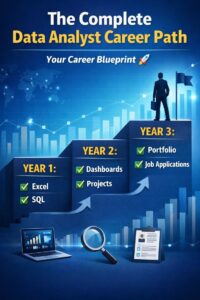
Year 1: Computer and Excel fundamentals
Year 2: Statistics and SQL
Year 3: Power BI and practical projects
Year 4: Python, portfolio and internship preparation
This is only an example.
The important principle is to avoid waiting until graduation before acquiring practical skills.
A student who graduates with a degree plus several well-documented analytics projects may have more evidence of practical ability than someone who only has academic coursework.
Data Analyst Career Path in Nigeria for Career Changers
You do not necessarily need to begin your career in technology to move toward analytics.
For example:
Accountant → Data Analyst
Existing knowledge of financial records can be useful.
Marketer → Marketing Analyst
Existing knowledge of campaigns and customers can complement analytics skills.
Business Administrator → Business Analyst
Existing business-process knowledge can support analytical work.
Teacher → Education Data Analyst
Experience in education can provide valuable domain knowledge.
Engineer → Data Analyst
Quantitative and problem-solving skills can provide a useful foundation.
The key is to combine your existing knowledge with data skills.
Data Analyst Career Path in Nigeria for Learners in Port Harcourt
Port Harcourt provides a useful environment for learning data analytics because the city has businesses and organisations across different sectors.
A learner can create projects around scenarios involving:
- Oil and gas services
- Retail
- Logistics
- Education
- Healthcare
- Hospitality
- Small businesses
- Financial services
For example, an aspiring analyst could create a fictional oil-and-gas services dashboard showing equipment maintenance records.
Another learner could analyse a fictional Port Harcourt retail dataset.
The purpose is not to pretend that these projects are real company projects.
The purpose is to demonstrate that you understand how analytical methods can be applied to realistic business situations.
How Potenmunia Tech School Approaches the Data Analyst Career Path
Potenmunia Tech School in Port Harcourt approaches technology training with an emphasis on practical, hands-on learning.
For learners following the Data Analyst Career Path in Nigeria, this type of approach is important because analytics is a skill that becomes stronger through practice.
Rather than learning tools only as isolated topics, learners can benefit from connecting:
Concept → Tool → Project → Analysis → Presentation → Portfolio
For example, instead of simply learning how PivotTables work, a learner could use them to investigate a realistic sales problem.
Instead of only learning SQL syntax, the learner could use SQL to answer business questions.
Instead of only learning Power BI buttons, the learner could build a dashboard around a specific analytical problem.
Potenmunia’s approach also places emphasis on:
- Hands-on practical learning
- Real-world projects
- Capstone experience
- Portfolio development
- Mentorship
- Career preparation
- AI integration
- Future-focused skills
- Innovation and entrepreneurship
This approach is particularly useful for learners who want to move from knowing about data analytics to demonstrating what they can actually do.
Common Mistakes on the Data Analyst Career Path in Nigeria
1. Learning Too Many Tools
You do not need to master ten tools immediately.
Build depth gradually.
2. Ignoring Excel
Some beginners believe that professional analysts should immediately jump to Python.
Excel remains useful for many everyday analytical tasks.
3. Avoiding SQL
If you want to work with database-driven organisations, SQL is an important skill to develop.
4. Building Only Attractive Dashboards
A dashboard should answer a question.
A beautiful dashboard with no useful insight is still a weak analytical project.
5. Copying Tutorials Without Understanding Them
Following a YouTube tutorial can help you learn.
But after completing it, try rebuilding the project independently.
Change the dataset.
Change the questions.
Explain your findings in your own words.
6. Ignoring Communication
You may find an important pattern but still struggle professionally if you cannot explain it.
7. Depending Completely on AI
AI can accelerate your work, but you remain responsible for checking the accuracy of your analysis.
How Long Does the Data Analyst Career Path in Nigeria Take?
There is no fixed period.
A learner studying consistently might structure their development like this:
Months 1–2
- Data fundamentals
- Excel
- Basic statistics
Months 3–4
- SQL
- Data cleaning
- More advanced Excel
Months 5–6
- Power BI
- Data modelling
- Dashboard development
Months 7–8
- Python
- Pandas
- Portfolio projects
Months 9+
- Advanced projects
- Interview preparation
- Applications
- Specialisation
These are learning milestones rather than guarantees.
Your actual progress depends on your background, study time, practice, learning environment and ability to apply what you learn.
Data Analyst Career Path in Nigeria: A Practical Checklist
Use this checklist to monitor your progress.
Foundation
- Understand basic data concepts
- Learn percentages and averages
- Understand basic statistics
- Develop computer skills
Excel
- Learn formulas
- Learn lookup functions
- Learn PivotTables
- Learn charts
- Practise data cleaning
- Build a simple dashboard
SQL
- SELECT
- WHERE
- GROUP BY
- ORDER BY
- JOIN
- CASE
- Subqueries
- CTEs
- Window functions
Power BI
- Import data
- Clean data
- Create relationships
- Build data models
- Learn basic DAX
- Create dashboards
- Practise data storytelling
Python
- Learn Python fundamentals
- Learn Pandas
- Learn NumPy basics
- Explore data visualisation
- Practise automation
Portfolio
- Build a sales project
- Build a customer project
- Build a business dashboard
- Document your findings
- Explain recommendations
Career
- Create a professional CV
- Prepare a portfolio
- Practise SQL interview questions
- Practise explaining projects
- Develop communication skills
- Look for internships and entry-level opportunities
Frequently Asked Questions About the Data Analyst Career Path in Nigeria
Can I become a data analyst without a computer science degree?
Yes.
People enter data analytics from backgrounds including economics, accounting, mathematics, engineering, business, statistics and other disciplines.
What matters is developing the required analytical and technical competencies.
What should I learn first?
For many beginners, Excel and basic data concepts are a practical starting point.
You can then progress to SQL, Power BI and Python.
Is SQL important for the Data Analyst Career Path in Nigeria?
Yes.
SQL is particularly useful when working with data stored in relational databases.
Is Python compulsory?
Not necessarily for every entry-level role.
However, learning Python can expand your analytical capabilities, especially for automation and more advanced data work.
Is Power BI worth learning?
Power BI is a useful business-intelligence and visualisation platform and can be valuable for analysts who need to create interactive reports and dashboards.
Do I need advanced mathematics?
No.
You should understand basic quantitative concepts and gradually learn statistics that are relevant to your work.
How many portfolio projects should I build?
There is no magic number.
Three to five strong, well-documented projects can provide a useful starting portfolio.
Can I learn data analytics in Port Harcourt?
Yes.
You can combine self-study, online resources, academic education and structured practical training.
For learners who prefer face-to-face guidance and project-based learning, a technology school such as Potenmunia Tech School can provide a structured environment for developing practical skills.
Can data analytics lead to other careers?
Yes.
Data analytics can provide foundations for areas such as business intelligence, product analytics, financial analytics, marketing analytics, data science and analytics management.
Conclusion on the Data Analyst Career Path in Nigeria
The Data Analyst Career Path in Nigeria is best understood as a continuous learning journey rather than a single course.
You can start with basic data literacy and Excel.
Then progress to:
Excel → Statistics → SQL → Power BI → Python → Projects → Portfolio → Professional Experience → Specialisation
The order can change depending on your background, but the principle remains the same: develop skills progressively and apply them to realistic problems.
Do not focus only on collecting certificates.
Build evidence.
Do not focus only on learning software.
Learn how to solve problems.
Do not focus only on creating attractive dashboards.
Learn how to communicate insights.
And do not treat AI as a replacement for analytical thinking. Learn how to use AI responsibly while maintaining the ability to verify your results.
For learners in Port Harcourt, Potenmunia Tech School provides a practical environment for developing technology skills through hands-on learning, real-world projects, portfolio development, mentorship and career preparation.
If you are beginning the Data Analyst Career Path in Nigeria, you do not need to master everything at once.
Start with one skill.
Practise it.
Build a project.
Learn from it.
Then move to the next stage.
That is how a beginner gradually develops into a professional data analyst.