
If you are searching for Data Analyst Jobs in Port Harcourt, one of the most important questions to ask is not simply, “Where can I find a data analyst job?”
A better question is:
“What skills do employers expect from someone applying for Data Analyst Jobs in Port Harcourt?”
The answer goes beyond having a certificate.
Employers need people who can collect, clean, analyse and interpret information and then turn that information into useful insights for business decisions. In practical terms, a data analyst helps an organisation understand what its data is saying.
According to Wikipedia’s overview of data analysis, data analysis involves inspecting, cleaning, transforming and modelling data to discover useful information, support conclusions and improve decision-making.
This makes data analytics relevant to businesses across many industries.
For people looking for Data Analyst Jobs in Port Harcourt, developing practical skills in Microsoft Excel, SQL, Power BI, statistics, Python, data visualisation and communication can provide a strong foundation.
But technical tools are only part of the picture.
You also need to know how to solve problems, communicate findings, build a portfolio and demonstrate that you can apply your skills to realistic situations.
 What Are Data Analyst Jobs in Port Harcourt?
Data Analyst Jobs in Port Harcourt are roles where professionals use data to help organisations understand performance, identify trends, solve problems and make informed decisions.
A data analyst might work with:
- Sales records
- Customer information
- Financial data
- Marketing data
- Inventory records
- Operational reports
- Employee information
- Survey results
- Website and digital data
- Business performance indicators
The exact responsibilities depend on the employer and industry.
For example, a retail company may need an analyst to understand product sales.
A logistics company may want to analyse delivery performance.
A financial organisation may analyse customer transactions.
An energy-related company may need reporting and operational analysis.
A healthcare organisation may need someone to work with patient or operational data.
This is one reason Data Analyst Jobs in Port Harcourt can exist across multiple industries rather than only within technology companies.
Why Data Analytics Skills Matter in Port Harcourt
Port Harcourt has a diverse business environment, including companies and organisations involved in energy, professional services, finance, retail, logistics, education, healthcare and other sectors.
All of these organisations can generate data.
The challenge is turning that data into useful information.
Consider a fictional Port Harcourt retail business with thousands of transactions.
Management may want answers to questions such as:
- Which products sell the most?
- Which products generate the most revenue?
- Which months have the strongest sales?
- Which customers buy most frequently?
- Which locations perform better?
- Are sales increasing or declining?
- Which products may need additional marketing?
A data analyst can help answer these questions.
That is the practical value behind many Data Analyst Jobs in Port Harcourt.
What Skills Are Required for Data Analyst Jobs in Port Harcourt?
There is no universal list of requirements for every data analyst position.
However, several skills are particularly useful for anyone preparing for Data Analyst Jobs in Port Harcourt and Nigeria.
1. Microsoft Excel
Excel remains one of the most useful tools for beginning data analysts.
You should understand:
- Formulas and functions
- Sorting and filtering
- Data cleaning
- PivotTables
- Charts
- Lookups
- Conditional formatting
- Basic statistical calculations
- Data organisation
For example, an employer could give you six months of sales data and ask you to identify the highest-performing products.
You need to be able to analyse the information rather than simply enter numbers into a spreadsheet.
2. SQL
SQL is another important skill for people targeting Data Analyst Jobs in Port Harcourt.
Many organisations store information in databases.
SQL allows analysts to retrieve and manipulate information from those databases.
You should gradually become comfortable with:
- SELECT statements
- WHERE conditions
- ORDER BY
- GROUP BY
- Aggregate functions
- JOINs
- Subqueries
- CASE statements
- Common table expressions
- Window functions as you advance
Imagine a Port Harcourt logistics company has separate tables containing customers, deliveries and payments.
A data analyst might use SQL to answer:
Which customer categories generated the most revenue during the last six months?
That is the type of business question SQL can help answer.
3. Power BI
Power BI is useful for turning data into interactive reports and dashboards.
Someone applying for Data Analyst Jobs in Port Harcourt should understand how to transform data and communicate insights visually.
A Power BI dashboard might show:
- Monthly revenue
- Sales performance
- Customer trends
- Product performance
- Operational KPIs
- Regional performance
- Year-on-year comparisons
However, learning Power BI is not simply about creating attractive charts.
A good analyst asks:
What decision should this dashboard help someone make?
That distinction separates reporting from meaningful analysis.
4. Statistics
Data analysts need analytical thinking as well as software skills.
Useful statistical concepts include:
- Mean
- Median
- Mode
- Percentages
- Percentage change
- Probability
- Distribution
- Variability
- Correlation
- Outliers
- Sampling
Suppose sales increased by 25%.
A beginner might simply report the increase.
A stronger analyst asks:
- Compared with which period?
- Did the number of customers increase?
- Did prices change?
- Was there a promotion?
- Did one product cause most of the increase?
- Was the previous period unusually weak?
Those questions demonstrate analytical thinking.
5. Python
Python is not required for every entry-level data analyst position, but it can be a valuable addition to your skill set.
Python can support:
- Data cleaning
- Data transformation
- Exploratory analysis
- Automation
- Statistical analysis
- Repetitive tasks
Libraries such as pandas are widely used for working with structured data.
For someone beginning a career in data analytics, however, it is usually better to build a strong analytical foundation before trying to learn every advanced Python technique.
6. Data Visualisation
A data analyst must communicate information effectively.
You may have discovered an important trend, but if nobody understands your explanation, the analysis has limited value.
You should learn how to choose appropriate charts and explain:
- What happened?
- Why might it have happened?
- Why does it matter?
- What should the organisation investigate next?
Tools such as Power BI, Excel and Tableau can support this process.
7. Communication
Communication is one of the most underrated skills for people searching for Data Analyst Jobs in Port Harcourt.
A data analyst may work with people who have little or no technical background.
You might need to explain your findings to:
- Managers
- Business owners
- Marketing teams
- Finance teams
- Operations staff
- Project managers
- Executives
The ability to translate technical analysis into clear business language can make a significant difference.
8. Business Understanding
Knowing how to use Excel or SQL is useful.
Understanding why the business needs the analysis is even more important.
Suppose an organisation asks:
“Show us our monthly sales.”
You should be able to go further.
Ask:
- Which products are responsible for the change?
- Which customer groups are contributing?
- Which locations are performing differently?
- What happened compared with the previous period?
- What should management investigate?
That is where technical skills meet business thinking.
9. AI Literacy
AI is becoming increasingly relevant to data analysis.
Modern analysts can use AI tools to support activities such as:
- Generating SQL drafts
- Explaining formulas
- Brainstorming analytical questions
- Automating repetitive tasks
- Documenting analysis
- Exploring datasets
However, AI-generated output still needs human verification.
A data analyst should understand the underlying data well enough to identify incorrect assumptions, misleading conclusions or faulty calculations.
For future Data Analyst Jobs in Port Harcourt, AI literacy can therefore complement rather than replace fundamental analytical skills.
Where Can You Find Data Analyst Jobs in Port Harcourt?
People searching for Data Analyst Jobs in Port Harcourt should avoid limiting their search to companies that describe themselves as technology companies.
Potential industries include:
Oil and Gas
Energy-related organisations generate large amounts of operational, financial and project data.
Analytics can support reporting, performance monitoring and decision-making.
Banking and Financial Services
Financial institutions use data for reporting, customer analysis, risk management and operational decisions.
Fintech
Fintech companies can require analysts to work with transaction, customer and product data.
Retail
Retail businesses can use data to understand sales, customers, inventory and product performance.
Logistics
Logistics organisations can analyse deliveries, routes, costs, customers and operational performance.
Healthcare
Healthcare organisations can use data for operational reporting, planning and service analysis.
Education
Schools, training organisations and educational institutions can analyse enrolment, attendance, performance and other information.
Professional Services
Consulting and professional-service organisations may use analysts to support research, reporting and client projects.
This means your search for Data Analyst Jobs in Port Harcourt should consider industries as well as job titles.
Data Analyst Job Titles to Search For
Do not search only for:
“Data Analyst Jobs in Port Harcourt.”
Also look for related titles such as:
- Junior Data Analyst
- Data Analyst
- Business Intelligence Analyst
- Reporting Analyst
- Operations Analyst
- Business Analyst
- Marketing Analyst
- Financial Analyst
- Data Reporting Specialist
- Business Intelligence Specialist
- Data and Reporting Officer
- Research Analyst
Different companies can use different titles for similar responsibilities.
What Employers Look for Beyond a Certificate
One of the biggest mistakes beginners make when searching for Data Analyst Jobs in Port Harcourt is assuming that a certificate is enough.
A certificate can demonstrate that you completed training.
But employers also want evidence of practical ability.
Imagine two applicants.
Candidate A
Has several certificates but no portfolio projects.
Candidate B
Has fewer certificates but can demonstrate:
- An Excel project
- A SQL project
- A Power BI dashboard
- A documented analytical process
- Business insights
- Recommendations based on the findings
Candidate B has tangible evidence to discuss.
This is why portfolio development should be part of your preparation for Data Analyst Jobs in Port Harcourt.
How to Build a Data Analyst Portfolio
You do not need dozens of projects.
Three to five carefully developed projects can provide a useful foundation.
1. Sales Analysis
Analyse a fictional or publicly available sales dataset.
Look at:
- Revenue
- Products
- Customers
- Monthly trends
- Sales performance
Use Excel or Power BI.
2. SQL Analysis
Create or use a database containing:
- Customers
- Orders
- Products
- Transactions
Then answer practical business questions using SQL.
3. Power BI Dashboard
Create a dashboard that answers a specific business question.
For example:
“What is driving the company’s sales performance?”
Do not simply fill the screen with charts.
Explain the insights.
4. Nigerian Business Dataset
Build a project around a Nigerian context where appropriate.
Potential themes include:
- Transportation
- Education
- Energy
- Agriculture
- Population
- Business activity
- Consumer behaviour
Make sure the data is legally and ethically sourced and clearly document its limitations.
5. AI-Assisted Data Analysis
Demonstrate how AI can support your workflow.
For example, you could document how you used an AI tool to help generate initial SQL ideas and then explain how you manually checked and corrected the output.
This demonstrates both technical and modern workplace skills.
How to Prepare for Data Analyst Jobs in Port Harcourt
A practical learning path can help you avoid becoming overwhelmed.
1. Learn Excel
Master the fundamentals before moving into more advanced tools.
2. Learn SQL
Practise retrieving and analysing data from databases.
3. Learn Power BI
Build dashboards and learn data modelling and visualisation.
4. Learn Statistics
Understand the mathematics behind the analysis.
5. Learn Python
Add Python when your analytical foundation is strong enough.
6. Build Projects
Do not wait until you have mastered everything.
Build projects as you learn.
7. Build Your Portfolio
Document your projects professionally.
8. Prepare Your CV
Highlight relevant skills and measurable project outcomes.
9. Practise Interviews
Prepare for:
- Excel questions
- SQL questions
- Data interpretation
- Business case studies
- Power BI questions
- Behavioural questions
10. Start Applying
Once you can demonstrate practical competence, begin applying rather than waiting until you feel “perfect.”
How Potenmunia Tech School Approaches Data Analytics
For learners interested in Data Analyst Jobs in Port Harcourt, Potenmunia Tech School positions its data analytics training around practical technology skills and career preparation.
Its published programme covers Excel, SQL, SPSS, Tableau, Python and Power BI, giving learners exposure to several tools used across data analysis and business intelligence.
The school’s broader approach is designed for students, graduates, working professionals and job seekers, with practical projects and professional certification included among its programme features.
For someone preparing for Data Analyst Jobs in Port Harcourt, the useful part of this approach is the emphasis on applying skills rather than treating learning as purely theoretical.
A practical learning experience should help you:
- Work with real or realistic datasets
- Clean and transform data
- Write SQL queries
- Create dashboards
- Interpret results
- Build portfolio projects
- Receive mentorship
- Develop job-readiness skills
- Understand how AI can support modern data workflows
Potenmunia also offers separate courses covering Excel, SQL, Power BI, Python and data science, allowing learners to develop specific skills alongside broader data-analysis training.
What Makes a Strong Data Analyst Candidate?
A strong candidate for Data Analyst Jobs in Port Harcourt does not necessarily know every software tool.
Instead, they can demonstrate a combination of:
Technical ability + analytical thinking + communication + business understanding + practical evidence.
For example, imagine an interviewer gives you a sales dataset.
They might not only ask:
“Can you create a PivotTable?”
They could ask:
“Sales dropped by 15% last month. What would you investigate?”
A good analyst might consider:
- Product performance
- Customer activity
- Pricing changes
- Marketing campaigns
- Seasonality
- Stock availability
- Geographic differences
- Data-quality problems
That approach demonstrates analytical thinking.
Data Analyst Jobs in Port Harcourt: Your Job-Readiness Checklist
Before applying, check whether you can confidently say yes to the following.
Technical skills
- I can analyse data in Excel.
- I understand PivotTables.
- I can clean a dataset.
- I can write basic SQL queries.
- I understand SQL JOINs.
- I can create a Power BI dashboard.
- I understand basic statistics.
- I have started learning Python or understand where it fits.
Analytical skills
- I can turn a business problem into analytical questions.
- I can identify trends.
- I can investigate unusual results.
- I understand the difference between correlation and causation.
- I can explain limitations in my analysis.
Portfolio
- I have at least three practical projects.
- My projects use realistic datasets.
- I explain the problem behind each project.
- I document my process.
- I explain the insights.
- I provide recommendations where appropriate.
Career preparation
- My CV clearly presents my analytical skills.
- I can explain every project on my CV.
- I have prepared for SQL interviews.
- I can discuss a Power BI dashboard.
- I can explain technical concepts to a non-technical person.
Frequently Asked Questions About Data Analyst Jobs in Port Harcourt
Are there Data Analyst Jobs in Port Harcourt?
Yes, data analysis skills can be relevant to organisations across Port Harcourt’s business environment. Opportunities can appear under different titles and across industries such as finance, retail, logistics, healthcare, professional services and energy.
However, vacancies change frequently, so candidates should check current job listings and study the requirements employers are actually requesting.
What skills do I need for Data Analyst Jobs in Port Harcourt?
Start with Excel, SQL, Power BI and statistics. Python can be added as your skills develop. Communication, business understanding, problem-solving and portfolio development are also important.
Can I become a data analyst without a computer science degree?
Yes. Data analytics can be learned by people from different educational backgrounds. Degrees in computer science, statistics, mathematics, economics, engineering and related areas can be useful, but practical competence remains important.
Is Excel enough for Data Analyst Jobs in Port Harcourt?
Excel is an excellent starting point, but learning SQL and a visualisation/business-intelligence platform such as Power BI can broaden your capabilities.
Do I need Python for Data Analyst Jobs in Port Harcourt?
Not every position requires Python. However, it is a useful skill for data cleaning, automation and more advanced analytical work.
Is SQL difficult to learn?
SQL can seem unfamiliar at first, but beginners can learn it progressively. Start with SELECT, WHERE, ORDER BY and GROUP BY before moving into JOINs and more advanced concepts.
Do I need a data analytics certificate?
A certificate can support your professional profile, but it should be combined with practical skills and projects. Your ability to demonstrate what you can actually do is important.
How many projects should I have in my portfolio?
There is no fixed number. Three to five strong projects can be a useful starting point if they demonstrate different skills and clearly explain the business problem, analysis and findings.
Can I work remotely as a data analyst?
Some data-analysis roles can be remote or hybrid, depending on the employer and position. Developing strong technical and communication skills can help you compete for opportunities beyond your immediate location.
What is the difference between a data analyst and a data scientist?
A data analyst generally focuses on examining data, identifying patterns, creating reports and supporting business decisions. Data science can involve more advanced statistical modelling, machine learning and predictive systems. There is some overlap between the fields.
Conclusion Data Analyst Jobs in Port Harcourt
The search for Data Analyst Jobs in Port Harcourt should begin with skills rather than job titles.
Learn the tools.
Understand the concepts.
Practise with real datasets.
Build projects.
Develop your communication skills.
Then learn how to demonstrate your abilities to employers.
You do not need to know everything before beginning. A realistic path is to start with Excel, progress to SQL and Power BI, strengthen your statistical thinking, add Python and continue building projects.
For learners who prefer structured training, Potenmunia Tech School provides a practical data-analysis programme covering Excel, SQL, SPSS, Tableau, Python and Power BI, alongside its wider focus on practical digital skills and career preparation.
The goal should not simply be:
“I completed a data analytics course.”
The stronger statement is:
“I can take a business problem, analyse the data, explain what I discovered and show you the project.”
That is the kind of practical capability worth developing when preparing for Data Analyst Jobs in Port Harcourt. wikipedia
AI vs Machine Learning vs Deep Learning: The Complete Beginner Guide for 2026
If you have been hearing terms like Artificial Intelligence, Machine Learning, and Deep Learning everywhere across Port Harcourt, Lagos, and social media, and you feel confused about what each term actually means, you are not alone. Many beginners assume these concepts are identical, but they are not. Understanding the precise differences prevents you from enrolling in the wrong training program and wasting time or money.
This practical guide breaks down AI, Machine Learning, and Deep Learning in clear, accessible language, using relatable Nigerian business examples from Mile 1 market, fashion brands in GRA, and financial institutions in Trans Amadi. By the end of this article, you will clearly understand how these technologies work together and know exactly which skill path to prioritize in 2026.
Table of Contents
-
Why You Are Confused About AI vs Machine Learning vs Deep Learning
-
What is Artificial Intelligence? The Big Umbrella
-
What is Machine Learning? The Data-Driven Engine Inside AI
-
What is Deep Learning? The Neural Network Inside Machine Learning
-
AI vs Machine Learning: Core Differences Explained
-
Practical Nigerian Business Examples
-
Which Technology Should You Learn First in 2026?
-
How Potenmunia Tech School Teaches All Three Step by Step
-
Conclusion and Beginner FAQs
1. Why You Are Confused About AI vs Machine Learning vs Deep Learning
The confusion exists because many training centers and online tutorials use these terms interchangeably without clarifying how they fit together. Some providers advertise an AI course when they only teach basic ChatGPT prompts, while others offer a Machine Learning course that focuses solely on basic spreadsheet formulas. Students often complete these programs with certificates but lack clear execution skills.
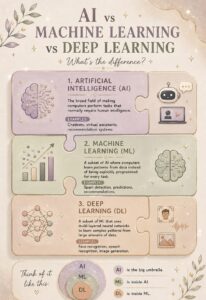
The clearest way to visualize the relationship is through nested layers:
-
Artificial Intelligence is the outer umbrella covering any technology that mimics human intelligence.
-
Machine Learning sits inside Artificial Intelligence as a specialized discipline focused on learning patterns from data.
-
Deep Learning sits inside Machine Learning as an advanced subfield utilizing multi layered neural networks.
Like nested containers, Deep Learning is part of Machine Learning, and Machine Learning is part of Artificial Intelligence.
2. What is Artificial Intelligence? The Big Umbrella
Artificial Intelligence refers to any computer program or system engineered to perform tasks that traditionally require human intelligence, such as processing speech, recognizing visual objects, or making operational decisions.
AI includes any system that simulates human reasoning or task completion:
-
Point of Sale Systems in Retail: A basic POS machine calculates transaction totals. An AI powered POS system evaluates daily inventory logs and prompts the manager to reorder fast selling goods before stock runs out.
-
Automated Customer Service in E-Commerce: An automated messaging system that greets Instagram or WhatsApp customers at night, sends product catalogs, and processes order details simulates the routine work of a human sales representative.
Artificial Intelligence is the broad goal. Any software system that automates human like logic falls under the AI umbrella.
3. What is Machine Learning? The Data-Driven Engine Inside AI
Machine Learning is a specialized subfield within Artificial Intelligence where systems automatically improve their performance through data experience rather than relying strictly on manual rules written by programmers.
To understand the core difference between basic AI and Machine Learning, consider these two approaches:
-
Rule Based AI: You write fixed rules for a customer service chatbot. If a user types the exact word “Price”, the system sends a fixed price list. The computer only follows your manual rules.
-
Machine Learning: You feed 1,000 historical customer conversations into an algorithm. The model analyzes the text variations and learns independently that phrases like “How much?”, “Cost?”, and “What is the price?” express the exact same customer intent. It learns the pattern directly from data without a human writing individual rules for every phrase.
All Machine Learning is Artificial Intelligence, but not all Artificial Intelligence uses Machine Learning. Machine Learning is the specific methodology within AI that extracts insights directly from historical data.

4. What is Deep Learning? The Neural Network Inside Machine Learning
Deep Learning is an advanced subset of Machine Learning inspired by the structure and function of the human brain. It uses multi layered artificial neural networks to process vast amounts of unstructured data, such as images, video frames, audio recordings, and complex natural text.
When processing unstructured data like visual images, the technical approach differs significantly:
-
Traditional Machine Learning: A developer must manually inform the model which specific measurements or features to analyze, such as eye spacing or nose width, before the system calculates a match.
-
Deep Learning: You input thousands of raw photographs directly into a deep neural network. The layered architecture automatically identifies key visual elements, extracting fine facial contours, shadows, and subtle features on its own.
Deep Learning powers complex modern technologies like facial recognition systems, self driving vehicle navigation, automated speech recognition, and advanced generative AI models.
5. AI vs Machine Learning: Core Differences Explained
Understanding the functional distinctions helps you select the right learning track:
6. Practical Nigerian Business Examples
Seeing how these technologies function in local enterprises makes the distinctions clear:
-
Fashion Enterprises in GRA Port Harcourt:
-
AI Application: An automated customer service system responds instantly to inquiries outside business hours, delivering product catalogs.
-
Machine Learning Application: An algorithm analyzes six months of purchase histories to predict which individual customers are likely to buy high end seasonal collections, enabling targeted marketing campaigns.
-
-
Commercial Supermarkets in Mile 1:
-
AI Application: An automated inventory tracker records sales and generates daily digital receipts.
-
Machine Learning Application: A predictive sales model analyzes historical holiday trends and local economic indicators to forecast exact demand for staple commodities, preventing stockouts and overpurchasing.
-
-
Financial Institutions in Trans Amadi:
-
AI Application: An automated interactive voice system guides callers through standard account balance inquiries.
-
Machine Learning Application: A real time classification model evaluates transaction speed, location, and account histories to detect and flag fraudulent fund transfers instantly.
-
7. Which Technology Should You Learn First in 2026?
A structured learning sequence ensures steady progress and career clarity:
-
Start with AI Automation Fundamentals: Begin by mastering prompt engineering, workflow automation tools, and generative AI productivity platforms. This foundational layer allows you to build user facing solutions, build immediate tech confidence, and automate routine tasks without complex code.
-
Advance to Machine Learning Engineering: Transition into data analysis, clean programming logic with Python, data transformation using Pandas, and statistical modeling with Scikit-Learn. Learning to build and deploy regression and classification models opens up high value data science and engineering roles.
-
Specialize in Deep Learning: Once you hold a firm grasp of traditional machine learning, progress into deep neural networks using frameworks like TensorFlow or PyTorch to build advanced computer vision and natural language processing applications.

8. How Potenmunia Tech School Teaches All Three Step by Step
Learning technology successfully requires physical structure, expert oversight, and consistent guidance. Potenmunia Tech School provides a practical environment designed to help you understand AI vs Machine Learning through real competence:
-
100% Practical Execution: Every lesson focuses on hands on coding, real scenario problem solving, and building functional applications so you master AI vs Machine Learning concepts directly on your laptop.
-
Progressive Curriculum: Training starts with foundational AI tools and automation before moving into Python programming, data cleaning, statistical modeling, and basic neural network architectures to clarify AI vs Machine Learning step by step.
-
Portfolio Development: You publish complete source code, documentation, and live deployed application links on GitHub, showing how you apply AI vs Machine Learning to build concrete proof of your skills for prospective employers and clients.
-
Direct Practitioner Mentorship: Experienced data scientists and instructors review your code, guide your troubleshooting live, and share real industry standards on AI vs Machine Learning practices.
-
Accessible Facilities: Students who do not immediately own personal laptops can utilize Potenmunia’s fully equipped computer lab in Port Harcourt during training hours while learning AI vs Machine Learning.
-
Career Readiness and Freelance Guidance: The program includes focused guidance on resume optimization, technical interview preparation, and pitching predictive data solutions covering both AI vs Machine Learning to local and international clients.
Learn more about our structured learning tracks in our comprehensive guides on the Machine Learning Course in Port Harcourt and our Data Science Course in Port Harcourt.
Conclusion and Beginner FAQs
Distinguishing between Artificial Intelligence, Machine Learning, and Deep Learning equips you to choose the right learning path. Understanding AI vs Machine Learning ensures you know that AI provides the broad vision of computer automation, Machine Learning supplies the statistical tools to extract actionable predictions from data, and Deep Learning handles complex, unstructured data tasks.
Building genuine expertise in AI vs Machine Learning requires moving beyond passive video tutorials and stepping into practical, project based learning. With structured guidance, daily hands-on practice, and portfolio development at Potenmunia Tech School, you can transition from an absolute beginner to a confident technical professional equipped for global opportunities.
Frequently Asked Questions
I am a complete beginner, which program should I enroll in first to understand AI vs Machine Learning?
Beginners should enroll in a structured program that begins with foundational AI tools and Python programming fundamentals before advancing into machine learning. This practical approach clarifies AI vs Machine Learning while building your coding confidence step by step.
Do I need a personal laptop before enrolling at Potenmunia Tech School to study AI vs Machine Learning?
Having a personal laptop is recommended for daily practice, but students studying AI vs Machine Learning at Potenmunia Tech School have access to our fully equipped computer lab in Port Harcourt during scheduled training hours to complete coursework and build live projects.
How does building a portfolio help me secure jobs or freelance clients after learning AI vs Machine Learning?
A certificate confirms program completion, but a GitHub portfolio containing live, working models covering AI vs Machine Learning applications proves your actual engineering competence to hiring managers, corporate recruiters, and international freelance clients
If you are a complete beginner looking to build high paying technical skills, learning machine learning is one of the smartest steps you can take. You do not need a computer science degree or a background in advanced mathematics to start. This guide breaks down the full roadmap, practical steps, core tools, and career paths in simple language so you can transition from zero knowledge to building job ready models.
Table of Contents
-
What Does It Mean to Learn Machine Learning as a Nigerian Beginner?
-
Real Reasons to Learn Machine Learning in Nigeria in 2026
-
Step 1: Start With Python
-
Step 2: Master Data Cleaning
-
Step 3: Learn Data Visualization and Storytelling
-
Step 4: Build Your First Prediction Models
-
Step 5: Deploy Your Models Online
-
Step 6: Build Your Portfolio and Start Earning
-
Why Potenmunia Tech School is the Best Place for Your Training
-
Common Mistakes to Avoid
-
Conclusion and Beginner FAQs

1. What Does It Mean to Learn Machine Learning as a Nigerian Beginner?
To learn machine learning simply means learning how to teach a computer using historical examples so it can make accurate predictions for you automatically.
For example, imagine you run a point of sale business or retail shop in Mile 1, Port Harcourt. You have one full year of daily sales records written in a ledger or stored in a spreadsheet. Instead of guessing how much stock to buy next month, you give that historical data to a machine learning model. The computer analyzes past patterns, seasonal surges, and weekly trends, then predicts your exact inventory needs for the coming month.
Instead of writing static, manual rules for every situation, you feed clean data into an algorithm, and the system learns how to make forecasts, detect anomalies, or recommend products. You are learning how to transform existing business data into actionable forecasts that save time and increase profitability.
2. Real Reasons to Learn Machine Learning in Nigeria in 2026
Machine learning expertise is one of the most in demand technical skills in the modern job market:
-
High Earning Corporate Roles: Commercial banks, fintech firms like Moniepoint and Opay, and multinational energy corporations pay attractive entry level salaries ranging from ₦400,000 to ₦800,000 monthly for professionals who can build predictive systems and fraud detection algorithms.
-
Global Remote Opportunities: Foreign startups and international agencies on platforms like Upwork and Fiverr regularly hire model builders at hourly rates between $40 and $80. You can live in Port Harcourt, Lagos, or Abuja and earn a sustainable foreign currency income.
-
Business Growth and Automation: If you operate a business, building recommendation engines similar to major e-commerce platforms can increase your sales conversion rate by up to 35% without requiring extra advertising spend.
-
High Demand and Low Competition: Less than 2% of tech practitioners in Nigeria possess deep hands-on expertise in machine learning and data engineering, ensuring those who build real project portfolios enjoy high demand.
3. Step 1: Start With Python
If you want to master machine learning, Python is the primary programming language you should focus on. Python features a clean, readable syntax that reads similarly to standard English, making it accessible for absolute beginners.
During your first two weeks, focus purely on foundational concepts:
-
Variables and basic data types
-
Lists, dictionaries, and loops
-
Writing modular functions
-
Loading datasets into Pandas DataFrames
-
Handling missing values and basic summary statistics
At Potenmunia Tech School, we teach Python from zero, guiding you step by step through software installation, environment configuration, and writing your first working scripts.
4. Step 2: Master Data Cleaning
Real business data is rarely clean. Datasets often contain missing phone numbers, duplicate records, incorrect formatting, or missing dates. Feeding dirty data into a machine learning algorithm leads to inaccurate predictions and model failure.
Data cleaning accounts for roughly 70% of a data practitioner’s daily work. Mastering tools like Pandas and NumPy allows you to clean tens of thousands of data rows in minutes. Learning to filter out duplicate records, replace missing values logically, and standardize categorical entries is the key skill that separates theoretical learners from industry ready professionals.
5. Step 3: Learn Data Visualization and Storytelling
After cleaning your dataset, you must present your findings clearly to business decision makers. Data visualization involves converting raw numbers into visual charts that tell a clear business story.
By using plotting libraries like Matplotlib and Seaborn, you can showcase trends clearly, such as demonstrating to a retail manager that sales dip every Monday and spike every Friday evening. This allows business owners to make data backed marketing and staffing choices.
Learn more about our data visualization modules in our comprehensive guide on the Data Science Course in Port Harcourt.

6. Step 4: Build Your First Prediction Models
Building predictive models is the core of machine learning. Beginners start by mastering two primary types of supervised learning:
-
Regression (Predicting Continuous Numbers): Building models that predict real estate prices, revenue growth, or salary figures based on historical input features.
-
Classification (Predicting Discrete Categories): Building models that identify whether a bank transaction is fraudulent, whether a customer is likely to cancel a subscription, or whether a loan applicant will default.
At Potenmunia Tech School, student training centers on localized datasets, such as Port Harcourt real estate trends and regional commercial transactions, giving you relevant local context while mastering global technical tools.
7. Step 5: Deploy Your Models Online
Building a model on your local laptop is only half the process. To make your work valuable to employers and clients, you must publish your model as an interactive web application.
Using tools like Streamlit, you can construct a clean web user interface in under an hour without deep web development knowledge. Users can input values into form fields on a live web page and receive immediate predictions generated by your underlying machine learning model. Sharing a live application link demonstrates clear technical execution to hiring managers.
8. Step 6: Build Your Portfolio and Start Earning
A portfolio of deployed projects provides direct proof of your technical abilities. Storing your source code and documentation on GitHub gives global recruiters immediate visibility into your engineering capabilities.
Once your portfolio contains live deployed projects, you can pursue four direct earning paths:
-
Applying for local and remote corporate Machine Learning Engineer and Data Analyst roles
-
Pitching freelance prediction and automation services on international platforms
-
Launching an independent AI solutions agency offering predictive modeling to businesses
-
Optimizing your own business ventures using custom recommendation and forecasting engines

9. Why Potenmunia Tech School is the Best Place for Your Training
Learning technology successfully requires physical structure, expert oversight, and consistent guidance. Potenmunia Tech School provides the ideal environment for beginners in Port Harcourt to transition into capable, industry ready data professionals.
Rather than relying on abstract lectures or passive video watching, Potenmunia focuses directly on functional competence, job readiness, and applied technical skills.
100% Practical, Live Execution
Every training session centers on active coding and hands-on execution. You open your laptop, write code alongside experienced instructors, and apply core concepts immediately. Complex topics like data manipulation, regression analysis, and predictive modeling are learned through live problem solving, ensuring you build genuine debugging confidence from your very first week.
Real World Datasets and Local Industry Capstones
Instead of practicing exclusively on standard international datasets, you work on projects grounded in real commercial scenarios. You clean messy business records, construct sales forecasting models for retail enterprises, and build fraud detection systems tailored to local financial transaction patterns. Your capstone project reflects actual engineering challenges, giving you direct experience in building end-to-end data pipelines.
Production-Level Portfolio Development
A certificate states that you completed a course, but a portfolio proves what you can actually build. Potenmunia guides you in hosting your code, documentation, and live applications on GitHub and cloud deployment platforms. You graduate with a collection of working machine learning applications that hiring managers, corporate recruiters, and freelance clients can test directly.
Applied AI Integration and Modern Tooling
The modern tech landscape demands familiarity with modern development workflows. Potenmunia embeds modern artificial intelligence tools, specialized Python libraries, and automated deployment frameworks directly into the curriculum. You learn how to leverage AI coding assistants to speed up development, write cleaner code, and deploy user-facing web interfaces using Streamlit.
Direct Industry Mentorship
Self study often leads to frustration when technical bugs arise. At Potenmunia, practicing data scientists and machine learning engineers review your logic, point out code inefficiencies, and guide your troubleshooting in real time. This structured feedback loop accelerates your learning curve and instills professional coding standards early.
Fully Equipped Learning Facilities
To ensure accessibility for every committed learner, students who do not immediately own personal laptops can utilize Potenmunia’s fully equipped computer lab in Port Harcourt during training hours to complete coursework, build projects, and collaborate with peers.
Career Readiness and Freelance Pathways
Technical proficiency is paired with practical career preparation. The curriculum includes guidance on optimizing your resume for automated tracking systems, structuring your LinkedIn profile, preparing for technical interviews, and pitching predictive modeling services to freelance clients on global platforms like Upwork.
Innovation and Venture Building
For students interested in business ownership, Potenmunia provides insights into launching independent AI solutions agencies or integrating automated data systems into existing business models. You learn how to package machine learning applications as high-value business services that drive real revenue growth.
10. Common Mistakes to Avoid
Avoid these frequent pitfalls when learning machine learning:
-
Consuming Content Passively Without Coding: Watching hours of video tutorials without opening an editor to write code slows skill acquisition. Daily hands-on practice is essential.
-
Learning Too Many Languages Simultaneously: Switching between Python, R, Java, and C++ leads to confusion. Focus strictly on Python until you achieve mastery.
-
Neglecting Version Control and Documentation: Failing to publish clean code and project documentation on GitHub limits your job prospects.
-
Rushing Into Complex Architectures Prematurely: Skipping foundational Python logic and data cleaning concepts to build complex neural networks creates gaps in core engineering skills.
Conclusion and Next Steps
Deciding to learn machine learning in 2026 is a practical, achievable goal when backed by structured guidance and daily hands-on practice. By following a clear step by step roadmap to learn machine learning, writing code consistently, and building a GitHub portfolio of live deployed applications, you position yourself for a rewarding, high paying technical career in Nigeria or remotely across the globe.
Machine learning is not magic, it is simply teaching computers to learn from data to solve real human and business problems. Moving past theoretical tutorials and stepping into practical execution to learn machine learning is what transforms an absolute beginner into a job ready professional.
If you are ready to learn machine learning through project based training and direct mentorship, explore our structured programs at Potenmunia Tech School. Check out our comprehensive Machine Learning Course in Port Harcourt or review our Data Science Guide to select the right learning path for your goals and reserve your seat for the upcoming cohort.
Beginner FAQs
Do I need advanced mathematics to learn machine learning?
No, basic secondary school mathematics covering simple averages, percentages, and basic statistics is sufficient to start when you learn machine learning. The specific mathematical principles behind algorithm tuning are taught step by step inside the course using simple, practical examples.
Can I learn machine learning if I do not own a personal laptop yet?
Yes, you can learn machine learning even if you do not own a laptop immediately. While having a personal laptop helps with daily home practice, you can start learning concepts right away. Students who learn machine learning at Potenmunia Tech School get full access to our physical computer lab in Port Harcourt during training hours to complete assignments and practice live coding.
How soon can I start earning after I learn machine learning?
When you learn machine learning with us, you will complete over 20 real models and deployed web applications hosted on GitHub by graduation. This practical portfolio serves as proof of your competence when applying for corporate roles, pitching local businesses, or taking on freelance contracts on platforms like Upwork. Dedicated students who learn machine learning often secure paid opportunities within two to three months after training.
If you are wondering how to become a data scientist in Nigeria, the most practical answer is to build your skills in stages rather than trying to learn everything at once.
A typical journey starts with mathematics, statistics and programming, then moves into data analysis, SQL, visualization and machine learning. From there, you need to apply what you have learned through real-world projects, build a portfolio and develop the communication and problem-solving skills expected of a professional data scientist.
You do not necessarily need to begin with a degree in data science. People from backgrounds such as computer science, mathematics, statistics, engineering, economics, finance and other analytical disciplines can develop data-science skills. What matters is building genuine competence and being able to demonstrate what you can do.
For learners in Nigeria, including those in Port Harcourt, there is another important consideration: learning data science should go beyond watching tutorials or collecting certificates.
You need to learn how to work with real data and solve meaningful problems.
According to Wikipedia, data science is an interdisciplinary field concerned with extracting knowledge and insights from data using methods that draw from areas including statistics, computing, algorithms and visualization.
That definition captures an important idea: data science is much broader than simply learning Python.
What Is Data Science?
Data science is the process of using data, statistical reasoning, computing and analytical techniques to understand problems, discover patterns, make predictions and support decisions.
Data can be:
- numerical;
- textual;
- categorical;
- structured;
- unstructured;
- historical; or
- continuously generated.
A data scientist combines different skills to turn that data into useful information.
For example, a business may have thousands of customer transactions but not know:
- which products customers prefer;
- why customers stop buying;
- which locations generate the most revenue;
- what factors influence sales;
- how demand may change in the future; or
- which customers may require additional attention.
Data science provides methods for investigating these questions.
The field draws from several areas, including:
- mathematics;
- statistics;
- computer science;
- programming;
- machine learning;
- databases;
- data visualization; and
- domain knowledge.
You can explore the broader concept through Wikipedia’s Data Science article.
What Does a Data Scientist Do?
A data scientist’s responsibilities vary depending on the organization and industry.
A typical data scientist may:
- collect or access data;
- clean and prepare datasets;
- explore data for patterns;
- perform statistical analysis;
- create visualizations;
- develop predictive models;
- apply machine-learning techniques;
- evaluate model performance;
- automate analytical tasks;
- communicate findings; and
- help organizations make evidence-based decisions.
Imagine a Nigerian e-commerce company notices that customers in one region are purchasing fewer products than expected.
A data scientist could investigate:
- historical sales;
- product categories;
- prices;
- customer behavior;
- delivery times;
- location;
- marketing campaigns; and
- seasonal patterns.
The objective is not simply to create a machine-learning model.
The objective is to understand the problem and use evidence to help answer it.
That is one of the biggest differences between learning data science and simply learning data-science tools.
How to Become a Data Scientist in Nigeria: Step-by-Step
The following roadmap provides a practical path for someone starting from beginner level.
1. Understand What Data Scientists Actually Do
Before enrolling in a course or spending months learning programming, understand the profession.
Data science involves much more than writing code.
You should be prepared to:
- investigate problems;
- work with imperfect information;
- ask questions;
- analyze evidence;
- explain findings;
- test assumptions;
- build models where appropriate; and
- communicate results.
If you enjoy solving problems and discovering patterns, data science may be an interesting career direction to explore.
2. Learn Basic Mathematics
You do not need to become a mathematician before beginning.
However, mathematics provides an important foundation for understanding algorithms and statistics.
Start with:
- algebra;
- functions;
- equations;
- graphs;
- ratios;
- percentages;
- basic probability; and
- introductory linear algebra.
As you progress, you can study the mathematical concepts behind machine learning in greater depth.
The goal is understanding rather than memorizing formulas.
3. Learn Statistics
Statistics is one of the most important foundations of data science.
Learn concepts such as:
- mean;
- median;
- mode;
- variance;
- standard deviation;
- probability;
- distributions;
- sampling;
- correlation;
- regression;
- confidence intervals;
- hypothesis testing; and
- statistical significance.
Statistics teaches you to think carefully about evidence.
Suppose an analysis shows that customers who receive a particular message spend more money.
A beginner might conclude that the message caused the increase.
A stronger data scientist asks:
Could another factor explain the relationship?
That kind of reasoning is central to data science.
4. Learn Python
Python is a strong programming language for beginners entering data science.
Start with programming fundamentals:
- variables;
- strings;
- numbers;
- lists;
- dictionaries;
- conditions;
- loops;
- functions;
- modules;
- file handling; and
- error handling.
Do not rush through Python just because you want to start machine learning.
If you understand the programming fundamentals, later data-science tools become easier to learn.
After learning the basics, you can move into libraries commonly used for data work, including:
- NumPy;
- pandas;
- Matplotlib; and
- scikit-learn.
5. Learn SQL
Python is not enough.
Organizations store enormous amounts of information in databases, so learning SQL is an important part of becoming a data professional.
Learn how to:
- retrieve data;
- filter records;
- sort information;
- group data;
- calculate aggregates;
- join tables;
- use subqueries; and
- create analytical queries.
For example, a company might store customers, orders and products in separate database tables.
SQL allows you to bring relevant information together so you can investigate business questions.
6. Learn Data Cleaning
Real-world data is rarely perfect.
You may encounter:
- missing values;
- duplicate records;
- incorrect entries;
- inconsistent spelling;
- different date formats;
- unusual values;
- incomplete records; and
- incorrect data types.
Data cleaning teaches you how to turn messy information into something suitable for analysis.
This is one reason practical experience is so important.
A tutorial dataset may already be perfectly prepared.
Real data usually is not.
7. Learn Exploratory Data Analysis
Exploratory Data Analysis, commonly called EDA, involves examining a dataset to understand its structure, patterns and unusual characteristics.
You might investigate:
- distributions;
- relationships between variables;
- trends;
- outliers;
- missing information;
- categories; and
- changes over time.
For example, if you were analyzing sales data, you could investigate:
Which products generate the most revenue?
Which months have the highest sales?
Which locations perform differently?
Are there unusual changes in purchasing behavior?
EDA helps you understand the data before building models.
8. Learn Data Visualization
A data scientist needs to communicate findings clearly.
Learn how to create and interpret:
- bar charts;
- line charts;
- scatter plots;
- histograms;
- box plots;
- heatmaps; and
- other appropriate visualizations.
Tools such as Matplotlib and other visualization platforms can help.
However, learning visualization is not about creating attractive charts.
The important question is:
Does the visualization make the underlying information easier to understand?
A simple chart that clearly communicates an important finding is often more useful than a complicated dashboard that confuses the reader.
9. Learn Machine Learning
Once you understand programming, statistics and data analysis, you can begin learning machine learning.
Machine learning involves methods that allow computers to learn patterns from data and make predictions or decisions based on those patterns.
Start with fundamental concepts.
Supervised learning
The model learns from data where the desired outcome is known.
Examples include:
- predicting house prices;
- classifying customers;
- predicting whether a transaction belongs to a particular category.
Unsupervised learning
The algorithm works with data without predefined target labels.
Examples include:
- customer segmentation;
- clustering;
- discovering groups within datasets.
Beginner machine-learning topics include:
- linear regression;
- logistic regression;
- decision trees;
- random forests;
- clustering;
- feature engineering;
- model evaluation;
- overfitting; and
- underfitting.
The goal is not to memorize dozens of algorithms.
The goal is to understand which method is appropriate for a particular problem and how to evaluate the result.
10. Learn How to Evaluate Machine-Learning Models
Building a model is only part of the job.
You also need to determine whether it performs adequately.
Depending on the problem, you may encounter metrics such as:
- accuracy;
- precision;
- recall;
- F1 score;
- mean absolute error;
- mean squared error; and
- R².
Different problems require different evaluation approaches.
For example, accuracy alone may not be appropriate for a highly imbalanced classification problem.
Understanding evaluation prevents you from assuming that a model is useful simply because it produces an output.
11. Learn Data Science With Real-World Nigerian Examples
This is where your learning can become much more relevant.
Instead of working exclusively with generic datasets, look for legitimate and appropriately sourced datasets that allow you to investigate questions relevant to Nigeria.
Possible areas include:
- retail;
- banking;
- transportation;
- agriculture;
- education;
- energy;
- telecommunications;
- logistics;
- public services;
- environmental data; and
- business operations.
For example, you could create a project that analyzes a Nigerian retail dataset and investigates seasonal purchasing patterns.
Another project could examine transportation data and explore changes in travel patterns.
The important thing is to begin with a question.
Question → Data → Analysis → Insight → Recommendation
That workflow helps you think like a data professional.
12. Build a Data Science Portfolio
A portfolio is one of the most useful ways to demonstrate your skills.
Instead of simply saying:
“I know Python.”
you can show a project where you used Python to solve a problem.
A good portfolio project should explain:
The problem
What were you trying to find out?
The data
Where did the data come from?
Data preparation
What problems did you find in the dataset?
Analysis
What techniques did you use?
Results
What did you discover?
Limitations
What should readers be cautious about?
Recommendations
What could someone reasonably do with the findings?
This makes the project much more valuable than a screenshot of a chart or a piece of copied code.
13. Create Different Types of Projects
A strong beginner portfolio can demonstrate different capabilities.
For example:
1. Exploratory analysis
Analyze a dataset and communicate important patterns.
2. Business dashboard
Create a dashboard showing sales, revenue, customers or another business metric.
3. Predictive model
Build a machine-learning model to predict a clearly defined outcome.
4. Nigerian-focused project
Use appropriate Nigerian data to investigate a local or national problem.
5. Capstone project
Combine several skills into one end-to-end data-science project.
The quality and originality of the projects matter more than simply increasing the number.
14. Learn Git and GitHub
As you build projects, learn how to manage and document your code.
Git and GitHub can help you:
- track changes;
- organize projects;
- collaborate;
- document your work;
- share code; and
- build a professional portfolio.
Your repository should be understandable to another person.
Include:
- a clear project title;
- description;
- objectives;
- setup information where necessary;
- methodology;
- results;
- screenshots or visualizations where useful; and
- limitations.
15. Develop Communication Skills
A data scientist needs to communicate.
You may need to explain your findings to:
- business owners;
- managers;
- engineers;
- marketers;
- researchers;
- customers; or
- other non-technical stakeholders.
Practice explaining technical findings without unnecessary jargon.
For example, instead of simply saying:
“The model has an F1 score of 0.82.”
explain what that means for the actual business or research problem.
Technical knowledge becomes more valuable when other people can understand and use it.
16. Learn AI Alongside Data Science
Artificial intelligence is increasingly connected with modern data workflows.
AI tools can assist with:
- coding;
- debugging;
- documentation;
- brainstorming;
- data exploration;
- research;
- automation; and
- learning unfamiliar concepts.
But AI should be treated as a tool rather than a replacement for understanding.
If an AI system generates Python code, you should still understand what that code does.
If AI produces an analytical conclusion, you should still verify the underlying evidence.
A future-focused data scientist should know how to use AI while maintaining critical thinking and responsible data practices.
17. Gain Practical Experience
After learning the fundamentals, look for opportunities to apply your skills.
Depending on your circumstances, this could include:
- internships;
- supervised projects;
- research;
- school projects;
- personal projects;
- volunteer work;
- business case studies; or
- appropriate freelance work.
Experience teaches things that tutorials cannot.
You learn how to:
- clarify requirements;
- work with imperfect data;
- manage deadlines;
- communicate with others;
- document decisions; and
- deal with unexpected problems.
What Qualifications Do You Need to Become a Data Scientist in Nigeria?
There is no single qualification that guarantees a data-science career.
A relevant university degree can be helpful, particularly for some employers and advanced roles.
Relevant academic backgrounds may include:
- computer science;
- statistics;
- mathematics;
- engineering;
- economics;
- physics;
- finance; and
- other quantitative disciplines.
However, people can also develop practical data-science skills through structured technology training, self-directed learning, projects and professional experience.
The important distinction is between qualification and competence.
A certificate can show that you completed a course.
A portfolio can provide evidence of what you can actually do.
Ideally, build both where appropriate.
Can You Become a Data Scientist Without a Degree?
Yes, it is possible to learn the technical skills associated with data science without having a degree specifically titled “Data Science.”
However, learners should be realistic.
Some employers may require university degrees for particular positions.
Others may place greater emphasis on practical skills and experience.
If you do not have a data-science degree, strengthen the other evidence of your ability:
- practical projects;
- portfolio;
- programming skills;
- SQL;
- statistics;
- machine learning;
- relevant certifications;
- internships; and
- demonstrable professional experience.
Should You Become a Data Analyst Before Becoming a Data Scientist?
Not necessarily, but data analytics can provide an excellent foundation.
Data analysts commonly work with:
- spreadsheets;
- SQL;
- dashboards;
- reporting;
- descriptive statistics; and
- business analysis.
Data scientists may work with these areas while also dealing more heavily with:
- predictive modelling;
- machine learning;
- statistical modelling;
- experimentation; and
- advanced computational techniques.
Because of this overlap, someone can begin with data analytics and progressively develop data-science capabilities.
For many beginners, this can be a practical way to build confidence.
How Long Does It Take to Become a Data Scientist in Nigeria?
There is no universal answer.
Your learning timeline depends on:
- your starting point;
- available study time;
- mathematics background;
- programming experience;
- learning method;
- consistency;
- project experience; and
- the level of expertise you want.
Rather than asking only, “How many months does it take?”, consider whether you can perform increasingly difficult tasks independently.
For example:
Beginner
You can write basic Python and SQL.
Developing learner
You can clean and analyze datasets and create useful visualizations.
Intermediate learner
You can build and evaluate machine-learning models.
Job-ready learner
You can complete an end-to-end project, explain your decisions and demonstrate your work through a portfolio.
This is a more useful way to measure progress.
What Tools Should You Learn?
Do not try to learn every tool used in the technology industry.
Start with a focused toolkit.
| Skill Area | Tools to Consider |
|---|---|
| Programming | Python |
| Databases | SQL |
| Data manipulation | pandas, NumPy |
| Visualization | Matplotlib |
| Machine learning | scikit-learn |
| Development environment | Jupyter |
| Version control | Git, GitHub |
| Spreadsheets | Excel or Google Sheets |
| Business intelligence | Power BI or similar tools |
As your experience grows, you can explore additional technologies.
Data Science vs Data Analytics
These fields overlap but are not identical.
Data analytics often focuses on understanding existing data and producing insights that support business or operational decisions.
Data science can include analytics but may also involve statistical modelling, machine learning, predictive modelling and more advanced computational techniques.
For a beginner, learning analytics first can therefore be a useful foundation.
Data Science Career Opportunities in Nigeria
Data skills can be applied across a wide range of industries.
Potential areas include:
- financial services;
- telecommunications;
- technology;
- e-commerce;
- healthcare;
- logistics;
- energy;
- insurance;
- manufacturing;
- agriculture;
- education;
- consulting; and
- public-sector organizations.
Possible career titles include:
- Data Analyst
- Data Scientist
- Junior Data Scientist
- Machine Learning Engineer
- Data Engineer
- Business Intelligence Analyst
- Product Analyst
- Research Analyst
- Analytics Consultant
The responsibilities attached to these titles vary from organization to organization.
How Much Can a Data Scientist Earn in Nigeria?
Compensation varies considerably based on:
- experience;
- technical specialization;
- employer;
- industry;
- location;
- responsibilities;
- seniority; and
- whether the role is local or international.
Because salaries change over time, readers should verify current compensation information from recent Nigerian job listings, salary surveys and reputable recruitment sources rather than relying on an old salary figure published in an article.
For learners, it is usually more productive to focus first on becoming competent and employable than on choosing a career solely because of a salary estimate.
Data Science in Port Harcourt
Port Harcourt provides a relevant environment for learners interested in technology because the city has businesses, professionals, educational institutions and technology-training organizations.
For someone learning data science in Port Harcourt, the city can also provide useful inspiration for practical projects.
Think about problems you can observe around you.
For example:
- How could businesses better understand customer behavior?
- How could transportation data be analyzed?
- How could sales data help a small business make decisions?
- How could organizations monitor operational performance?
- How can public datasets be used to understand local trends?
You do not need to wait for a multinational company to give you a dataset before practicing.
Start with legitimate, accessible data and clearly define what you are trying to investigate.
How Potenmunia Tech School Approaches Data Science Training
Potenmunia Tech School takes a practical, career-focused approach to technology education in Port Harcourt.
For data-science learners, practical learning is important because the profession requires more than understanding definitions.
The learning process can be built around hands-on practice, real-world projects and capstone experiences that allow students to apply concepts rather than simply memorize them.
Portfolio development is another important part of the process. Students need opportunities to turn classroom learning into projects that demonstrate their skills.
Mentorship can also help learners navigate challenges, understand technical concepts and improve their approach to projects.
Career and job-readiness preparation adds another dimension. Learning how to analyze data is different from learning how to explain a project during an interview or present findings to a potential employer.
Potenmunia also places emphasis on AI integration, innovation and entrepreneurship, helping learners understand how modern technology skills can be applied to practical problems and opportunities.
For someone considering data-science training in Port Harcourt, the most useful question is therefore not simply whether a school teaches “data science.”
Ask:
- Will I write and understand code?
- Will I work with real datasets?
- Will I build projects?
- Will I receive feedback?
- Will I create a portfolio?
- Will I have mentorship?
- Will I learn how data science connects to AI?
- Will I develop skills that can be applied beyond the classroom?
Those questions can help you evaluate any training programme objectively.
A 6-Stage Roadmap to Becoming a Data Scientist
If you want a simple roadmap, use this progression:
1. Foundations
Learn:
- mathematics;
- statistics;
- Python basics;
- problem-solving.
2. Data Skills
Learn:
- SQL;
- pandas;
- NumPy;
- data cleaning;
- exploratory data analysis;
- visualization.
3. Machine Learning
Learn:
- regression;
- classification;
- clustering;
- feature engineering;
- model evaluation.
4. Projects
Build several original projects.
At least one should involve a problem or dataset relevant to Nigeria or an industry you understand.
5. Portfolio
Document your projects professionally.
Use GitHub or another suitable portfolio platform.
6. Career Preparation
Develop:
- CV;
- portfolio;
- communication skills;
- interview skills;
- professional networking;
- practical experience.
This creates a much stronger foundation than simply completing one course and immediately applying for senior roles.
Common Mistakes to Avoid
Trying to Learn Everything
You do not need to master every programming language, database and AI framework.
Build your foundation first.
Learning Only From Videos
Watching someone analyze data is different from analyzing the data yourself.
Practice is essential.
Copying Portfolio Projects
Tutorials are useful for learning.
But your portfolio should increasingly contain work that reflects your own thinking.
Ignoring Statistics
Programming alone does not make someone a data scientist.
You need to understand how to reason about data.
Jumping Into Deep Learning Too Early
Advanced AI techniques are exciting, but beginners should first understand:
Python → statistics → SQL → data analysis → machine learning.
Focusing Only on Certificates
Certificates can complement your learning.
They should not replace practical evidence of your skills.
Ignoring Communication
A technically correct analysis that nobody understands has limited practical value.
Data Science Learning Checklist
Before considering yourself ready for entry-level data-science opportunities, ask whether you can:
- Write basic Python programs.
- Use pandas to manipulate data.
- Query databases with SQL.
- Clean messy datasets.
- Perform exploratory data analysis.
- Create meaningful visualizations.
- Explain basic statistical concepts.
- Build basic machine-learning models.
- Evaluate model performance.
- Explain the limitations of your analysis.
- Complete an end-to-end project.
- Document your project.
- Use Git/GitHub at a basic level.
- Explain your project to a non-technical person.
- Present a portfolio of original work.
If several boxes are still unchecked, that does not mean you have failed.
It simply shows you where your next learning effort should go.
Conclusion on How to Become a Data Scientist in Nigeria
The journey to becoming a data scientist in Nigeria is not about finding one magic course or memorizing the largest number of technologies.
It is about developing a combination of technical knowledge, analytical thinking, practical experience and communication skills.
Start with the fundamentals.
Learn mathematics and statistics.
Learn Python.
Learn SQL.
Learn how to clean, explore and visualize data.
Then progress into machine learning.
After that, build real projects and document them carefully.
If you are in Port Harcourt, look for learning opportunities that give you meaningful hands-on experience rather than relying entirely on theory. A strong training environment should help you move from learning concepts → applying concepts → building projects → developing a portfolio → preparing for professional opportunities.
Potenmunia Tech School provides one practical training option for learners in Port Harcourt who want structured technology education with an emphasis on hands-on learning, projects, portfolio development, mentorship, AI integration and career preparation.
You do not need to know everything before you begin.
You need to start, practice consistently, build real things and keep improving.
Frequently Asked Questions
1. How do I become a data scientist in Nigeria?
Start by learning statistics, Python and SQL. Progress to data cleaning, analysis, visualization and machine learning. Build real-world projects, create a portfolio and gain practical experience.
2. Can I become a data scientist without a computer science degree?
Yes. A computer science degree is not the only possible background. Mathematics, statistics, engineering, economics and other analytical disciplines can provide useful foundations, while practical skills can be developed through structured training and independent learning.
3. What should I learn first for data science?
Start with basic mathematics and statistics alongside Python programming. Then add SQL and data analysis.
4. Is Python enough to become a data scientist?
No. Python is important, but data science also involves statistics, data analysis, SQL, machine learning, communication and domain knowledge.
5. Is SQL important for data scientists?
Yes. SQL is widely useful for retrieving and analyzing information stored in relational databases.
6. Should I learn data analytics before data science?
It can be a very useful route, particularly for beginners. Data analytics develops skills in SQL, statistics, visualization and interpreting data.
7. Can I learn data science in Port Harcourt?
Yes. Learners in Port Harcourt can combine online resources, structured training, practical projects, mentorship and independent practice.
8. How many projects should I have in my portfolio?
There is no fixed number. A few strong, original and well-documented projects can be more useful than a large collection of incomplete or copied projects.
9. Do I need to be very good at mathematics?
You need a working understanding of mathematics and statistics, particularly as you progress into machine learning. You do not need to master every area of advanced mathematics before starting.
10. Is data science difficult to learn?
It can be challenging because it combines several disciplines. However, breaking the subject into stages makes the learning process more manageable.
11. Can an arts or business student become a data scientist?
Yes. The transition may require learning mathematics, statistics and programming fundamentals, but your previous academic background does not automatically prevent you from developing data-science skills.
12. What is the difference between a data analyst and a data scientist?
Data analysts generally focus on analyzing existing data and communicating insights, while data scientists may additionally work on predictive modelling, machine learning and more advanced statistical methods. The exact responsibilities vary by organization.
13. Is AI important for future data scientists?
Yes. AI tools are increasingly relevant to modern data workflows. However, data scientists still need the ability to understand data, validate results, reason critically and make responsible decisions.
14. Where can I learn more about data science?
You can use educational resources, documentation, textbooks, structured training and reputable reference materials. Wikipedia can also serve as a starting point for understanding concepts and discovering references, although important technical or career decisions should be checked against authoritative and up-to-date sources.
15. What is the best way to start learning data science?
Start small.
Learn Python fundamentals, understand basic statistics, practice SQL and analyze simple datasets. Then gradually increase the complexity of your projects.
The goal is not to become an expert overnight.
The goal is to become better at solving problems with data every week.
Choosing a career in technology can be challenging, especially when different fields appear to overlap.
Two of the most commonly confused career paths are data analytics and data science.
So, what is the difference between Data Analytics vs Data Science? Which one should you learn first? What skills do you need? Is data analytics easier than data science? Can a data analyst become a data scientist? And which path makes more sense if you are starting your technology career in Nigeria?
The short answer is:
Data analytics focuses primarily on examining data, identifying patterns, explaining what happened and supporting business decisions. Data science is broader and often combines programming, statistics, machine learning and advanced modelling to extract insights, make predictions and build data-driven solutions.
There is significant overlap between the two fields, however. Data analysis itself is an important part of data science, which is why the distinction can sometimes be confusing.
If you are considering a career in technology in Port Harcourt or elsewhere in Nigeria, understanding these differences can help you choose a learning path based on your interests, strengths and career goals.
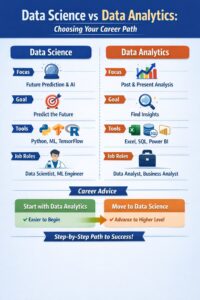
What Is Data Analytics?
Data analytics is the process of examining, cleaning, transforming and interpreting data to discover useful information and support decision-making.
According to Wikipedia’s explanation of data analysis, data analysis involves working with data to discover useful information, draw conclusions and support decisions.
In practical terms, a data analyst takes raw information and tries to answer questions that matter.
For example, imagine a business in Port Harcourt has recorded thousands of sales transactions over three years.
Management might want to know:
- Which products generate the most revenue?
- Which products are declining in popularity?
- Which months produce the highest sales?
- Which customer groups purchase most frequently?
- Which locations generate the most orders?
- Did a recent price increase affect sales?
- Which marketing campaigns produced the most conversions?
A data analyst can use tools such as Excel, SQL, Power BI, Tableau or Python to investigate these questions.
The result may be a report, dashboard, analysis or set of recommendations that helps the organisation make better decisions.
What Does a Data Analyst Do?
A typical data analyst workflow may look like this:
Business question → Data collection → Data cleaning → Analysis → Visualization → Insight → Recommendation
For example:
A Nigerian retail company notices that revenue has fallen.
The analyst may collect sales data, remove duplicate records, investigate missing values, group sales by product and location, compare periods and build a dashboard.
The final result might reveal that revenue has not fallen across the entire business. Instead, a particular product category has experienced a significant decline.
That finding gives management a much more useful starting point for investigating the problem.
What Is Data Science?
Data science is a broader, interdisciplinary field that combines data analysis, statistics, programming, scientific methods, algorithms and machine learning to extract knowledge and insights from data.
Wikipedia describes data science as an interdisciplinary field that uses scientific methods, processes, algorithms and systems to extract knowledge and insights from data.
Data science can involve structured data such as spreadsheets and database records, but it can also involve more complex or unstructured information such as text, images and other forms of data.
A data scientist may ask questions that go beyond describing historical performance.
For example:
- Can we predict next month’s sales?
- Which customers are likely to stop using our service?
- Can we automatically detect unusual transactions?
- Can we predict demand for a product?
- Can we classify documents automatically?
- Can a machine-learning model identify patterns that humans may overlook?
This is where programming, statistics, machine learning and mathematical modelling become particularly important.
Data Analytics vs Data Science: What Is the Difference?
The most useful way to understand Data Analytics vs Data Science is to compare the problems each discipline commonly addresses.
Data analytics often asks:
What happened?
Why did it happen?
What does the data tell us?
What should the organisation know before making a decision?
Data science may ask:
What is likely to happen next?
Can we predict an outcome?
Can we automate part of this decision?
Can we build a model that recognises patterns in new data?
These are not absolute rules.
A data analyst can perform predictive analysis, and a data scientist can perform descriptive analysis. The difference is better understood as a difference in scope, typical responsibilities and technical depth rather than a rigid boundary.
Data Analytics vs Data Science at a Glance
| Area | Data Analytics | Data Science |
|---|---|---|
| Main focus | Understanding data and generating insights | Extracting insights, modelling and prediction |
| Common questions | What happened? Why? | What may happen? Can we predict it? |
| Typical tools | Excel, SQL, Power BI, Tableau | Python, SQL, R, machine-learning libraries |
| Statistics | Important | Very important |
| Programming | Useful to important | Usually central |
| Data visualization | Frequently important | Important |
| Machine learning | May be optional depending on role | Common in many roles |
| Business communication | Very important | Very important |
| Mathematical depth | Usually moderate | Often greater |
| Portfolio projects | Dashboards and analysis | Models, experiments and applications |
| Typical entry point | Often accessible to beginners | Usually requires broader technical foundations |
The table is a general guide rather than a universal rule because employers use job titles and responsibilities differently.
Data Analyst vs Data Scientist: A Real-World Example
Imagine a Nigerian e-commerce company has five years of customer and sales information.
The company wants to improve its business performance.
What might the data analyst do?
The data analyst could investigate:
- Total revenue by month
- Best-selling products
- Average order value
- Customer acquisition trends
- Sales by location
- Repeat customer rates
- Marketing campaign performance
They could use SQL to query the company’s database, Excel to investigate specific datasets and Power BI to create an interactive management dashboard.
The final question could be:
“What happened to our sales, and what patterns should management know about?”
What might the data scientist do?
The data scientist might use some of the same information to develop predictive models.
For example:
“Which customers are most likely to make another purchase within the next 30 days?”
Or:
“How much demand should we expect for each product next month?”
This could require:
- Python
- Data preparation
- Feature engineering
- Statistics
- Machine learning
- Model training
- Model evaluation
- Experimentation
The data scientist is not simply producing a report. They may be developing a model that can be applied to new data.
The Relationship Between Data Analytics and Data Science
One reason people find Data Analytics vs Data Science confusing is that the fields are connected.
Data science does not exist completely separately from data analytics.
A data scientist may need to:
- Collect data
- Clean data
- Explore the data
- Visualize the data
- Identify patterns
- Build a statistical or machine-learning model
- Evaluate the model
- Communicate the results
Several of these activities are also part of data analytics.
This means the skills you learn in data analytics can become useful foundations for more advanced data science work.
Rather than thinking of the fields as two completely separate worlds, it is often more helpful to think of them as overlapping areas within the wider data ecosystem.
Data Analytics vs Data Science: Differences in Daily Work
Another useful way to compare the careers is to imagine a typical working day.
A Data Analyst’s Day
A data analyst might spend the morning responding to a request from the sales team.
The team wants to understand why revenue changed during the previous quarter.
The analyst could:
- Query the database using SQL
- Clean the extracted dataset
- Calculate important metrics
- Compare periods
- Segment customers
- Create charts
- Build a dashboard
- Present findings to stakeholders
Later, the analyst might receive another request from the finance or marketing department.
This means communication and understanding business requirements can be just as important as technical skills.
A Data Scientist’s Day
A data scientist might spend part of the day preparing a dataset for a machine-learning experiment.
They could:
- Explore the dataset
- Engineer useful features
- Select a modelling approach
- Train a model
- Test its performance
- Compare different approaches
- Investigate errors
- Document the experiment
A data scientist may also collaborate with software engineers, product teams, analysts and business stakeholders.
The work can involve more experimentation because the desired result is not always known in advance.
Data Analytics vs Data Science: Which Requires More Programming?
Generally, data science requires more programming depth.
Data analysts can certainly use Python, R and other programming tools, but many analytics roles can be performed primarily using SQL, spreadsheets and business-intelligence platforms.
For data scientists, programming is usually a core part of the job.
Python is particularly common in modern data science workflows.
A learner moving toward data science should become comfortable with:
- Python fundamentals
- Functions
- Data structures
- File handling
- Libraries
- pandas
- NumPy
- Data visualization
- Machine-learning libraries
Programming is not simply about writing code.
It gives data professionals the ability to automate repetitive work, manipulate larger datasets and build analytical solutions.
Data Analytics vs Data Science: Which Requires More Mathematics?
Mathematics and statistics are important in both fields, but the depth can differ.
Data analytics commonly requires knowledge of:
- Percentages
- Mean and median
- Probability basics
- Variability
- Correlation
- Descriptive statistics
- Basic statistical reasoning
Data science may require deeper understanding of:
- Probability
- Statistical inference
- Regression
- Linear algebra
- Calculus
- Optimization
- Statistical modelling
- Machine-learning concepts
You do not need to be a mathematics expert before beginning a data career.
However, if you are interested in data science, becoming increasingly comfortable with mathematics and statistics will help you understand why models work, not just how to run them.
Data Analytics vs Data Science: Which Tools Should You Learn?
Tools should follow the problem rather than become the goal.
Common Data Analytics Tools
Excel
Useful for:
- Spreadsheet analysis
- Formulas
- Pivot tables
- Data cleaning
- Quick calculations
- Basic visualization
SQL
SQL is essential for working with relational databases.
Important concepts include:
- SELECT
- WHERE
- GROUP BY
- ORDER BY
- JOIN
- CASE
- Subqueries
- Common table expressions
- Window functions
Power BI
Power BI can be used to transform data and build interactive reports and dashboards.
Tableau
Tableau is another widely used data visualization and business-intelligence platform.
Python
Python becomes increasingly useful when analytics work requires automation, advanced analysis or larger-scale data manipulation.
Common Data Science Tools
Data science frequently involves:
- Python
- SQL
- pandas
- NumPy
- Matplotlib
- Scikit-learn
- Jupyter
- R
- Machine-learning frameworks
Again, you do not need to learn everything simultaneously.
A structured progression is more effective.
Data Analytics vs Data Science: Which Career Is Easier for Beginners?
For many beginners, data analytics provides a more approachable starting point.
That is partly because you can begin with relatively accessible concepts:
Excel → Data cleaning → Basic statistics → SQL → Visualization → Business analysis
You can then introduce Python and more advanced techniques.
Data science typically has a wider technical foundation:
Programming → Statistics → Mathematics → Data manipulation → Machine learning → Model evaluation
This does not mean that data analytics is easy or that data science is only for people with advanced degrees.
It means the learning curves are different.
A motivated learner can develop either skill set through consistent practice.
Can You Start With Data Analytics and Move Into Data Science?
Yes.
This is one of the most practical answers to the Data Analytics vs Data Science question.
Suppose you start by learning:
- Excel
- SQL
- Power BI
- Data visualization
- Statistics
You then become interested in Python.
You learn:
- Python programming
- pandas
- NumPy
- Statistics
- Machine learning
- Model evaluation
You can gradually move toward more advanced data science responsibilities.
Your analytics experience can be useful because you already understand how to work with data and communicate findings.
The transition still requires serious learning. Knowing how to build a dashboard does not automatically make someone a data scientist.
But there is a logical progression between the fields.
Can a Data Scientist Become a Data Analyst?
Absolutely.
The relationship works in both directions.
A data scientist generally has many of the technical foundations required for analytics.
However, being a good data analyst involves more than technical knowledge.
A strong analyst needs to understand:
- Business questions
- Stakeholder requirements
- Data quality
- Communication
- Visualization
- Decision-making
A technically advanced professional still needs to explain findings clearly.
Data Analytics vs Data Science: Career Paths
Possible Data Analytics Roles
Depending on experience and employer requirements, related roles can include:
- Data Analyst
- Business Analyst
- Business Intelligence Analyst
- Reporting Analyst
- Marketing Analyst
- Operations Analyst
- Financial Analyst
- Product Analyst
The responsibilities of these roles can overlap.
Possible Data Science Roles
Related roles can include:
- Data Scientist
- Machine Learning Scientist
- Machine Learning Engineer
- Applied Scientist
- Research-oriented data roles
- Predictive analytics roles
Again, job titles vary significantly between organisations.
Always read the actual job description rather than choosing a career solely based on the title.
Data Analytics vs Data Science in Nigeria
The comparison becomes especially useful for Nigerian learners because data skills can be applied across many industries.
Organisations in Nigeria generate information through:
- Banking transactions
- Telecommunications
- E-commerce
- Logistics
- Education
- Healthcare
- Energy
- Agriculture
- Marketing
- Retail
- Technology products
- Public services
Consider a logistics company operating across several Nigerian cities.
It may collect information about:
- Delivery locations
- Delivery times
- Customer orders
- Vehicle usage
- Failed deliveries
- Fuel consumption
- Driver performance
A data analyst could identify where delivery delays occur most frequently.
A data scientist could potentially develop a model to forecast delivery demand or predict potential delays.
Both professionals contribute value, but their responsibilities are different.
Data Analytics vs Data Science in Port Harcourt
Port Harcourt provides an interesting environment for developing practical data skills because the city has businesses and organisations operating across areas such as energy, services, commerce, education, logistics and technology.
Imagine a business serving customers in different parts of Port Harcourt.
The business may want to understand:
- Which areas generate the most orders?
- What times produce the highest demand?
- Which products sell together?
- How frequently do customers return?
- Which delivery routes experience delays?
A data analyst could turn the company’s historical information into dashboards and reports.
A data scientist could potentially use the same data to build predictive models.
This illustrates an important point:
The difference between data analytics and data science is not simply the industry. It is the type and depth of problem being solved.
Which One Should You Learn First?
If you are completely new to technology and unsure about Data Analytics vs Data Science, beginning with data analytics can be a sensible option.
A possible learning path is:
1. Data Fundamentals
Learn:
- What data is
- Structured vs unstructured data
- Data types
- Data quality
- Basic statistics
2. Excel
Learn:
- Formulas
- Functions
- Pivot tables
- Charts
- Data cleaning
3. SQL
Learn:
- Queries
- Filtering
- Aggregation
- Joins
- Subqueries
4. Data Visualization
Learn how to create meaningful dashboards using tools such as Power BI.
5. Python
Learn Python fundamentals and data-manipulation libraries.
6. Advanced Analytics or Data Science
If you enjoy programming, mathematics and predictive modelling, begin exploring:
- Machine learning
- Regression
- Classification
- Clustering
- Forecasting
- Model evaluation
This approach lets you discover your interests through practice.
How to Know If Data Analytics Is Right for You
Data analytics may be a good fit if you enjoy:
- Finding patterns
- Working with numbers
- Asking business questions
- Creating dashboards
- Explaining information
- Working with SQL
- Making reports more useful
- Helping organisations make evidence-based decisions
You might enjoy asking:
“What does the data tell us?”
How to Know If Data Science Is Right for You
Data science may be a good fit if you enjoy:
- Programming
- Mathematics
- Statistics
- Experimentation
- Machine learning
- Predictive modelling
- Algorithms
- Solving complex technical problems
You might enjoy asking:
“What can we predict or build from this data?”
What If You Like Both?
That is actually a good position to be in.
You do not have to choose immediately.
Start by learning common foundations such as:
- Data literacy
- Statistics
- SQL
- Data visualization
- Python
Then experiment with both analytical and predictive projects.
For example, you could begin with a sales dataset.
Analytics project
Build a dashboard answering:
Which products, locations and months generated the most revenue?
Data science project
Use the same or a suitable dataset to explore:
Can historical information help us forecast future sales?
Working on both projects may reveal which type of problem-solving you enjoy more.
The Best Way to Compare the Two Fields
One of the most effective ways to understand Data Analytics vs Data Science is to build projects.
Reading about the difference is useful.
Actually doing the work is better.
Data Analytics Portfolio Project
Create a fictional Nigerian retail dataset containing:
- Product
- Customer
- Location
- Date
- Quantity
- Price
- Revenue
Then:
- Clean the dataset.
- Analyse it with Excel or SQL.
- Calculate important metrics.
- Build a Power BI dashboard.
- Identify trends.
- Write a short business recommendation.
Your portfolio demonstrates that you can move from raw data to actionable insight.
Data Science Portfolio Project
Use a suitable dataset to build a predictive model.
For example, you could explore:
- Sales forecasting
- Customer classification
- Customer segmentation
- Demand prediction
- Price prediction
Document:
- The problem
- The dataset
- Data preparation
- Exploratory analysis
- Features
- Model selection
- Evaluation
- Limitations
- Results
A good portfolio project does not need to be unnecessarily complicated.
It needs to show that you understand what you are doing.
Why Practical Experience Matters
Learning a list of tools is not the same as being able to solve a problem.
Someone might know the names of SQL commands but struggle when given an unfamiliar dataset.
Another learner may know what machine learning means but be unable to explain whether a model is actually useful.
That is why practical experience matters.
A strong learning process should give you opportunities to:
- Work with real or realistic datasets
- Make mistakes
- Debug your work
- Explain your findings
- Build projects
- Receive feedback
- Improve your approach
This is particularly important for learners preparing for technology careers rather than studying only for an examination.
How Potenmunia Tech School Approaches Data Learning
For learners in Port Harcourt looking for practical technology education, Potenmunia Tech School approaches training with an emphasis on applying knowledge to real problems.
Instead of treating data skills as a collection of software tools to memorise, the learning process can connect technical concepts with practical projects and career preparation.
This approach includes several areas that matter when learning data-related skills.
Hands-On Learning
Learners get opportunities to practise concepts rather than relying entirely on lectures or theoretical explanations.
Real-World Projects
Projects can help learners understand how data skills apply to business and technology problems outside the classroom.
Portfolio Development
Completing projects gives learners material they can use to demonstrate practical ability.
A portfolio might include:
- SQL analysis
- Excel analysis
- Power BI dashboards
- Python notebooks
- Data visualizations
- Machine-learning experiments
Mentorship
Guidance can help learners understand not only technical concepts but also how to approach problems and improve their work.
Career and Job Readiness
Technical knowledge is only one part of becoming employable.
Learners also need to develop communication, problem-solving, project presentation and professional habits.
AI and Future Skills
Data and artificial intelligence increasingly intersect.
Understanding how AI tools, automation and machine learning affect data workflows can help learners prepare for changing technology environments.
Innovation and Entrepreneurship
Data skills are not limited to traditional employment.
Someone with strong analytical skills can use data to identify business opportunities, understand customers, improve operations or develop technology products.
The objective should ultimately be competence: being able to take a problem, work with data, produce a useful result and explain the reasoning behind it.
Data Analytics vs Data Science: Common Mistakes Beginners Make
1. Choosing Based Only on Salary
Salary can matter, but it should not be the only reason you choose a career.
Consider:
- Your interests
- Learning requirements
- Work style
- Career goals
- Technical strengths
- Long-term development
2. Trying to Learn Everything at Once
You do not need Excel, SQL, Python, R, Power BI, Tableau, machine learning and cloud technologies simultaneously.
Start with a foundation and progress logically.
3. Collecting Certificates Without Projects
Certificates can demonstrate learning, but projects demonstrate application.
Build things.
Analyse datasets.
Explain your findings.
4. Thinking Tools Are the Career
Knowing Power BI does not automatically make someone a good analyst.
Knowing Python does not automatically make someone a good data scientist.
The real skill is problem-solving with data.
5. Ignoring Communication
A brilliant analysis that nobody understands has limited practical value.
Learn to explain:
What did you discover?
Why does it matter?
What evidence supports the conclusion?
What should happen next?
Data Analytics vs Data Science: Frequently Asked Questions
What is the main difference between data analytics and data science?
Data analytics focuses heavily on examining data, identifying patterns, generating insights and supporting decisions.
Data science is broader and often incorporates programming, statistics, machine learning and predictive modelling to solve more complex data problems.
There is substantial overlap between the fields.
Is data analytics part of data science?
Data analysis is an important component of data science. Data science can involve data collection, preparation, analysis, visualization, statistical modelling and machine learning.
Is data science harder than data analytics?
For many learners, data science has a steeper learning curve because it can require stronger programming, mathematics, statistics and machine-learning skills.
That does not mean data analytics is easy. Professional analytics also requires strong technical, analytical and communication abilities.
Should I learn data analytics before data science?
Not necessarily, but it can be a practical route for beginners.
Learning analytics can give you experience with data cleaning, SQL, statistics and visualization before you move into Python and machine learning.
Can I become a data analyst without Python?
Yes.
Many analytics roles rely heavily on tools such as Excel, SQL and Power BI.
However, Python can expand your capabilities and is worth learning as your skills develop.
Can a data analyst become a data scientist?
Yes.
A data analyst can progress toward data science by developing stronger programming, statistics, mathematics and machine-learning skills.
Does a data scientist need SQL?
SQL is highly useful because organisations commonly store information in databases.
A data scientist may need SQL to retrieve, combine and prepare data before analysing or modelling it.
Which has more mathematics: data analytics or data science?
Data science generally requires greater mathematical and statistical depth, especially when working with machine-learning models.
Data analytics still requires statistical reasoning, but the mathematical requirements vary considerably by role.
Which is better for beginners in Nigeria?
There is no single answer.
If you enjoy dashboards, SQL, business questions and communicating insights, data analytics may be a good starting point.
If you already enjoy programming, statistics and mathematical problem-solving, you may want to explore data science.
Is data analytics a good career in Nigeria?
Data analytics can be applied across many industries in Nigeria, including finance, telecommunications, retail, logistics, education, healthcare, energy and technology.
Your career opportunities will depend on your actual skills, experience, portfolio, communication ability and the requirements of individual employers.
Where can I learn data analytics in Port Harcourt?
Learners in Port Harcourt can look for training that combines data fundamentals with practical exercises, projects, portfolio development and career preparation.
Potenmunia Tech School provides a practical technology-learning environment for learners interested in developing career-focused digital and data skills.
Conclusion
So, Data Analytics vs Data Science — which career is right for you?
The answer depends on the kind of problems you want to solve.
Choose data analytics if you are interested in:
- SQL
- Excel
- Dashboards
- Business intelligence
- Data visualization
- Finding patterns
- Explaining what happened
- Supporting business decisions
Explore data science if you are interested in:
- Python
- Statistics
- Mathematics
- Machine learning
- Predictive modelling
- Algorithms
- Programming
- Building data-driven systems
But remember that the boundary is not absolute.
Data analysts can use Python and predictive techniques. Data scientists perform data analysis. Some professionals move between the fields, and organisations define roles differently.
The most important thing is not choosing the more impressive title.
It is developing the ability to solve meaningful problems with data.
For someone beginning a technology career in Port Harcourt or Nigeria, a practical path can start with data fundamentals, Excel, SQL and visualization before progressing into Python, statistics and machine learning.
If you are considering structured training, Potenmunia Tech School offers a practical, career-focused environment where learners can develop technical skills through hands-on work, projects, portfolio building and mentorship.
You do not need to know exactly where your data career will end before you begin.
Start by learning how data works.
Build something.
Analyse a real problem.
Create a project.
Then let your experience help you decide whether data analytics, data science or another technology path is the right direction for you.
If you are wondering how to become a data analyst without a degree, you do not necessarily need a computer science degree to begin developing the practical skills required for data analytics. You can build a data analyst career through structured learning, practical experience, projects, mentorship and consistent practice.
Data analysis involves examining, cleaning, transforming and modelling data to discover useful information, draw conclusions and support decision-making.
This makes data analytics an attractive career path for people from different educational backgrounds. You may have studied business, accounting, economics, engineering, social sciences or another subject—or you may be changing careers entirely.
The key question is not simply whether you have a computer science degree. The more important question is:
Can you demonstrate that you know how to work with data, solve analytical problems, and communicate useful insights?
This guide explains how to become a data analyst without a degree, the skills to learn, the tools to master, the projects to build, and how to prepare for data analyst opportunities in Nigeria and beyond.
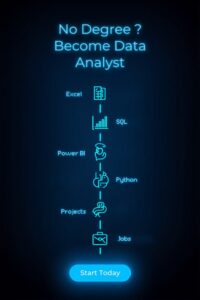
Can You Become a Data Analyst Without a Degree?
Yes, you can learn the skills required for data analytics without completing a computer science degree.
However, this does not mean qualifications never matter. Some employers have specific educational requirements, while others may place greater emphasis on relevant technical skills, experience and demonstrated ability.
If you want to understand how to become a data analyst without a degree, focus on building evidence of your ability.
You should eventually be able to demonstrate that you can:
- Work with spreadsheets
- Clean and organise datasets
- Write SQL queries
- Analyse trends and patterns
- Build dashboards
- Apply basic statistics
- Use data visualization tools
- Explain analytical findings
- Answer business questions using data
- Present projects in a professional portfolio
This practical evidence can make your career transition more credible.
What Does a Data Analyst Do?
A data analyst works with data to help organisations understand what is happening and make better decisions.
A typical analysis may involve:
- Understanding a business problem
- Collecting or accessing relevant data
- Cleaning the data
- Exploring the dataset
- Identifying trends and patterns
- Creating visualisations
- Communicating findings
- Recommending possible actions
For example, imagine a retail business in Port Harcourt wants to understand why monthly revenue has fallen.
A data analyst might investigate:
- Monthly revenue
- Product categories
- Customer purchases
- Branch performance
- Sales volume
- Average order value
- Customer retention
The analyst could then create a dashboard showing where the decline occurred and provide evidence that management can use to investigate the problem.
That is why learning how to become a data analyst without a degree should involve much more than learning software commands. You need to learn how to think analytically.
Why Data Analytics Is Accessible to People From Different Backgrounds
Data analysis is used across many fields.
Businesses, government organisations, financial institutions, healthcare organisations, retailers, technology companies and other industries use data to understand performance and make decisions.
You therefore do not have to start with a computer science background.
Someone who studied accounting may already understand financial information.
Someone with a business background may understand business processes.
Someone from economics may already have experience interpreting quantitative information.
Someone from another field can learn the technical tools needed to work with data.
Your previous experience can become an advantage when combined with data analytics skills.
How to Become a Data Analyst Without a Degree: The Complete Roadmap
If you are serious about learning how to become a data analyst without a degree, follow a structured progression instead of trying to learn every technology at the same time.
A practical roadmap is:
Computer and data fundamentals → Excel → SQL → Statistics → Power BI → Python → Projects → Portfolio → Interview preparation → Job applications
Let’s examine each stage.
1. Understand Data Analytics Fundamentals
Before learning advanced tools, understand what data analytics actually involves.
Start with concepts such as:
- Data
- Variables
- Rows and columns
- Structured data
- Data cleaning
- Data transformation
- Data visualization
- Descriptive statistics
- KPIs
- Business questions
- Data-driven decision-making
Understanding these concepts makes it easier to learn the tools later.
Data analysis is broader than simply creating charts. It involves turning raw information into useful insights.
2. Learn Excel for Data Analysis
Excel is a practical starting point for many aspiring data analysts.
You should learn:
- Basic formulas
- SUM
- AVERAGE
- COUNT
- COUNTA
- COUNTBLANK
- IF
- SUMIF
- COUNTIF
- XLOOKUP
- Sorting
- Filtering
- Conditional formatting
- Data cleaning
- Pivot tables
- Charts
- Dashboards
Do not only watch Excel tutorials.
Practise with datasets.
For example, create a fictional sales dataset containing:
- Customer
- Product
- Quantity
- Price
- Date
- Location
- Sales representative
Then calculate revenue and investigate which products and locations perform best.
This changes Excel from something you are simply learning into a tool you are actually using.
3. Learn SQL
SQL is an important skill for aspiring data analysts because organisations frequently store information in databases.
Start with:
- SELECT
- FROM
- WHERE
- ORDER BY
- GROUP BY
- HAVING
- Aggregate functions
- CASE statements
- JOINs
- Subqueries
- Common table expressions
Practise answering questions such as:
- Which products generated the most revenue?
- Which customers purchased most frequently?
- Which month had the highest sales?
- Which branches performed below target?
- What percentage of customers returned?
When learning how to become a data analyst without a degree, don’t focus on memorising SQL syntax without understanding why you are using it.
Instead, begin with a question and use SQL to answer it.
4. Learn Basic Statistics
Statistics provides a foundation for interpreting data.
You should understand:
- Mean
- Median
- Mode
- Range
- Percentages
- Variance
- Standard deviation
- Correlation
- Probability basics
- Sampling
Statistics is concerned with collecting, organising, analysing, interpreting and presenting data.
You don’t need to become an advanced statistician before starting a data analyst career.
Instead, learn enough statistics to interpret datasets responsibly and communicate findings accurately.
5. Learn Power BI or Another Visualization Tool
After building a foundation with Excel and SQL, learn a business intelligence and visualization platform.
Power BI can help you:
- Import datasets
- Transform data
- Create relationships
- Build calculations
- Design charts
- Create interactive dashboards
- Present business KPIs
A good beginner project could be a sales dashboard containing:
- Total revenue
- Total orders
- Average order value
- Monthly revenue
- Sales by location
- Sales by product
- Top customers
The objective isn’t to make the dashboard look impressive just for appearance.
The objective is to help someone understand the business.
6. Learn Python for Data Analysis
Python can be added after you understand the fundamentals.
You don’t need to become a software engineer before using Python for data analysis.
Start with:
- Variables
- Lists
- Dictionaries
- Functions
- Loops
- Conditions
- Pandas
- NumPy
- Data cleaning
- Data visualization
Pandas is particularly useful for manipulating and analysing datasets.
Python becomes increasingly useful when you want to automate repetitive analytical tasks or work with larger and more complex datasets.
7. Learn to Ask Better Questions
One of the biggest differences between someone who knows analytical tools and someone who thinks like a data analyst is the ability to ask useful questions.
Instead of asking:
“What does the dataset contain?”
ask:
“What does this dataset tell us about business performance?”
Instead of:
“Can I create a chart?”
ask:
“Which visualization will make this trend easiest for a decision-maker to understand?”
Instead of:
“What is the average sales value?”
ask:
“Why is average sales value changing, and what factors might explain the change?”
This analytical mindset is essential when learning how to become a data analyst without a degree.
8. Build Real Data Analyst Projects
Projects are one of the most important ways to demonstrate your skills.
Instead of simply listing:
Excel, SQL, Power BI and Python
on your CV, show what you have done with them.
1. Sales Analysis
Analyse sales transactions and identify:
- Revenue trends
- Top products
- Regional performance
- Monthly performance
- Average order value
2. Customer Analysis
Analyse customer behaviour.
Investigate:
- Repeat purchases
- Customer segments
- Average spending
- Purchase frequency
3. Employee Analysis
Create an employee dataset and analyse:
- Departments
- Employee tenure
- Salaries
- Turnover
- Workforce distribution
4. Nigerian Business Analysis
Build a project around a realistic Nigerian business scenario.
For example:
“Sales Performance Analysis for a Retail Business in Port Harcourt.”
You could analyse:
- Sales by location
- Product demand
- Monthly revenue
- Customer behaviour
- Sales targets
This gives your portfolio a local business context.
5. SQL Business Analysis
Create a relational database and answer 15–20 business questions using SQL.
Document:
- The question
- SQL query
- Result
- Interpretation
- Recommendation
This demonstrates more than memorisation.
It demonstrates problem-solving.
9. Create a Strong Data Analyst Portfolio
A portfolio is particularly useful when you’re learning how to become a data analyst without a degree because it gives employers something tangible to evaluate.
For each project, include:
Business Problem
What problem were you trying to solve?
Dataset
Where did the data come from?
Tools
Did you use:
- Excel?
- SQL?
- Power BI?
- Python?
Data Cleaning
What problems did you find in the dataset?
Analysis
What did you investigate?
Findings
What patterns did you discover?
Recommendations
What could a business potentially do based on your findings?
A strong portfolio tells a story.
It should not simply be a collection of screenshots.
10. Build Your CV Around Skills and Evidence
If you don’t have professional data analyst experience yet, your CV should still demonstrate practical ability.
Include:
- Technical skills
- Projects
- Previous work experience
- Education
- Relevant certifications
- Portfolio
- LinkedIn profile
For example, instead of:
“Good knowledge of Power BI.”
write something more specific:
“Created an interactive Power BI sales dashboard analysing revenue, product performance and regional trends.”
Specific evidence is stronger than vague claims.
11. Prepare for Data Analyst Interviews
Interview preparation is another important part of learning how to become a data analyst without a degree.
Prepare for questions about:
- Excel
- SQL
- Statistics
- Power BI
- Data cleaning
- Data visualization
- Business analysis
- Your projects
- Problem-solving
You should also practise explaining your projects.
An interviewer might ask:
“Tell me about a data project you completed.”
A strong response should explain:
- The problem
- The dataset
- Your process
- The tools you used
- Your findings
- The recommendations
Don’t memorise a complicated answer.
Understand your project well enough to explain it naturally.
12. Start Applying for Entry-Level Opportunities
Once you have developed a reasonable foundation, begin looking for relevant opportunities.
Potential job titles include:
- Junior Data Analyst
- Data Analyst Intern
- Reporting Analyst
- Business Intelligence Intern
- Junior Business Analyst
- Operations Analyst
- Data Assistant
Job titles differ between organisations, so don’t search using only one phrase.
When applying, customise your CV where appropriate and make your portfolio easy to access.
How to Become a Data Analyst Without a Degree in Nigeria
For Nigerian learners, the learning process can be adapted to local business situations.
A learner in Port Harcourt, for example, could create analytical projects based on fictional businesses involving:
- Retail
- Logistics
- Restaurants
- E-commerce
- Education
- Telecommunications
- Financial services
You don’t need access to a multinational company’s confidential database to practise.
A realistic simulated dataset can still help you practise the analytical process.
For example:
Port Harcourt Retail Sales Dashboard
You could create a dataset with:
- Customer ID
- Product
- Quantity
- Price
- Date
- Branch
- Salesperson
Then use Excel or Power BI to investigate:
- Which branch generates the highest revenue?
- Which products sell most?
- Which months perform best?
- Which products have declining sales?
- What percentage of total revenue comes from the top products?
This approach makes your learning practical.
Can You Get Remote Data Analyst Jobs Without a Degree?
It is possible to apply for remote data-related opportunities without a computer science degree, but remote positions can be competitive.
Your focus should therefore be on becoming genuinely useful.
Develop:
- Excel skills
- SQL skills
- Visualization skills
- Analytical thinking
- Communication
- Portfolio projects
- Interview skills
Don’t make “remote” the only goal.
First become capable of doing the work.
Then you can explore opportunities that match your skills and circumstances.
How Long Does It Take to Become a Data Analyst Without a Degree?
There is no fixed amount of time.
Your timeline depends on:
- Your current computer knowledge
- Your study schedule
- Learning resources
- Practice frequency
- Mentorship
- Project complexity
- Previous professional experience
A learner who studies consistently and works on practical projects will generally progress differently from someone who watches a tutorial occasionally.
Instead of asking only:
“How many months will it take?”
ask:
“Can I independently complete a realistic data analysis project?”
That is a more useful measure of progress.
How Potenmunia Tech School Approaches Data Analytics Training
For learners who prefer structured guidance, Potenmunia Tech School in Port Harcourt takes a practical approach to technology training.
One aspect of its approach is one-on-one learning with a dedicated personal instructor. This gives learners an opportunity to receive individual feedback and work through difficult concepts according to their learning pace.
The training is also built around practical, session-based learning. For aspiring data analysts, this can mean spending learning time applying concepts rather than simply listening to theoretical explanations.
For example, a learner might work through an Excel dataset, write SQL queries, build a Power BI dashboard and then explain the findings.
Career preparation is also incorporated into the learning journey through areas such as:
- CV development
- Portfolio building
- Interview preparation
- Job application support
- Mentorship
This is relevant because learning how to become a data analyst without a degree involves more than learning technical software.
You also need to learn how to demonstrate your skills.
A learner who can show a portfolio, explain their analytical decisions and confidently discuss their projects is in a stronger position to demonstrate competence during an application or interview.
Potenmunia also provides both one-on-one and cohort learning paths, giving learners different ways to approach practical technology training.
Common Mistakes When Learning How to Become a Data Analyst Without a Degree
Learning Too Many Tools
Don’t attempt to learn every data technology simultaneously.
A practical beginner sequence is:
Excel → SQL → Power BI → Python
Build competence before adding more tools.
Watching Tutorials Without Practising
Tutorials can introduce concepts, but practice develops ability.
After learning something, use it.
Collecting Certificates Without Building Projects
Certificates can be useful, but they don’t replace practical evidence.
Build projects alongside your learning.
Copying Portfolio Projects
If you copy a project exactly from a tutorial, you may struggle when someone asks you to explain it.
Change the questions.
Change the dataset.
Develop your own conclusions.
Ignoring Data Cleaning
Real-world datasets can contain:
- Missing values
- Duplicates
- Incorrect formats
- Inconsistent categories
- Incorrect data types
Learn to identify and handle these problems.
Ignoring Communication Skills
Data analysts don’t work with numbers alone.
They communicate with managers, business teams, clients and other stakeholders.
Learn to explain complicated findings in simple language.
A Practical Data Analyst Roadmap Without a Degree
Here is a simple roadmap you can follow:
1. Foundations
Learn:
- Computer basics
- Data concepts
- Analytical thinking
2. Excel
Learn:
- Formulas
- Data cleaning
- Pivot tables
- Charts
- Dashboards
3. SQL
Learn:
- Queries
- Filtering
- Aggregations
- Joins
- Subqueries
4. Statistics
Learn:
- Mean
- Median
- Percentages
- Variability
- Correlation
- Sampling
5. Power BI
Learn:
- Data transformation
- Relationships
- Visualizations
- Dashboards
- Basic DAX
6. Python
Learn:
- Python fundamentals
- Pandas
- NumPy
- Data cleaning
- Visualization
7. Projects
Build three to five strong projects.
8. Portfolio
Document your projects professionally.
9. Career Preparation
Prepare:
- CV
- Portfolio
- Interview answers
10. Applications
Begin applying for suitable internships, junior roles and data-related opportunities.
What Matters Most When Becoming a Data Analyst Without a Degree?
If you remember only five things from this guide on how to become a data analyst without a degree, remember these:
1. Learn the fundamentals
Don’t rush into advanced tools without understanding data.
2. Build technical skills
Focus on practical tools such as Excel, SQL, Power BI and eventually Python.
3. Build projects
Projects provide evidence that you can apply what you have learned.
4. Build a portfolio
Make your work easy for employers or clients to review.
5. Learn to communicate
A data analyst must be able to explain what the numbers mean.
Conclusion on How to Become a Data Analyst Without a Degree
Learning how to become a data analyst without a degree is not about finding an easy shortcut around education.
It is about choosing a practical route to develop valuable skills.
You can begin with Excel, move into SQL, learn Power BI, develop your statistical knowledge, add Python and build projects that demonstrate your ability.
Your background does not have to be computer science.
What matters is the combination of technical competence, analytical thinking, practical experience, communication and career readiness.
For learners in Port Harcourt and across Nigeria, this pathway can provide a structured starting point for entering the broader technology and data ecosystem.
If you prefer guided learning, practical projects and instructor feedback, a structured data analytics programme can help you stay accountable and develop your skills systematically.
For additional background reading, you can explore Wikipedia and its resources on data analysis, data science and related subjects. Wikipedia’s data analysis overview explains how data analysis involves processes such as inspecting, cleansing, transforming and modelling data to support useful conclusions and decisions.
The most important step is to start practising.
You don’t need to know everything before beginning.
Start with one dataset, one question and one analytical tool—and gradually build from there.
Frequently Asked Questions
Can I become a data analyst without a degree?
Yes. You can develop data analytics skills through structured learning, practical projects, mentorship and consistent practice. However, individual employers may have different educational requirements.
Can I become a data analyst without a computer science degree?
Yes. Data analytics can be learned by people from many educational backgrounds. Excel, SQL, Power BI, statistics and Python can form a strong technical foundation.
What is the easiest way to become a data analyst without a degree?
There is no guaranteed shortcut. A practical approach is to learn Excel, SQL and a visualization tool, build several realistic projects, create a portfolio and prepare for interviews.
What should I learn first?
For many beginners, Excel and basic data concepts are a good starting point. You can then progress to SQL, Power BI, statistics and Python.
Is SQL important for data analysts?
Yes. SQL is widely used to retrieve and analyse information stored in relational databases, making it an important skill for many data analyst roles.
Do I need Python to become a data analyst?
Not necessarily at the beginning. You can develop a strong foundation with Excel, SQL and visualization tools before adding Python.
How many projects should I put in my portfolio?
Three to five well-documented projects can be a useful starting point. Focus on quality, originality and your ability to explain the analysis.
Can I become a data analyst in Nigeria without a degree?
It depends on the requirements of individual employers. Some organisations may require degrees, while others may focus more heavily on relevant skills, experience and demonstrated competence.
Can I work remotely as a data analyst without a degree?
You can apply for remote opportunities, although competition can be significant. Focus on developing strong technical skills, communication, a portfolio and interview readiness.
Is data analytics difficult to learn?
There is a learning curve because you need to combine technical tools, statistics, analytical thinking and communication. Breaking the learning process into stages can make it more manageable.
Is a certificate enough to become a data analyst?
A certificate alone does not demonstrate every practical skill required for the job. Combine training with projects, portfolio work and interview preparation.
What is more important: a degree or data analyst skills?
Both can matter depending on the employer. A degree may satisfy an educational requirement, while practical skills demonstrate what you can actually do. The strongest approach is to develop relevant skills and understand the requirements of the roles you want to pursue.
Business owners in Nigeria face the same daily stress. Too many customer messages. Invoices to write. Stock to check. Posts to create. Follow-ups to remember.
Many wonder if AI is only for big tech firms in Lagos. It is not.
Small shops in Port Harcourt now use AI to reply to customers at night. Fashion brands use it to write captions. Stores use it to track what will sell.
If you search for AI for Business in Nigeria, you want clear ideas that save time and grow sales. Not big grammar.
This article shows what AI for business means and 10 powerful ways companies in Nigeria use it today.

What Does AI for Business in Nigeria Really Mean?
AI for Business in Nigeria means using simple AI tools to do routine business tasks faster.
It is not about robots. It is about tools that handle repeat work.
For example, instead of answering “What is delivery fee to Lagos?” 30 times a day, an AI assistant answers from your price list instantly. Instead of writing invoices by hand, a system creates them with your logo.
For businesses in Nigeria, AI means less manual work, faster replies, and better decisions.
Why Are More Companies in Nigeria Using AI in 2026?
Three things make AI for Business in Nigeria urgent now.
First, customers want instant replies. If you delay on WhatsApp, they buy elsewhere. AI replies in seconds.
Second, costs are high. Staff is small. AI helps you do more with less.
Third, tools are cheap and simple. Google Sheets, free AI APIs, Zapier, and WhatsApp Business App are free to start. You do not need a large budget to use AI for Business in Nigeria.
Companies in Port Harcourt, Lagos, and Abuja use AI to compete with bigger brands.
10 Powerful Ways Companies Use AI for Business in Nigeria to Grow
Here are 10 detailed ways that flow into each other. You can start with one and add more.
1. Automatic WhatsApp Replies That Save Hours
This is the top use of AI for Business in Nigeria.
What it does: It reads incoming messages and replies instantly from your FAQ. If someone asks about delivery to Enugu, it replies with fee. If it does not know, it says an agent will reply soon.
Result: You save 3 hours daily. Customers get fast answers at night.
2. Smart Product Suggestions That Increase Sales
Many customers buy only one item because they do not know what else fits.
What it does: When a customer buys a gown, AI suggests matching shoes. It uses past sales to find patterns like “Buyers of red Ankara also buy gold earrings.”
This AI for Business in Nigeria idea grows average order value for fashion and electronics stores in Port Harcourt.
3. Auto Invoices and Receipts That Look Professional
Writing invoices by hand wastes time and looks unprofessional.
What it does: You enter name and items. System creates clean invoice with logo and sends by email automatically. It also saves record in Google Sheets.
This simple AI for Business in Nigeria project saves 30 minutes per invoice.
4. Customer Message Analysis That Shows Real Problems
You get 100 messages daily. Hard to know main complaint.
What it does: AI reads all messages and summarizes: “20 customers asked for size 14, 15 complained about late delivery.”
This AI for Business in Nigeria helps you fix real issues fast.
5. AI Content Creation for Instagram and Facebook
Daily posting is tiring.
What it does: You upload product photo and details like “blue chiffon dress size 10 for office.” AI writes three captions: professional, friendly, persuasive. You schedule them for the week.
This popular AI for Business in Nigeria use helps small brands stay active without a writer.
6. Stock Alerts and Sales Prediction
Running out of stock loses sales. Overstock ties cash.
What it does: AI checks your sales sheet. It alerts when stock is low: “Rice 5kg remaining 3 bags.” It also predicts: “White sneakers sold fast last December. Stock more.”
This practical AI for Business in Nigeria helps traders in Mile One Market manage cash.
7. Lead Sorting That Finds Serious Buyers
Not every inquiry is ready to buy.
What it does: AI reads new inquiries and sorts into hot, warm, cold. Hot means ready now. Warm means later. Cold means browsing.
This smart AI for Business in Nigeria helps you focus on hot leads first and close more sales.
8. Daily Sales Reports Sent to Your Phone
Many owners do not know daily profit until month end.
What it does: Every evening by 7 pm, you get WhatsApp summary: total sales today, best product, low stock, top question.
This daily report is one of the most loved AI for Business in Nigeria tools because it gives control.
9. Voice to Text for Meeting Notes and Orders
Many orders come by voice note on WhatsApp.
What it does: AI converts voice notes to text and extracts order details: name, product, address.
This AI for Business in Nigeria idea saves time for businesses that take many voice orders in Pidgin and English.
10. Simple Chatbots for Websites and Facebook Pages
Customers visit your website and Facebook page and ask same questions.
What it does: A small chatbot on your site answers from your FAQ and price list. It works 24 hours.
This last example of AI for Business in Nigeria ensures you never miss a lead, even when you sleep.

How Can Small Businesses in Port Harcourt Start Small With AI?
Do not try all 10 at once.
Start with one task that stresses you most. Is it WhatsApp replies? Start there.
Collect 15 common questions and answers. Build simple bot with WhatsApp Business App and free AI tool. Test for one week. Measure time saved.
Then add invoice generator. Then daily report. Small steps.
This step by step method makes AI for Business in Nigeria easy for beginners and small teams.
How Potenmunia Tech School Supports AI for Business in Nigeria
Potenmunia Tech School is a practical, career focused technology training school based in Port Harcourt. The school helps business owners and learners gain real competence in AI for Business in Nigeria through hands on work that reflects actual business needs.
At Potenmunia, learning is 100% practical and session based. Every session is built around doing, not just listening. You work on real world projects like automatic reply systems for WhatsApp, invoice generators that fill themselves, and daily sales report bots that solve daily problems for businesses in Port Harcourt and across Nigeria. This project driven approach helps you understand how AI for Business in Nigeria works in real life.
A key part of the Potenmunia experience is one on one learning with a dedicated personal instructor. Every learner is paired with an assigned instructor who guides you throughout your learning journey. Your instructor provides individualized pacing, reviews your automation flows, checks your prompts, and gives you clear feedback to help you improve. You receive mentorship beyond instruction, so you avoid common beginner mistakes and build systems that are reliable for real business use. Potenmunia offers both one on one and cohort learning paths, with the same practical and outcome driven standard applied to both.
Potenmunia also focuses on career and job readiness. Training is built around employability, not certificates alone. You receive CV and portfolio building support to help you document your AI for Business in Nigeria projects in a professional way that employers can understand. You also receive structured interview preparation to prepare you for technical and behavioral interviews, where you learn to explain how your solution saves time and cuts costs in simple language. In addition, you get job application support with practical guidance on finding opportunities, applying effectively, and positioning your skills for roles or for offering services to small businesses.
The school also reflects AI integration and future skills exposure. The tools you use reflect current practices in the industry, and the training encourages an innovation and entrepreneurship orientation for learners who want to build solutions, not just seek employment.
Frequently Asked Questions
What is AI for Business in Nigeria in simple terms?
AI for Business in Nigeria means using simple and affordable artificial intelligence tools to automate daily business tasks like replying to customer messages, creating invoices, tracking stock, and analyzing feedback. It helps companies in Nigeria save time, reduce costs, and grow sales without a large team.
How can a small business in Port Harcourt start using AI for Business in Nigeria?
Start with one repeat task that takes most of your time, like replying to WhatsApp questions. Write down 15 to 20 common questions and answers. Use free tools like Google Sheets and free tiers of AI APIs. Test your automation for one week. Then add more as you see results. This simple start makes AI for Business in Nigeria easy for small businesses.
What are the cheapest tools for AI for Business in Nigeria?
Affordable tools include Google Sheets for data, Google Colab for simple automation, free tiers of AI text APIs for replies and captions, free plans of Zapier or Make for connecting apps, and WhatsApp Business App. Many useful AI for Business in Nigeria projects can be built with these free tools, which is ideal for small businesses in Port Harcourt.
Does AI for Business in Nigeria replace staff?
No. AI for Business in Nigeria removes boring repeat tasks so staff can focus on important work like closing sales and helping serious buyers. For example, auto replies handle common questions while staff handle complex orders. It helps improve productivity.
Can AI for Business in Nigeria help me get more customers?
Yes. Fast replies stop lost sales on WhatsApp and Facebook. Smart product suggestions increase order size. Daily reports help you stock products that sell. These practical uses of AI for Business in Nigeria help small businesses in Port Harcourt and Lagos serve customers better and compete with bigger brands.
Conclusion
You do not need ten automations today. You only need one that works well and saves you time.
Look at the ten powerful ways above and pick the one that solves your biggest daily problem. Build a simple version this week. Test it with real customers in data. Check how much time you save.
When the first one works, add a second and third. That is how real growth happens with AI for Business in Nigeria. Small consistent wins lead to big results.
If you want hands on guidance with a dedicated instructor who reviews your work, supports you with portfolio building, and prepares you to explain your projects in interviews, you can explore the practical sessions at Potenmunia Tech School in Port Harcourt.
Have you ever received a fake bank alert? Have you seen a business lose its WhatsApp account to hackers? Have you heard of a company in Port Harcourt losing money because someone hacked their system?
These things happen every day in Nigeria.
Cybersecurity is the skill that stops them.
If you are searching for cybersecurity school in Port Harcourt, you are looking for a place to learn how to protect systems, data, and people from online attacks. You want to learn in simple language. You want practical skills. You want a skill that can give you a job in Nigeria or remote work abroad.
This guide explains everything a novice needs to know. What cybersecurity is. Why it matters in Port Harcourt. What you will learn in a cybersecurity school in Port Harcourt. How to choose the best school. What careers you can do after.
It is written in simple English. Short sentences. No big grammar. Professional and easy to read.
For background, computer security, also called cybersecurity, is the protection of computer systems and information from harm, theft, and unauthorized use. You can learn more here: https://en.wikipedia.org/wiki/Computer_security

What Is Cybersecurity?
Cybersecurity means protecting computers, phones, networks, and data from bad people.
Think of your house. You lock doors. You have gate. You have security. You do this to stop thieves.
Cybersecurity is same for digital house. Your phone, your bank app, your business website, your customer data are your digital house. Cybersecurity locks them and protects them.
Bad people try to steal data. They try to hack bank accounts. They try to take over WhatsApp business accounts. They try to shut down websites.
Cybersecurity experts stop them. They find weak points. They fix them. They monitor systems. They respond when attack happens.
For a novice, you do not need to know all big terms now. You just need to know that cybersecurity keeps digital life safe. And every business in Port Harcourt needs it today.
Learning at a cybersecurity school in Port Harcourt teaches you how to do this protection step by step.
Why Cybersecurity Matters in Port Harcourt and Nigeria
Port Harcourt is growing fast. Many businesses now use online banking, POS, WhatsApp for sales, and websites for customers. This is good. But it also brings risk.
Here is why cybersecurity matters in Port Harcourt:
1. Small businesses lose money to fraud. Fake alerts and hacked accounts cause losses. Many traders in Mile One and Garrison have faced this. Cybersecurity helps prevent it.
2. Companies need to protect customer data. If customer data leaks, business loses trust. Companies in Port Harcourt now look for people who can secure their systems.
3. Jobs are growing. Banks, oil and gas companies, startups, and government agencies in Rivers State need cybersecurity staff. Learning in a cybersecurity school in Port Harcourt opens job doors.
4. Remote work opportunity. You can live in Port Harcourt and work for companies in Lagos, UK, or US as a cybersecurity analyst. Skills are global.
5. Personal safety. Learning cybersecurity helps you protect your own phone, email, and bank accounts from hackers.
So cybersecurity is not only for tech experts. It is for anyone who wants a relevant skill for 2026 and beyond. That is why interest in cybersecurity school in Port Harcourt is rising.
What Is a Cybersecurity School in Port Harcourt?
A cybersecurity school in Port Harcourt is a training school that teaches you how to protect computer systems and networks from attacks.
Good school does not just teach theory. It teaches practical skills. You learn by doing labs, not just watching slides.
In a cybersecurity school in Port Harcourt, you learn how hackers think, how they attack, and how to stop them ethically. This is called ethical hacking. You learn with permission, to protect, not to harm.
You learn how to set up safe networks, how to check for weak passwords, how to detect phishing emails, how to secure websites, and how to respond when attack happens.
Good cybersecurity school in Port Harcourt also helps you build portfolio. You document labs you did, vulnerabilities you found, and systems you secured. This portfolio helps you get jobs.
For a novice, good school starts from zero. You do not need to be a programmer before. You learn step by step, with instructor guidance.

10 Powerful Ways to Choose the Best Cybersecurity School in Port Harcourt
Not all schools are good. Some give you videos and certificate only. Some give you practical skills and mentorship.
Use these 10 ways to choose the best cybersecurity school in Port Harcourt.
1. Check If Training Is 100% Practical and Hands-On
Ask school, “Will I do practical labs every session?”
Good cybersecurity school in Port Harcourt says yes. Every session you practice. You learn how to scan network, check open ports, test password strength, secure WiFi, and analyze phishing email.
You do not just listen to definition of firewall for 2 hours. You configure firewall yourself.
Practical learning keeps you engaged. You remember better when you do. That is key for novice.
2. Look for Dedicated Instructor and One-on-One Support
Cybersecurity can feel hard at first. New terms, new tools.
If you are in a class of 40 people with no personal help, you will get lost.
Good cybersecurity school in Port Harcourt offers one on one learning with a dedicated personal instructor. Your instructor knows your name and your pace. He or she explains again until you understand.
Your instructor checks your lab work. He corrects mistakes. He guides you.
When you search for cybersecurity school in Port Harcourt, ask, “Will I have a personal instructor or will I be alone in a large group?”
3. Check Real Labs, Real Tools, Real Attacks (Ethical)
Good cybersecurity training uses real tools used by professionals.
Ask, “What tools will I learn?”
Good cybersecurity school in Port Harcourt teaches tools like Wireshark for network analysis, Nmap for scanning, Kali Linux basics, Burp Suite for web testing, and how to analyze logs.
You practice in safe lab environment. You learn ethical hacking with permission. You do not harm real systems.
If school only shows slides without labs, it is not practical cybersecurity school in Port Harcourt.
4. Look for Portfolio and Career Support
Certificate alone will not give you job.
Employers ask, “Show me what you secured. Show me lab reports.”
Good cybersecurity school in Port Harcourt includes portfolio and CV building support. You learn how to document your labs, write simple reports, and build portfolio that shows your skills.
You leave training with portfolio of 5 to 7 practical labs and capstone project that proves you can protect a small business network.
That portfolio is what helps you get job in Port Harcourt or remote.
5. Check Curriculum That Covers Beginner to Advanced
For novice, curriculum should start simple.
Good cybersecurity school in Port Harcourt curriculum covers:
- Basics of computer networks and how internet works
- Types of cyber attacks in Nigeria (phishing, SIM swap, fake alerts)
- How to secure personal devices and business systems
- Ethical hacking basics
- Network security and firewall
- Web security basics
- How to respond to incidents
It moves from beginner to intermediate step by step. It does not jump to advanced hacking on day one.
Ask for curriculum list before you pay for cybersecurity school in Port Harcourt.
6. Look for Both One-on-One and Cohort Learning Options
People learn differently.
Some prefer private learning with full attention. Some prefer group learning with peers.
Good cybersecurity school in Port Harcourt offers both one on one and cohort learning paths with same practical standard.
One on one is good if you want flexible time and fast pace. Cohort is good if you want to learn with others and share ideas.
Flexibility shows school cares about your learning style.
7. Check Mentorship and Guidance Beyond Class
Mentorship is more than teaching.
Teaching is, “This is how to scan ports.” Mentorship is, “I see you want to help your uncle’s business in Trans Amadi secure its POS system. Let us use this lab to build protection plan for his shop.”
Good cybersecurity school in Port Harcourt gives mentorship throughout journey. You can ask questions after class. You get guidance on next steps, what to learn next, and how to grow.
This support helps beginners stay motivated and finish.
8. Look at Student Reviews and Project Proof
Before paying, ask to see proof.
Ask, “Can I see past student lab reports or portfolio? Can I see reviews?”
Good cybersecurity school in Port Harcourt is transparent. It shows student work, reviews, and what learners built.
If school cannot show any proof, be careful. Good schools are proud to show results.
9. Check Job-Readiness and Interview Preparation
Learning skill is one part. Getting job is another.
Many learners know small cybersecurity but fail interview because they cannot explain simple concepts like phishing or firewall in simple English.
Good cybersecurity school in Port Harcourt includes interview preparation and job application support. You practice how to answer questions like, “How would you secure a small business website?” You learn how to present your portfolio.
This job readiness focus is what makes training truly useful for beginners looking for cybersecurity school in Port Harcourt.
10. Check Affordability, Location and Flexibility
You live in Port Harcourt. You need school that fits your life.
Good cybersecurity school in Port Harcourt is affordable for Nigerian budget, located in accessible area or offers good online one on one option, and has flexible timing for students and workers.
It also allows you to learn with average laptop and internet, not expensive setup.
When you check cybersecurity school in Port Harcourt, ask about fees, location, and schedule.
What Will You Learn in a Cybersecurity School in Port Harcourt?
If you are a novice, here is what you will learn in good cybersecurity school in Port Harcourt step by step.
Module 1: Cybersecurity Basics for Novice
You learn what is hacking, types of hackers, what is ethical hacking, why businesses in Port Harcourt need protection.
Module 2: Computer Networking Basics
You learn how internet works, IP address, routers, switches, how data moves. You need this to understand attacks.
Module 3: Common Attacks in Nigeria
You learn phishing emails, fake bank alerts, WhatsApp hijacking, SIM swap, ransomware. You see real examples in Nigeria.
Module 4: Securing Personal and Business Systems
You learn strong passwords, two factor authentication, how to secure phone, laptop, POS, and small business WiFi.
Module 5: Network Scanning and Vulnerability Checking
You learn to use Nmap to see open ports, Wireshark to see network traffic, and how to find weak points ethically.
Module 6: Web Security Basics
You learn how websites get hacked, what is SQL injection and XSS in simple terms, how to secure small business website built with WordPress or custom code.
Module 7: Incident Response
You learn what to do when attack happens. How to contain, how to report, how to recover data.
Module 8: Capstone Project
You secure a small business network in lab. You write report. You present what you did and how you protected it.
By the end, you have practical skills and portfolio, not just certificate. This is what good cybersecurity school in Port Harcourt delivers.
Career Paths After Cybersecurity School in Port Harcourt
After learning in a cybersecurity school in Port Harcourt, you can work in many roles:
1. Cybersecurity Analyst: You monitor systems and look for attacks. Banks and oil companies in Port Harcourt hire analysts.
2. Ethical Hacker / Penetration Tester: You test systems with permission to find weak points before bad hackers find them.
3. SOC Analyst (Security Operations Center): You work in team that watches security alerts 24 hours.
4. IT Support with Security Skills: You help small businesses secure their POS, laptops, and WiFi. Many businesses in Port Harcourt need this.
5. Freelance Cybersecurity Consultant: You help small businesses secure websites and train staff on safe online behavior.
6. Remote Security Jobs: You can work remotely for companies in Lagos, UK, or US while living in Port Harcourt.
Salaries vary, but entry level cybersecurity roles in Nigeria can start from N100k to N300k monthly, and remote roles pay higher. Practical skills from good cybersecurity school in Port Harcourt help you qualify.
Table: Good vs Bad Cybersecurity School in Port Harcourt
This table helps you compare quickly.
|
What to Check |
Good Cybersecurity School in Port Harcourt |
Bad Cybersecurity School in Port Harcourt |
|---|---|---|
|
Learning Style |
100% practical, hands on labs every session |
Theory only, slides, no labs |
|
Instructor |
Dedicated personal instructor, one on one support |
Large group, no personal help |
|
Tools |
Real tools: Nmap, Wireshark, Kali, Burp Suite in safe lab |
Only definitions, no tools |
|
Portfolio |
CV and portfolio building support, capstone project |
Only certificate, no portfolio |
|
Curriculum |
Beginner to advanced, covers Nigerian attack examples |
Confusing, jumps to advanced, no local context |
|
Learning Paths |
Both one on one and cohort options |
Only one rigid group class |
|
Mentorship |
Mentorship throughout journey and beyond |
No mentorship after class |
|
Job Help |
Interview prep and job application support |
No job guidance |
|
Proof |
Shows student lab reports and reviews |
No proof, only promises |
|
Focus |
Career and job readiness |
Certificate only |
Use this table when you evaluate any cybersecurity school in Port Harcourt.

How Potenmunia Tech School Teaches Cybersecurity Practically
When people search for cybersecurity school in Port Harcourt, they want practical training, not hype.
Potenmunia Tech School is based in Port Harcourt. It is a practical, career focused technology training school. It teaches cybersecurity in a way that novice can understand and apply.
At Potenmunia, every session is 100 percent practical and session based. Learners do labs every day. They practice network scanning, password security, phishing analysis, and securing small business systems. These are real world projects and capstone experience that mirror problems businesses in Port Harcourt face, like hacked WhatsApp accounts and fake alerts.
Every learner gets one on one learning with a dedicated personal instructor. You are not left alone in a large class. You have instructor who knows your pace and guides you. This mentorship continues throughout your learning journey. Instructor reviews your lab reports, corrects your approach, and helps you understand in simple language.
Potenmunia offers both one on one and cohort learning paths with same practical standard. You can choose what fits your schedule.
The school focuses on career and job readiness. Learners get CV and portfolio building support. You leave with portfolio of labs and capstone that shows what you can do. You also get structured interview preparation to prepare for technical and behavioral interviews. You practice how to explain what is phishing, how to secure POS, and how you would respond to attack. You also get job application support with guidance on finding roles in Port Harcourt, Lagos, and remote.
Potenmunia also ensures future skills exposure and encourages innovation and entrepreneurship orientation. You learn current tools and how to adapt as threats change.
This practical model is why many beginners looking for cybersecurity school in Port Harcourt prefer schools that offer personal mentorship, real labs, and job readiness over theory heavy courses.
If you are comparing options for cybersecurity school in Port Harcourt, look for this kind of practical, mentorship driven approach. Check if school gives you personal instructor, real labs, portfolio support, and interview prep. That is how you know training is truly practical.
Frequently Asked Questions
What is cybersecurity school in Port Harcourt for beginners?
Cybersecurity school in Port Harcourt for beginners is a training school that teaches you how to protect computers, networks, and data from online attacks. It starts from zero, with practical labs, ethical hacking basics, and guidance from dedicated instructor. You learn by doing, not just theory.
Do I need to know programming before joining cybersecurity school in Port Harcourt?
No. You do not need programming before. Good cybersecurity school in Port Harcourt starts from basics of networking and security. You learn step by step. You will touch some basic commands and tools, but instructor guides you. Many beginners in Port Harcourt start with no code and grow.
How long does cybersecurity training take in Port Harcourt?
Duration varies. With practical session based learning, beginners can learn basics in 4 to 6 weeks and build full portfolio with capstone in 3 to 4 months. Good cybersecurity school in Port Harcourt focuses on building labs, not long theory.
What jobs can I get after cybersecurity school in Port Harcourt?
After cybersecurity school in Port Harcourt, you can work as cybersecurity analyst, ethical hacker, SOC analyst, IT support with security skills, or freelance consultant helping small businesses secure systems. You can also apply for remote roles while living in Port Harcourt.
Is cybersecurity school in Port Harcourt expensive?
Cost depends on school. Theory only courses may be cheap but give no portfolio or job support. Practical cybersecurity school in Port Harcourt with one on one instructor, real labs, portfolio building, and interview prep has higher value because it helps you become job ready. Check schools in Port Harcourt for current fees.
Can I learn cybersecurity school in Port Harcourt online?
Yes. Many good schools offer online one on one with same practical labs and mentorship as physical class. If you are in Port Harcourt, you can also attend physical sessions for hands on and networking. Good cybersecurity school in Port Harcourt offers both paths.
Conclusion
Cybersecurity is no longer optional. It is needed for every business and every person who uses phone or internet in Port Harcourt.
Choosing the right cybersecurity school in Port Harcourt matters. Do not choose based on cheap price or big promise. Choose based on practical labs, dedicated instructor, real tools, portfolio support, mentorship, and job readiness.
Use the 10 ways in this guide to check any school before you pay. Ask about labs, instructor, curriculum, student work, and career support.
Start small. Visit school. Ask to see lab. Ask to see student portfolio. Ask how they support you after training.
When you find school that builds real labs every session, gives you personal instructor, and helps you with portfolio and interview, you have found good cybersecurity school in Port Harcourt that can help you start a strong career.
If you want to explore practical, mentorship driven programme in Port Harcourt that follows this model, you can look at hands on, session based programmes at Potenmunia Tech School. You will see how one on one learning and real world labs help beginners become confident and job ready.
Digital transformation across West Africa has accelerated rapidly. Commercial banks, financial technology platforms, logistics hubs, and government agencies in Nigeria now process millions of online transactions every single day. However, this sudden expansion of web portals, cloud storage, and mobile databases has also created targets for malicious cybercriminals.
When corporate networks are left unmonitored or poorly configured, unauthorized parties can exploit hidden software vulnerabilities. A single data breach can result in massive financial loss, stolen customer records, and severe legal liability. To protect these digital assets, organizations rely on defensive security specialists to probe their own systems, identify security flaws, and fix technical gaps before bad actors can exploit them. To learn more about the formal principles and history behind legal security testing, explore Wikipedia Ethical Hacking.
Because defensive security has become an absolute necessity for modern enterprise operations, gaining practical skills in ethical hacking in Port Harcourt opens direct doors into a high-demand tech career. Skilled defenders who understand offensive testing methodologies earn competitive salaries and secure global remote opportunities.

2. What Is Ethical Hacking and How Does Penetration Testing Work?
Ethical hacking, often referred to as white hat security testing, is the authorized practice of inspecting computer systems, corporate networks, and web applications to discover security weaknesses. Unlike malicious hackers who bypass security for financial theft or disruption, security researchers operate under strict legal authorization to reinforce system defenses.
Pursuing hands-on training in ethical hacking in Port Harcourt introduces you to the structured, multi-phase methodology used by professional penetration testers:
-
Reconnaissance and Information Gathering: Collecting public intelligence, domain details, IP ranges, and system configurations associated with the target organization.
-
Network Scanning and Enumeration: Actively probing open network ports, identifying active operating systems, and auditing running services using tools like Nmap.
-
Vulnerability Assessment: Analyzing scanned endpoints to spot outdated software, unpatched bugs, missing encryption, and misconfigured access permissions.
-
Controlled System Exploitation: Safely validating security flaws in isolated environments to demonstrate how an unauthorized party could breach the system.
-
Technical Reporting and Mitigation: Documenting every identified weakness in a clear written report, accompanied by practical steps to fix the issues.
Mastering these five phases requires more than reading textbooks. You need access to virtual testing labs, realistic exercise scenarios, and live guidance to understand how tools behave on actual networks.
3. Core Modules Mastered in Professional Ethical Hacking Courses
When evaluating courses focused on ethical hacking in Port Harcourt, look for a practical, well-rounded curriculum that bridges foundational computing concepts with advanced offensive strategies.
Computer Networking and Packet Inspection
You cannot defend or test a network you do not understand. Trainees learn TCP/IP protocol suites, IP subnetting, Domain Name System (DNS) structures, and router configurations, while capturing live network traffic using packet analyzers like Wireshark.
System Hardening across Windows and Linux
Enterprise networks rely heavily on server infrastructure. Courses cover operating system architecture, terminal command-line operations, file permission structures, Active Directory configuration, and privilege management.
Web Application Security and API Auditing
Websites face specialized threats like SQL injection, cross-site scripting (XSS), and broken authentication controls. Learners practice intercepting HTTP traffic and testing web application logic using tools like Burp Suite.
Wireless Network and Infrastructure Security
Defending physical office spaces requires auditing wireless access points, inspecting Wi-Fi encryption protocols, and identifying rogue devices connected to corporate access networks.
Quality training in ethical hacking in Port Harcourt organizes these modules into progressive stages so beginners can build skills logically and systematically.

4. Technical Skills and Tools Mastered by Security Trainees
Succeeding as a technical security specialist requires practical fluency with industry-standard security tools. Students focusing on ethical hacking in Port Harcourt gain hands-on experience inside isolated virtual lab environments:
| Tool / Platform | Primary Operational Purpose | Key Learning Objective |
| Kali Linux | Security Auditing Operating System | Master command-line security tools pre-installed on Linux distributions. |
| Wireshark | Packet Capture & Traffic Inspection | Analyze live data packets to identify unencrypted traffic and unusual data flows. |
| Nmap | Network Mapper & Port Auditor | Discover active network hosts, inspect open ports, and map operating systems. |
| Burp Suite | Web Application Testing | Intercept, modify, and evaluate web requests to uncover application security flaws. |
| Metasploit | Penetration Testing Framework | Validate system weaknesses safely by testing proof-of-concept exploits. |
| Wazuh / Splunk | SIEM Log Analysis | Monitor enterprise security event feeds and identify active intrusion attempts. |
Developing command-line fluency with these exact applications during your studies in ethical hacking in Port Harcourt ensures you graduate with practical, job-ready capabilities.
5. Globally Recognized Certifications to Target for Career Growth
While practical project demonstration remains paramount, earning recognized credentials validates your technical knowledge to hiring teams globally. Quality local training aligns its teaching with international exam blueprints:
Certified Ethical Hacker (CEH)
Issued by EC-Council, the CEH credential validates knowledge across offensive security methodologies, malware analysis, and security auditing frameworks. Practical preparation in ethical hacking in Port Harcourt gives students the baseline knowledge needed to approach this exam.
Offensive Security Certified Professional (OSCP)
Offered by OffSec, the OSCP is a hands-on, lab-based penetration testing certification. It is widely respected across the technology sector because candidates must demonstrate real-time exploitation capabilities in a live sandbox environment.
CompTIA Security+
An entry-level vendor-neutral credential that covers core principles across network security, operational compliance, threat management, and cryptography.
Certified Cybersecurity Technician (C|CT)
An entry-level credential focused on hands-on practical skills across network security, application auditing, and basic digital forensics.
Aligning your studies in ethical hacking in Port Harcourt with these recognized certification paths helps convert practical lab hours into formal career credentials.
6. A Step-by-Step Roadmap to Launch Your Security Career in Nigeria
Transitioning into a technical security role requires a structured plan. Follow this practical framework to maximize your technical progress:
-
Step 1 Build Strong Networking Foundations: Understand how data packets travel across routers, switches, subnets, and firewalls.
-
Step 2 Gain Operating System Fluency: Practice shell commands and system administration across both Linux distributions and Windows Server environments.
-
Step 3 Enroll in Hands-on Training: Register for practical courses in ethical hacking in Port Harcourt to access virtual lab environments and mentorship.
-
Step 4 Construct a Virtual Home Laboratory: Install hypervisors like VirtualBox or VMware to safely practice system audits and configuration hardening locally.
-
Step 5 Earn an Industry Credential: Prepare for and pass a recognized exam like CompTIA Security+ or C|CT to validate your baseline knowledge.
-
Step 6 Build a Public Technical Portfolio: Publish clear lab reports, network documentation, and vulnerability walkthroughs on GitHub to present to potential employers.
Following this progressive sequence while learning ethical hacking in Port Harcourt keeps your efforts focused on measurable career growth.
Practical Advice: Avoid Common Traps When Learning Security
Beginner security enthusiasts often face preventable setbacks. Keep these guidelines in mind as you study:
-
Do Not Skip Fundamentals: Attempting advanced penetration testing without understanding networking protocols or command-line administration leads to confusion. Strong offensive testing builds on solid network basics.
-
Always Stay Within Legal Boundaries: Never run security scanning tools against systems you do not own or lack written permission to audit. Always practice exclusively inside authorized virtual labs.
-
Develop Technical Writing Skills: Security specialists must write clean, detailed reports for corporate managers and business clients. Clear written communication is just as vital as terminal command fluency.
-
Avoid Purely Theoretical Study: Reading textbooks without typing commands into live terminals leaves you unprepared for technical job interviews. Always prioritize hands-on execution.
Focusing on these best practices during your journey through ethical hacking in Port Harcourt protects your career and accelerates your technical growth.

9. How Potenmunia Tech School Delivers Practical Security Mentorship
For learners who thrive with direct personal guidance and hands-on practice, Potenmunia Tech School in Port Harcourt provides an outcome-focused learning environment. Rather than filling classrooms with crowded lectures, Potenmunia structures its programs around individual student support, practical execution, and real-world career readiness.
When you study ethical hacking in Port Harcourt at Potenmunia Tech School, your educational journey is built around distinct operational pillars:
Dedicated One-on-One Personal Mentorship
Every learner works directly alongside an assigned instructor. This individual model means your instructor reviews your terminal commands in real time, helps you troubleshoot virtual lab configurations, and explains technical concepts at your natural absorption speed.
100% Practical, Session-Based Execution
Classes avoid long abstract lectures. Every session is spent working inside virtual labs, configuring firewalls, capturing packet captures, scanning server ports, and writing structured vulnerability reports.
Structured Interview and Portfolio Preparation
Technical skill alone is only half the equation. Potenmunia guides learners through building a public technical portfolio on GitHub that showcases completed lab exercises. Furthermore, trainees receive dedicated coaching on technical interview scenarios and resume optimization to prepare them for real hiring processes.
Reliable Learning Infrastructure
The physical campus in Port Harcourt provides comfortable study areas, steady power generation, and fast internet connections, ensuring your lab work and terminal practice proceed without interruption.
Choosing to study ethical hacking in Port Harcourt through Potenmunia Tech School connects you with a clear, practical path toward job-ready competence.
10. Frequently Asked Questions (FAQ)
-
What is ethical hacking in Port Harcourt?
It refers to practical technical instruction delivered in Port Harcourt that teaches students how to legally audit computer networks, identify software security flaws, and strengthen system defenses against unauthorized access.
-
Do I need a computer science degree to learn ethical hacking in Port Harcourt?
No. Formal computer science degrees are not required. Quality programs start with basic principles, teaching computer networking, operating system command lines, and security concepts step by step.
-
Is learning ethical hacking in Port Harcourt legal?
Yes, provided you perform security testing exclusively on systems you own or have explicit, written legal permission to audit. Training programs emphasize legal boundaries and ethical frameworks.
-
How long does it take to complete training in ethical hacking in Port Harcourt?
Program durations vary based on schedule intensity. Most practical courses run from several weeks to six months. At Potenmunia Tech School, flexible pacing allows you to progress at your own speed.
-
Can I secure remote jobs after learning ethical hacking in Port Harcourt?
Yes. Companies worldwide hire skilled security analysts, threat hunters, and penetration testers remotely. Building a documented portfolio during your training helps demonstrate your capabilities to international employers.
-
What key tools will I learn during ethical hacking in Port Harcourt?
You will gain hands-on experience with industry-standard applications like Kali Linux, Wireshark, Nmap, Burp Suite, Metasploit, and SIEM log monitoring platforms.
-
Why choose Potenmunia Tech School for ethical hacking in Port Harcourt?
Potenmunia Tech School offers dedicated one-on-one personal mentorship, 100% practical lab work, flexible learning schedules, portfolio development, and interview coaching in Port Harcourt.
Conclusion
As organizations across Nigeria continue to expand their digital infrastructure, the demand for qualified, ethical security defenders will remain strong. Protecting enterprise systems from cyber threats is one of the most stable, rewarding tech career paths available today.
Enrolling in structured training focused on ethical hacking in Port Harcourt gives you access to virtual lab environments, essential tools, certification prep, and expert mentorship. Learning step-by-step how to audit systems and defend networks builds the practical confidence required to launch a successful career.
If you are ready to move from passive interest into practical technical execution, start your journey today. Visit Potenmunia Tech School in Port Harcourt to explore hands-on training paths designed around your personal goals.