
If you are searching for the top full-stack development courses in Nigeria, you will find many programs offering different learning paths, technologies, durations, teaching formats, and career-support options. Choosing the right course therefore requires more than looking at the course title or price.
The top full-stack development courses in Nigeria should help learners understand how complete web applications are designed, developed, tested and deployed. A strong program should normally cover frontend development, backend programming, databases, APIs, version control, deployment, and practical projects.
For beginners, the right full-stack development course in Nigeria can provide a structured path into software development. For professionals, it can provide an opportunity to expand from frontend or backend development into broader application development.
This guide explains what to look for when comparing the top full-stack development courses in Nigeria, what technologies you may learn, what projects you should build, how long training can take, and how to evaluate a practical full-stack development program.

What Is Full-Stack Development?
Full-stack development involves working across the major layers of a web application, particularly the frontend and backend.
The frontend is the part of an application that users see and interact with. It commonly involves technologies such as HTML, CSS and JavaScript.
The backend handles application logic, server-side processing, APIs, authentication and communication with databases.
A full-stack developer therefore needs to understand how these different components work together.
For a simple example, imagine an online shopping platform.
A customer sees products through the frontend. When the customer adds an item to a cart, the frontend communicates with the backend. The backend processes the request and interacts with a database containing products, customers and orders.
That complete flow is why full-stack development is broader than learning only how to create webpages.
Wikipedia’s overview of web development also distinguishes frontend development from backend development and explains that full-stack developers can work across both sides of a web application.
Why Are Full-Stack Development Courses Popular in Nigeria?
The growth of digital businesses, startups, online services and technology-enabled organizations has increased interest in software development skills.
Learners in Nigeria may be interested in full-stack development because it provides exposure to several parts of the software development process rather than limiting them to one layer.
A full-stack learner can eventually explore areas such as:
- Frontend development
- Backend development
- API development
- Database development
- Software engineering
- Web application development
- Freelance development
- Startup product development
- Remote software development
This broad foundation is one reason people search for the top full-stack development courses in Nigeria rather than looking only for frontend or backend training.
However, learning full-stack development does not mean that a student must become an expert in every technology. It means developing a useful understanding of how the different parts of an application connect.
What Should the Top Full-Stack Development Courses in Nigeria Teach?
When comparing the top full-stack development courses in Nigeria, start with the curriculum.
A course that calls itself “full-stack” should provide meaningful coverage of both frontend and backend development, along with the tools required to connect and deploy applications.
1. HTML and CSS
HTML provides the structure of a webpage, while CSS controls its appearance and layout.
Beginners should learn:
- HTML structure
- Semantic HTML
- Forms
- Links and navigation
- CSS selectors
- Flexbox
- CSS Grid
- Responsive design
- Mobile-friendly layouts
These skills form the foundation of web development.
2. JavaScript Programming
JavaScript is an important part of modern web development.
A beginner-oriented full-stack program should introduce concepts such as:
- Variables
- Functions
- Arrays
- Objects
- Loops
- Conditions
- DOM manipulation
- Events
- Asynchronous programming
- Fetching data from APIs
- Modern JavaScript syntax
Students should practice these concepts by building working applications rather than simply memorizing definitions.
3. Frontend Frameworks
Many modern applications use frontend frameworks or libraries.
Depending on the program, learners may encounter technologies such as React, Vue or Angular.
For example, some current Nigerian full-stack programs teach React alongside backend technologies such as Python/Django or Node.js.
A useful course should explain why a framework is used and how its components fit into a complete application.
4. Backend Development
Backend development is another major component of the top full-stack development courses in Nigeria.
Students may learn technologies such as:
- Node.js
- Express
- Python
- Django
- PHP
- Laravel
- Java
- C#
- Other backend frameworks
The specific language matters less than whether learners understand backend concepts such as routing, APIs, authentication, validation and application logic.
5. Databases
Most useful applications need somewhere to store information.
A full-stack development course should introduce database concepts and, depending on its technology stack, systems such as:
- MySQL
- PostgreSQL
- MongoDB
- Other SQL or NoSQL databases
Students should understand how applications create, retrieve, update and delete information.
6. APIs
APIs allow different software components to communicate.
For example, a frontend application might send a request to a backend API to retrieve a customer’s information.
Students should understand:
- HTTP requests
- GET and POST requests
- PUT/PATCH requests
- DELETE requests
- JSON
- Authentication
- API endpoints
- Error handling
7. Git and GitHub
Git is widely used for version control.
A practical full-stack course should teach learners how to:
- Create repositories
- Commit changes
- Create branches
- Merge changes
- Work with GitHub
- Document projects
- Collaborate with other developers
A GitHub profile can also become part of a learner’s professional portfolio.
8. Deployment
A developer should understand what happens after an application has been built locally.
Depending on the program, students may be introduced to hosting platforms, cloud services, domain configuration, environment variables and basic deployment workflows.
Some current Nigerian programs explicitly include deployment and DevOps topics in their full-stack curriculum.
Top Full-Stack Development Courses in Nigeria: What Makes a Course Worth Considering?
There is no single curriculum that will suit every learner.
When researching the top full-stack development courses in Nigeria, consider the following factors.
Practical Project-Based Learning
One of the first questions to ask is:
What will I build during the course?
A learner may understand programming concepts but still struggle to create an application independently.
Practical projects help bridge that gap.
A strong full-stack course may involve projects such as:
- Portfolio websites
- Blog platforms
- Student management systems
- E-commerce applications
- Booking systems
- Business dashboards
- Authentication systems
- REST APIs
- Full-stack CRUD applications
Current Nigerian programs demonstrate different approaches to project-based learning. For example, some advertise capstone projects or live applications as part of their curriculum.
A Clear Learning Progression
The top full-stack development courses in Nigeria should have a logical progression.
A beginner should not be expected to understand complex backend architecture before learning basic programming concepts.
A sensible progression might look like:
HTML/CSS → JavaScript → Frontend → Backend → Databases → APIs → Integration → Deployment → Capstone Project
This allows learners to build on previous knowledge.
Instructor Support
Learning programming can involve difficult problems.
A learner may spend hours trying to understand why an application is not working.
Instructor feedback can help explain:
- What caused the problem
- How to debug it
- How to improve the code
- How to approach similar problems independently
This is particularly valuable for beginners.
Portfolio Development
A course should ideally help students produce evidence of their practical skills.
Instead of finishing with only a certificate, learners should have projects that they can demonstrate.
A portfolio might include:
- GitHub repositories
- Live applications
- Project descriptions
- Screenshots
- Technical explanations
- Personal developer website
Career Preparation
The learning process does not end with writing code.
Aspiring developers may also need to understand:
- Technical interviews
- Behavioral interviews
- CV preparation
- LinkedIn profiles
- GitHub presentation
- Portfolio presentation
- Job applications
- Freelance proposals
These areas can be particularly useful for learners who intend to pursue software development professionally.
Top Full-Stack Development Courses in Nigeria for Beginners
Beginners should pay particular attention to how a program introduces programming.
A course that assumes substantial prior knowledge may not be suitable for someone writing their first lines of code.
A beginner-friendly full-stack development course in Nigeria should gradually introduce concepts.
1. Programming Fundamentals
Learn:
- Variables
- Data types
- Functions
- Conditions
- Loops
- Arrays
- Objects
- Problem-solving
2. Web Development Fundamentals
Learn:
- HTML
- CSS
- Responsive design
- JavaScript
- Browser concepts
3. Frontend Development
Build interactive interfaces using JavaScript and a modern frontend framework.
4. Backend Development
Learn:
- Servers
- APIs
- Routing
- Authentication
- Backend programming
- Application logic
5. Databases
Learn how applications store and retrieve information.
6. Full-Stack Integration
Connect the frontend, backend and database into one working application.
7. Deployment
Publish applications so that they can be accessed through the internet.
8. Portfolio Development
Select your strongest projects and present them professionally.
Full-Stack Development Courses in Nigeria: Technologies You May Learn
Different schools use different technology stacks.
For example, some programs focus on JavaScript, React and Node.js, while others combine React with Python and Django or PHP and Laravel.
Current Nigerian course offerings illustrate this variety. Univelcity’s full-stack program, for example, combines React.js with Python/Django, while other programs use combinations such as React, Node.js, PostgreSQL, PHP, Laravel or MySQL.
This means students should not select a course simply because it contains a long list of programming languages.
Instead, ask:
Does the technology stack support the type of development I want to learn?
A student interested in modern JavaScript development may prefer a JavaScript/TypeScript-based pathway.
Another learner may prefer Python/Django.
Someone interested in PHP-based business applications may find a Laravel pathway more relevant.
The important thing is to understand the fundamentals and learn how to build complete applications.
Top Full-Stack Development Courses in Nigeria and Practical Projects
Projects should become progressively more complex.
Beginner Project: Personal Portfolio
A portfolio website teaches:
- HTML
- CSS
- Responsive design
- Basic JavaScript
- Deployment
Intermediate Project: Blog Platform
A blog can introduce:
- User authentication
- Database operations
- CRUD functionality
- APIs
- Backend programming
Advanced Project: E-Commerce Platform
An e-commerce application can introduce:
- User accounts
- Product management
- Shopping carts
- Orders
- Authentication
- Database relationships
- Payment integration
- Backend APIs
Capstone Project
A capstone should combine multiple technologies into one meaningful application.
For example, Nigerian learners could build:
- A school management system
- A local service-booking platform
- A small-business inventory system
- A marketplace
- A logistics management application
- A community platform
The goal should be to solve a realistic problem while demonstrating technical ability.
Full-Stack Development Training in Port Harcourt
Learners searching for top full-stack development courses in Nigeria may also be specifically interested in full-stack development training in Port Harcourt.
Port Harcourt learners should consider more than proximity.
When evaluating a technology training school, examine:
- Curriculum
- Practical sessions
- Instructor access
- Class size
- One-on-one support
- Projects
- Portfolio development
- Mentorship
- Interview preparation
- Job application support
- Learning schedule
The learning environment can have a significant effect on the experience of a beginner.
For someone who repeatedly gets stuck while learning JavaScript, direct instructor feedback may be more useful than simply watching additional tutorials.
How Potenmunia Tech School Approaches Full-Stack Development
At Potenmunia Tech School in Port Harcourt, full-stack development can be approached from a practical and career-focused perspective.
Rather than treating programming as purely theoretical, the learning approach emphasizes hands-on practice and real-world projects.
One feature is one-on-one learning with a dedicated personal instructor. This gives learners an opportunity to receive individualized guidance, feedback and mentorship based on their progress.
The practical structure also allows learners to work through coding exercises and projects instead of relying exclusively on lectures.
As learners develop their technical skills, portfolio development can become part of the process. Real projects provide examples that can eventually be presented to employers, clients or collaborators.
Career preparation is another part of the wider learning approach. Learners can receive support with CV development, portfolio presentation, technical interviews, behavioral interviews and job applications.
For someone in Port Harcourt researching top full-stack development courses in Nigeria, these practical and career-focused elements are worth examining alongside the technology stack and curriculum.
How Long Do Full-Stack Development Courses in Nigeria Take?
There is no standard duration for every full-stack development course in Nigeria.
Current programs demonstrate significant variation. For example, publicly listed programs include courses lasting approximately eight weeks, six months and nine months, depending on their curriculum and learning structure.
The duration should therefore be considered alongside the amount of practical work involved.
A shorter course may provide an introduction, while a longer program may have more time for projects, advanced concepts, mentorship and capstone development.
Instead of asking only:
“How many months is the course?”
also ask:
“What will I be able to build when I finish?”
How Much Do Full-Stack Development Courses in Nigeria Cost?
The cost varies considerably depending on the institution, duration, learning format, curriculum and level of support.
Publicly listed Nigerian programs currently show different pricing structures. For example, some programs advertise fees in the hundreds of thousands of naira, while others use different payment structures or installment options.
Rather than choosing a course solely because it is cheaper, compare what the tuition includes.
Check whether the fee covers:
- Instructor-led classes
- Practical projects
- Mentorship
- Course materials
- Code reviews
- Portfolio development
- Career preparation
- Certification
- Capstone projects
- Post-training support
A lower tuition price does not necessarily mean lower value, and a higher price does not automatically guarantee a better learning experience.
Top Full-Stack Development Courses in Nigeria: Online vs Physical Training
Another consideration is how you prefer to learn.
Physical Training
Physical classes can provide:
- Direct instructor interaction
- Classroom structure
- Peer collaboration
- Immediate feedback
- A dedicated learning environment
Online Training
Online programs can provide:
- Flexible location
- Remote learning
- Recorded materials
- Flexible scheduling
- Access from different parts of Nigeria
Hybrid Training
Hybrid programs combine physical and online elements.
The right option depends on the learner’s schedule, learning style and access to reliable internet and equipment.
Career Opportunities After Full-Stack Development Training
Completing a full-stack program can provide a foundation for several technology roles.
Possible career directions include:
- Junior Full-Stack Developer
- Frontend Developer
- Backend Developer
- Web Developer
- Software Developer
- Application Developer
- Freelance Developer
- Remote Developer
- Startup Developer
A learner may initially study full-stack development and later specialize.
For example, someone may discover a strong interest in frontend development and specialize in React and TypeScript.
Another learner may prefer backend development, databases and APIs.
Full-stack development can therefore provide a broad foundation from which specialization can develop.
A Practical Checklist for Choosing Among the Top Full-Stack Development Courses in Nigeria
Before enrolling, ask these questions:
Curriculum
- Does the program teach frontend development?
- Does it teach backend development?
- Does it include databases?
- Does it cover APIs?
- Does it teach Git and GitHub?
- Does it include deployment?
Practical Experience
- How many projects will I build?
- Is there a capstone project?
- Will my applications be deployed?
- Will I receive code reviews?
Instructor Support
- Can I ask questions directly?
- Is there one-on-one guidance?
- How frequently do instructors provide feedback?
Career Support
- Is CV development included?
- Is interview preparation included?
- Is portfolio development supported?
- Is job application guidance available?
Learning Format
- Is it physical, online or hybrid?
- What is the class schedule?
- How much practice is expected each week?
Cost
- What does the tuition include?
- Are payment plans available?
- Are there additional costs for tools or examinations?
This checklist can help you compare the top full-stack development courses in Nigeria based on actual learning outcomes rather than marketing language.
What Skills Should You Have Before Starting?
You do not necessarily need professional programming experience.
However, basic computer literacy can make the learning process easier.
You should be prepared to:
- Use a computer regularly
- Install software
- Work with files and folders
- Search for technical information
- Practice consistently
- Read documentation
- Solve problems
- Learn from mistakes
The most important beginner skill is persistence.
Programming often involves errors. Learning how to investigate and solve those errors is part of becoming a developer.
How to Become a Full-Stack Developer in Nigeria
A practical roadmap can look like this:
1. Learn HTML and CSS.
2. Learn JavaScript and programming fundamentals.
3. Build small frontend projects.
4. Learn a frontend framework such as React.
5. Learn backend programming.
6. Learn databases and APIs.
7. Connect frontend and backend applications.
8. Learn Git and GitHub.
9. Learn deployment.
10. Build substantial portfolio projects.
11. Prepare your CV and developer portfolio.
12. Practice technical interviews and begin applying for suitable opportunities.
This roadmap can be followed through a structured course, self-study or a combination of both.
Conclusion on the Top Full-Stack Development Courses in Nigeria
The top full-stack development courses in Nigeria should be evaluated by the skills, projects and practical experience they provide rather than by the name of the institution alone.
A useful full-stack development program should give learners a structured path through frontend development, backend programming, databases, APIs, version control and deployment.
Beginners should also look for instructor support and a curriculum that does not assume extensive previous programming knowledge.
For aspiring professionals, portfolio development, interview preparation, CV support and job application guidance can add another important dimension to technical training.
For learners in Port Harcourt, evaluating local training options should involve examining the actual learning experience, project structure, instructor support and career preparation.
Ultimately, the purpose of learning full-stack development is not simply to collect technologies or complete a certificate. It is to develop the ability to understand problems, write code, build applications, debug errors and create useful digital products.
If you are exploring the top full-stack development courses in Nigeria, take time to compare the curriculum, practical projects, mentorship, learning format, cost and career support before making your choice. A well-structured learning journey can give you a stronger foundation for continued growth in software development.
Frequently Asked Questions
What are the top full-stack development courses in Nigeria?
The top full-stack development courses in Nigeria are programs that provide structured training in frontend development, backend programming, databases, APIs, version control, deployment and practical application development. Learners should compare programs based on curriculum, projects, mentorship and career support.
Which full-stack development course is best for beginners?
Beginners should look for a course that starts with programming and web fundamentals before progressing into frontend, backend and database development. Instructor support and practical projects are particularly useful for beginners.
Can I learn full-stack development without a computer science degree?
Yes. Full-stack development can be learned through structured training, self-study, projects and practical experience. A computer science degree can provide useful foundations, but it is not the only route into web development.
How long do full-stack development courses in Nigeria take?
The duration varies. Current Nigerian programs range from shorter intensive courses to programs lasting six months or longer. The appropriate duration depends on the curriculum, learning schedule and amount of practical work.
How much do full-stack development courses in Nigeria cost?
Costs vary by institution, duration, curriculum and learning format. Students should compare what is included in tuition rather than considering price alone.
What programming languages should a full-stack developer learn?
There is no requirement to learn every programming language. A learner can begin with JavaScript and later explore technologies such as TypeScript, Python, PHP or other languages depending on their goals.
Is React important for full-stack development?
React is widely used for frontend development and is included in several current Nigerian full-stack programs. However, understanding JavaScript and fundamental web development concepts is important before relying heavily on a framework.
What database should a beginner learn?
SQL databases such as PostgreSQL or MySQL provide useful foundational knowledge. Learners may later explore NoSQL databases such as MongoDB depending on the applications they build.
Can I learn full-stack development in Port Harcourt?
Yes. Learners in Port Harcourt can pursue full-stack development through physical technology schools, online programs and independent learning. When choosing a local program, evaluate its curriculum, practical work, instructor support and career preparation.
What projects should I build after learning full-stack development?
Build projects that demonstrate increasing levels of ability. Examples include portfolio websites, blogs, authentication systems, dashboards, booking platforms, e-commerce applications and other complete web applications.
Is a full-stack development certificate enough to get a job?
A certificate documents training, but employers may also want evidence of practical ability. A portfolio containing working applications, GitHub repositories and clearly explained projects can help demonstrate what you can build.
What should I look for when comparing the top full-stack development courses in Nigeria?
Compare curriculum depth, practical projects, instructor access, mentorship, portfolio development, interview preparation, job application support, learning format, duration and total cost.
Can full-stack development help me build my own technology business?
Yes. Full-stack skills can help entrepreneurs understand and build prototypes, websites, web applications and digital products. However, building a successful business also requires knowledge of customers, product development, marketing, operations and business management.
If you are searching for information about becoming a Data Analyst in Nigeria, you are likely wondering what data analysts do, which skills you need, what tools you should learn, how long it takes to become job-ready, and where to start your career.
The good news is that becoming a Data Analyst in Nigeria does not require you to know everything about technology from day one. You can start with fundamental data skills, learn tools such as Excel and SQL, progress to Power BI and Python, and build practical projects that demonstrate your ability to solve real problems with data.
Data analysis involves inspecting, cleaning, transforming and modelling data to discover useful information, support conclusions and improve decision-making.
For learners in Port Harcourt and other parts of Nigeria, data analytics can be applied across industries such as banking, telecommunications, education, healthcare, retail, logistics, oil and gas, marketing, e-commerce and technology.
This guide provides a practical roadmap for anyone who wants to become a Data Analyst in Nigeria, whether you are a student, graduate, professional changing careers or someone starting from scratch.
What Is a Data Analyst?
A Data Analyst in Nigeria is a professional who works with data to help organisations understand what is happening in their business and make better decisions.
A data analyst may collect, organise, clean, analyse and visualise information from different sources.
For example, a Nigerian business may have data about:
- Customers
- Sales
- Products
- Employees
- Expenses
- Website visitors
- Marketing campaigns
- Inventory
- Transactions
- Customer support
- Business operations
The Data Analyst in Nigeria uses analytical methods and technology tools to turn this raw information into useful insights.
In simple terms:
A data analyst takes raw data and turns it into information that people can understand and use.
You can read more about the general concept of data analysis through Wikipedia’s Data Analysis article.
What Does a Data Analyst in Nigeria Do?
The exact responsibilities of a Data Analyst in Nigeria depend on the organisation and industry.
However, many data analysts perform similar activities.
1. Collecting Data
A data analyst may obtain information from:
- Databases
- Excel spreadsheets
- Business applications
- Surveys
- Websites
- Customer relationship systems
- Financial systems
- Marketing platforms
The quality of the final analysis depends partly on the quality and relevance of the data collected.
2. Cleaning Data
Real-world data is rarely perfect.
A dataset may contain:
- Duplicate records
- Missing values
- Incorrect dates
- Spelling inconsistencies
- Invalid entries
- Different formats
- Incorrect calculations
A Data Analyst in Nigeria must know how to identify and correct these problems before relying on the data.
3. Analysing Data
After preparing the data, the analyst investigates patterns, relationships and trends.
For example:
- Which product sells the most?
- Which branch generates the highest revenue?
- Which month has the highest sales?
- Which marketing channel generates more customers?
- Why have customer purchases declined?
4. Creating Dashboards
Data analysts often create dashboards and reports to communicate their findings.
Tools such as Microsoft Power BI and Excel can help transform data into interactive visualisations.
5. Communicating Insights
A technically correct analysis is not enough.
A good Data Analyst in Nigeria must also explain what the results mean.
For example:
Instead of simply saying:
“Revenue declined by 12%.”
the analyst should investigate why revenue declined and communicate the factors supported by the available data.
6. Supporting Decisions
The ultimate value of data analysis is often decision support.
An organisation may use analysis to understand customers, improve operations, monitor performance or identify areas that require attention.
Why Become a Data Analyst in Nigeria?
The use of data is not limited to technology companies.
Businesses and organisations across Nigeria generate information every day.
Consider industries such as:
- Banking
- Fintech
- Telecommunications
- Oil and gas
- Education
- Healthcare
- Retail
- Manufacturing
- Logistics
- Agriculture
- E-commerce
- Marketing
- Professional services
- Government
A Data Analyst in Nigeria can therefore work with very different types of business problems.
For example, a logistics company may analyse delivery times.
A bank may analyse customer transactions.
A school may analyse student performance.
An e-commerce company may analyse customer purchases.
A marketing team may analyse campaign performance.
An oil and gas organisation may analyse operational information.
The industry changes, but the fundamental analytical process remains similar:
Question → Data → Analysis → Insight → Decision
How to Become a Data Analyst in Nigeria
There is no single path to becoming a Data Analyst in Nigeria.
Some analysts have degrees in computer science, statistics, mathematics, economics, engineering or business.
Others transition into data analytics after working in areas such as finance, marketing, administration, sales or operations.
What matters is developing practical analytical skills and being able to demonstrate them.
A useful roadmap is:
Data fundamentals → Excel → SQL → Power BI → Statistics → Python → Projects → Portfolio → Career preparation
Let’s look at each stage.
1. Learn the Fundamentals of Data Analytics
Before worrying about programming languages or advanced software, understand what data analytics actually means.
Learn concepts such as:
- Data types
- Structured data
- Categorical data
- Numerical data
- Variables
- Measures
- Dimensions
- Data cleaning
- Data visualisation
- Descriptive statistics
- Trends
- Correlation
- Outliers
- Key performance indicators
A beginner aspiring to become a Data Analyst in Nigeria should also develop the habit of asking good questions.
Suppose a company says:
“Our sales are falling.”
Do not immediately start creating charts.
First ask:
- When did sales begin falling?
- Which products are affected?
- Which locations are affected?
- Did prices change?
- Did customer numbers change?
- Was there a seasonal factor?
- Did marketing activity change?
Good analysis starts with a good question.
2. Learn Microsoft Excel for Data Analysis
Excel is a useful starting point for anyone learning how to become a Data Analyst in Nigeria.
You should understand:
- Formulas
- Functions
- Tables
- Sorting
- Filtering
- Conditional formatting
- PivotTables
- Charts
- Lookup functions
- Data validation
- Basic data cleaning
Example Excel Data Analyst Project
Imagine a Port Harcourt retail company gives you a spreadsheet containing:
- Product
- Quantity sold
- Price
- Date
- Salesperson
- Location
- Customer category
You could use Excel to calculate:
- Total revenue
- Monthly sales
- Average order value
- Best-selling products
- Sales by location
- Sales by salesperson
That simple exercise already introduces several activities performed by a real Data Analyst in Nigeria.
3. Learn SQL
SQL is one of the most important technical skills for a modern Data Analyst in Nigeria.
SQL stands for Structured Query Language.
It is used to retrieve and work with data stored in relational databases.
Important SQL concepts include:
- SELECT
- WHERE
- ORDER BY
- GROUP BY
- COUNT
- SUM
- AVG
- MIN
- MAX
- JOIN
- CASE
- Subqueries
- Common Table Expressions
- Window functions
Why Does a Data Analyst Need SQL?
Imagine that an organisation has millions of customer and transaction records.
Instead of manually opening thousands of spreadsheet rows, a data analyst can use SQL to query the database and retrieve the information needed for analysis.
For example, a business could ask:
“Which customers generated the highest revenue during the previous quarter?”
A Data Analyst in Nigeria could use SQL to retrieve the appropriate records, aggregate the results and prepare them for further analysis.
4. Learn Power BI and Data Visualisation
Learning how to analyse data is important.
Learning how to communicate data clearly is equally important.
Power BI is one of the tools you can learn as part of your Data Analyst in Nigeria roadmap.
Learn how to:
- Import data
- Clean data
- Transform data
- Create relationships
- Build calculated measures
- Create charts
- Create KPI cards
- Add filters
- Design dashboards
- Present insights
What Makes a Good Data Analytics Dashboard?
A good dashboard should answer useful questions.
For example, a sales dashboard might show:
- Total revenue
- Monthly revenue
- Sales by product
- Sales by location
- Top customers
- Revenue trends
The purpose is not to put as many charts as possible on one screen.
The purpose is to help the person viewing the dashboard understand the information quickly.
5. Learn Statistics
A Data Analyst in Nigeria needs statistical thinking, but you do not need to become an advanced mathematician before beginning.
Start with:
- Mean
- Median
- Mode
- Percentages
- Ratios
- Range
- Variance
- Standard deviation
- Probability
- Sampling
- Correlation
- Distributions
Statistics provides a foundation for understanding and interpreting data.
Example
Suppose a business reports that sales increased significantly in March.
A data analyst should investigate whether:
- There was a promotion
- A new product launched
- Customer numbers increased
- Prices changed
- March is normally a strong month
- The increase came from one unusual transaction
The analyst should avoid making conclusions based on a single number without understanding the context.
6. Learn Python for Data Analysis
Python can become an important part of your development as a Data Analyst in Nigeria.
You do not need to learn every part of Python.
For data analytics, concentrate on tools and concepts relevant to working with data.
Common Python libraries include:
- Pandas
- NumPy
- Matplotlib
- Seaborn
Python can help with:
- Data cleaning
- Exploratory data analysis
- Data transformation
- Automation
- Data visualisation
- Repetitive analytical tasks
Wikipedia’s overview of data science also describes data analysis as involving activities such as data collection, cleaning, preparation, visualisation and statistical analysis.
7. Develop Business and Analytical Thinking
This is one of the most important parts of becoming a successful Data Analyst in Nigeria.
Technology tools are only part of the job.
You must understand the problem behind the numbers.
Imagine a Nigerian e-commerce business reports:
Website traffic increased by 50%.
That sounds positive.
But what if sales stayed the same?
A good analyst would investigate:
- Conversion rate
- Traffic sources
- Customer behaviour
- Product availability
- Checkout abandonment
- Pricing
- Customer location
- Device type
The goal is not simply to report numbers.
The goal is to understand what the numbers may be telling the organisation.
8. Build Real Data Analyst Projects
If you want to become a Data Analyst in Nigeria, do not spend all your time watching tutorials.
Build projects.
Projects allow you to practise:
Data collection → Cleaning → Analysis → Visualisation → Interpretation → Communication
Data Analyst Project Ideas for Nigerian Learners
Nigerian Retail Sales Analysis
Create a fictional or appropriately sourced retail dataset.
Analyse:
- Revenue
- Products
- Locations
- Customers
- Monthly trends
E-commerce Customer Analysis
Analyse customer purchases and investigate:
- Repeat customers
- Average order value
- Product performance
- Monthly purchasing patterns
Small Business Expense Dashboard
Build a dashboard showing:
- Monthly expenses
- Expense categories
- Budget versus actual spending
- Major expense areas
Education Data Analysis
Use an appropriate dataset to examine:
- Attendance
- Student performance
- Subject results
- Trends across academic periods
Marketing Campaign Analysis
Analyse:
- Campaign reach
- Click-through rates
- Conversion
- Cost
- Customer acquisition
These projects can help an aspiring Data Analyst in Nigeria develop both technical and business skills.
9. Build a Data Analyst Portfolio
A portfolio is one of the clearest ways to demonstrate what you can actually do.
Instead of simply writing:
“I know Excel, SQL and Power BI.”
show your work.
A beginner Data Analyst in Nigeria portfolio could include:
- Excel projects
- SQL projects
- Power BI dashboards
- Python analyses
- A major capstone project
For every project, explain:
The Problem
What question were you trying to answer?
The Dataset
What data did you use?
Data Cleaning
What problems did you find?
Analysis
What methods or tools did you use?
Findings
What did you discover?
Recommendations
What could the organisation do with the findings?
This approach demonstrates analytical thinking rather than simply software familiarity.
10. Improve Your Communication Skills
Data analysts work with people who may not understand technical terminology.
You therefore need to communicate clearly.
For example, instead of saying:
“The dataset demonstrates a significant variance in customer purchasing behaviour.”
you might say:
“Customers in this group purchased more frequently than the other groups in the dataset.”
The second explanation is easier for a manager, business owner or client to understand.
A strong Data Analyst in Nigeria should be comfortable presenting information to both technical and non-technical audiences.
11. Prepare for Data Analyst Jobs in Nigeria
Once you have developed your skills, projects and portfolio, begin preparing for employment opportunities.
Possible job titles include:
- Data Analyst
- Junior Data Analyst
- Business Intelligence Analyst
- Reporting Analyst
- Business Analyst
- Marketing Analyst
- Operations Analyst
- Data Reporting Specialist
Different employers may expect different skills.
One job may focus heavily on Excel and Power BI.
Another may require SQL.
Another may expect Python.
Read job descriptions carefully and identify recurring requirements.
What Skills Does a Data Analyst in Nigeria Need?
A professional Data Analyst in Nigeria usually needs a combination of technical, analytical and communication skills.
| Skill | Purpose |
|---|---|
| Excel | Spreadsheet analysis |
| SQL | Database querying |
| Power BI | Dashboards and reporting |
| Statistics | Understanding data |
| Python | Automation and advanced analysis |
| Data cleaning | Improving data quality |
| Critical thinking | Asking better questions |
| Business knowledge | Understanding organisational problems |
| Communication | Explaining findings |
| Presentation | Sharing insights |
The most valuable combination is not knowing the largest number of tools.
It is knowing how to use appropriate tools to solve problems.
How Long Does It Take to Become a Data Analyst in Nigeria?
There is no fixed amount of time required to become a Data Analyst in Nigeria.
Your learning timeline depends on:
- Your previous education
- Your technology experience
- How much time you can study
- Your learning method
- How much practical work you complete
A possible learning progression is:
Months 1–2
Focus on:
- Data fundamentals
- Excel
- Basic statistics
Months 2–4
Add:
- SQL
- Power BI
- Data visualisation
Months 4–6
Focus on:
- Independent projects
- Portfolio development
- More advanced SQL
- Dashboard design
Month 6 and Beyond
Consider adding:
- Python
- Automation
- Advanced statistics
- More complex projects
- Specialisation
This is a guideline rather than a guarantee.
The important question is not:
“How many months have I studied?”
The more useful question is:
“Can I independently analyse a dataset and clearly explain what I discovered?”
Do You Need a Degree to Become a Data Analyst in Nigeria?
A degree can be useful, but there is not one specific degree that every Data Analyst in Nigeria must have.
Relevant academic backgrounds include:
- Computer Science
- Statistics
- Mathematics
- Economics
- Engineering
- Accounting
- Finance
- Business Administration
However, people from other backgrounds can also move into data analytics by developing relevant skills.
For example, someone with experience in marketing may understand customers and campaigns particularly well.
Someone with a finance background may already understand financial data.
Someone working in operations may already understand business processes.
Data analytics can add another layer of capability to these existing experiences.
Can a Beginner Become a Data Analyst in Nigeria?
Yes.
A complete beginner can learn data analytics progressively.
You do not need to master everything at once.
A practical progression could be:
Excel → SQL → Power BI → Statistics → Python → Projects → Portfolio
At every stage, practise with data.
This is much more effective than trying to memorise software features without applying them.
Common Mistakes Aspiring Data Analysts in Nigeria Make
Learning Too Many Tools at Once
You do not need to learn every analytics platform simultaneously.
Start with a focused toolkit.
Watching Tutorials Without Practising
Tutorials can teach concepts, but projects develop practical ability.
Copying Portfolio Projects
A portfolio should demonstrate your own thinking.
Use tutorials as learning resources, then create independent projects.
Ignoring Data Cleaning
Bad data can produce bad conclusions.
Always inspect your dataset before analysing it.
Creating Dashboards Without a Purpose
A dashboard should answer questions.
Do not add charts simply because you can.
Focusing Only on Certificates
Certificates can document learning, but practical projects provide evidence of application.
Ignoring Communication
The ability to explain your findings is an important part of becoming a well-rounded Data Analyst in Nigeria.
Data Analyst in Port Harcourt: Where Local Context Matters
Port Harcourt provides an interesting environment for learners interested in data analytics.
Businesses and organisations operating in and around the city work across areas including:
- Energy
- Oil and gas
- Education
- Retail
- Hospitality
- Logistics
- Professional services
- Healthcare
- Construction
- Technology
These sectors can generate many different types of data.
For example, an aspiring Data Analyst in Port Harcourt could practise analysing:
- Retail sales
- Inventory
- Business expenses
- Customer behaviour
- School performance
- Logistics records
- Marketing campaigns
- Operational performance
The dataset does not always need to come from a major corporation.
A carefully designed fictional dataset can be useful for learning, provided the project clearly explains that the data is simulated.
How Potenmunia Tech School Approaches and Handle Data Analytics
For learners looking for practical technology education, Potenmunia Tech School approaches data analytics as a skill that should be developed through application.
The emphasis is on helping learners understand how data analytics works in practice, rather than simply memorising definitions or software features.
100% Practical, Hands-On Learning
Learning data analytics requires practice.
Learners need opportunities to work with spreadsheets, databases, dashboards and analytical problems.
A practical exercise might begin with a raw sales dataset and require the learner to clean the information, analyse the numbers and produce a dashboard.
Real-World Projects and Capstone Experience
Projects help learners connect individual lessons.
A capstone project can combine:
Excel + SQL + Power BI + analytical reasoning + presentation
This provides a more complete learning experience than treating each tool as an isolated subject.
Portfolio Building
Learners should have evidence of what they can do.
A data analytics portfolio can contain dashboards, SQL analysis, spreadsheet projects and a capstone project.
The goal is to create work that the learner can confidently explain.
Career and Job Readiness
Becoming a Data Analyst in Nigeria also requires preparation beyond technical tools.
Career preparation can include:
- CV development
- Portfolio presentation
- Project explanation
- Interview preparation
- Understanding job descriptions
- Professional communication
AI Integration and Future Skills
Artificial intelligence is becoming increasingly relevant to technology work.
AI tools can assist analysts with tasks such as code suggestions, data exploration, documentation and repetitive workflows.
However, AI does not replace the need for analytical judgement.
A future-ready Data Analyst in Nigeria should understand how to use AI responsibly while still checking data, validating outputs and understanding the reasoning behind an analysis.
Mentorship, Innovation and Entrepreneurship
Data analytics can also support entrepreneurship.
A learner may eventually use data skills to:
- Help a small business understand its customers
- Analyse marketing performance
- Build reporting systems
- Provide analytics services
- Develop a data-driven technology product
This is why practical data analytics education should go beyond simply learning software.
Data Analyst in Nigeria Learning Checklist
Use this checklist to monitor your progress.
Data Fundamentals
- I understand what data analysis means.
- I understand different types of data.
- I can identify a business question.
- I understand basic statistics.
- I understand the importance of data quality.
Excel
- I can use formulas.
- I can clean spreadsheet data.
- I can use PivotTables.
- I can create charts.
- I can analyse a dataset independently.
SQL
- I understand SELECT.
- I can filter data.
- I can aggregate information.
- I understand GROUP BY.
- I can use JOINs.
- I can write SQL queries to answer business questions.
Power BI
- I can import data.
- I can transform data.
- I understand data relationships.
- I can create visualisations.
- I can build an interactive dashboard.
- I can explain the insights from my dashboard.
Python
- I understand basic Python syntax.
- I can work with Pandas.
- I can clean data with Python.
- I can perform basic exploratory analysis.
- I can create basic visualisations.
Portfolio
- I have completed independent projects.
- I can explain the problem behind each project.
- I can explain my data-cleaning process.
- I can explain my findings.
- I can explain the limitations of my analysis.
Career
- I have an updated CV.
- I have a professional portfolio.
- I can explain my projects.
- I can discuss Excel, SQL and Power BI confidently.
- I have practised data analyst interview questions.
Frequently Asked Questions About Data Analysts in Nigeria
What is a Data Analyst in Nigeria?
A Data Analyst in Nigeria is a professional who collects, cleans, analyses and interprets data to help organisations understand problems, identify patterns and make informed decisions.
The role can exist across industries including finance, telecommunications, retail, healthcare, education, logistics, energy and technology.
How do I become a Data Analyst in Nigeria?
A practical path is to learn:
Excel → SQL → Power BI → Statistics → Python
Then build real projects, develop a portfolio and prepare for job applications and interviews.
What should I learn first to become a Data Analyst in Nigeria?
For many beginners, Excel is a practical starting point.
You can then progress to SQL, Power BI, statistics and Python.
The exact order can change depending on your background.
Is data analytics difficult to learn?
Data analytics can be challenging because it combines technology, statistics, problem-solving and communication.
However, you can break the learning process into manageable stages.
You do not need to master everything at once.
Can I become a Data Analyst in Nigeria without a computer science degree?
Yes.
People from backgrounds such as finance, economics, business, engineering, mathematics and other disciplines can develop data analytics skills.
Your ability to demonstrate practical competence is important.
Do I need Python to become a Data Analyst in Nigeria?
Not necessarily at the beginning.
Excel, SQL and business intelligence tools can provide a strong foundation.
Python can be added as you progress.
Is SQL important for a Data Analyst in Nigeria?
Yes.
SQL is particularly useful for working with information stored in relational databases and is an important skill for many data analyst roles.
Is Power BI useful for data analysts?
Yes.
Power BI can be used to transform data into interactive reports and dashboards.
Learning Power BI can therefore be useful for someone building a Data Analyst in Nigeria skill set.
How many projects should I have in my data analyst portfolio?
There is no fixed number.
A small number of strong, independently completed projects is usually more useful than a large number of copied projects.
Aim to demonstrate different skills and explain your reasoning.
Can I learn data analytics in Port Harcourt?
Yes.
Learners in Port Harcourt can develop data analytics skills through structured training, self-study, practical projects and other learning approaches.
Potenmunia Tech School provides a practical technology-learning environment in Port Harcourt for learners interested in developing career-oriented digital skills.
How much does a Data Analyst in Nigeria earn?
Compensation varies widely depending on experience, industry, employer, location, technical skills and other factors.
It is therefore better to avoid treating one salary figure as representative of every Data Analyst in Nigeria.
Is a certificate enough to become a Data Analyst in Nigeria?
A certificate can demonstrate that you completed a learning programme, but it is not the same as demonstrating practical competence.
Projects, portfolio work, technical skills, problem-solving ability and communication can all be important.
Conclusion on Becoming a Data Analyst in Nigeria
The path to becoming a Data Analyst in Nigeria starts with learning how to think about data.
Do not worry about mastering every technology immediately.
Start with the fundamentals.
Learn Excel.
Learn SQL.
Learn Power BI.
Understand statistics.
Add Python.
Build projects.
Create a portfolio.
Practise explaining your findings.
Then begin applying your skills to real business problems.
The most important transition is from learning about data analytics to actually analysing data.
A learner who can take a messy dataset, identify a useful question, clean the information, analyse it, create a clear dashboard and explain the findings has developed something more valuable than software knowledge alone: practical analytical ability.
For learners in Port Harcourt who want structured, practical technology training, Potenmunia Tech School provides an environment focused on hands-on learning, real-world projects, portfolio development, mentorship, career preparation and future-oriented technology skills.
If becoming a Data Analyst in Nigeria is your goal, start with one dataset, one question and one project. Then keep building from there.
Machine Learning for Beginners is a practical starting point for anyone who wants to understand how computers can learn from data, identify patterns, and make predictions. Although machine learning is an important part of modern artificial intelligence, beginners do not need to start with complicated mathematics, advanced programming, or complex neural networks.
If you are searching for Machine Learning for Beginners, the most important thing to understand is that machine learning is a gradual learning process. You can start with basic programming, learn how data works, understand simple algorithms, and then progress toward more advanced artificial intelligence applications.
For a student, graduate, professional, entrepreneur, or aspiring technology specialist in Port Harcourt or elsewhere in Nigeria, learning machine learning can provide a useful foundation for exploring data science, artificial intelligence, and other technology fields.
This Machine Learning for Beginners guide explains what machine learning means, how it works, the major types of machine learning, what beginners should learn first, useful tools, practical projects, career opportunities, and how to develop machine learning skills through hands-on practice.

What Is Machine Learning?
Machine learning is a field of artificial intelligence in which computer systems learn patterns from data and use those patterns to make predictions, classifications or decisions.
A traditional computer program generally follows instructions written by a programmer.
Machine learning works differently.
Instead of writing a separate rule for every possible situation, a developer can provide data and an appropriate learning algorithm. The algorithm can identify patterns in the data and produce a model that can be used with new information.
For a beginner, this can be simplified as:
Data → Algorithm → Training → Model → Prediction
According to Wikipedia, machine learning focuses on algorithms that can learn from data and generalise their behaviour to previously unseen data. You can read more about the subject on Wikipedia’s Machine Learning page.
A Simple Machine Learning Example
Imagine a business has several years of sales records.
The data may contain:
- Product name
- Product category
- Price
- Number of units sold
- Date
- Location
- Promotion information
A machine learning model could learn relationships between these variables and sales.
The business could then use the model to help estimate future demand.
This is one of the easiest ways for Machine Learning for Beginners students to understand the concept: the computer learns from examples rather than relying entirely on manually written rules.
Why Should Beginners Learn Machine Learning?
There are several reasons people become interested in Machine Learning for Beginners training.
Machine learning is connected to:
- Artificial intelligence
- Data science
- Data analytics
- Software development
- Business intelligence
- Automation
- Predictive analytics
- Computer vision
- Natural language processing
Machine learning is also increasingly relevant to how modern software applications process and interpret data.
For beginners, however, the goal should not simply be to learn a fashionable technology.
The goal should be to develop the ability to solve problems using data and computational methods.
How Does Machine Learning Work?
Understanding the machine learning workflow is one of the most important parts of Machine Learning for Beginners education.
A typical project can involve several stages.
1. Define the Problem
Before collecting data or selecting an algorithm, identify the problem you want to solve.
For example:
Can historical sales data help us estimate next month’s sales?
This is more useful than simply saying:
I want to use machine learning.
A clear problem determines what data you need and how you should evaluate your model.
2. Collect Data
Machine learning requires data.
Data may come from:
- Databases
- Websites
- Business systems
- Surveys
- Sensors
- Mobile applications
- Public datasets
- Company records
The type and quality of data depend on the problem.
3. Clean the Data
Real-world datasets often contain problems.
For example:
- Missing information
- Duplicate records
- Incorrect values
- Different date formats
- Spelling inconsistencies
- Unnecessary columns
Data cleaning is therefore a major part of practical Machine Learning for Beginners training.
4. Explore the Data
Before building a model, examine the dataset.
Ask questions such as:
- What variables are available?
- Which variables appear important?
- Are there unusual values?
- Are some variables related?
- Is the dataset balanced?
- Are there missing values?
Data visualisation can help reveal patterns that are difficult to see in raw tables.
5. Prepare Features
Features are pieces of information used by a machine learning model.
For example, a house-price model might use:
- Number of bedrooms
- Property size
- Location
- Property age
- Number of bathrooms
The target might be the property’s price.
Understanding features and targets is a fundamental concept for Machine Learning for Beginners.
6. Select a Machine Learning Algorithm
Different problems require different approaches.
For example:
- Regression can be used to predict numerical values.
- Classification can be used to predict categories.
- Clustering can help identify groups in data.
Scikit-learn provides tools for classification, regression, clustering, preprocessing, model selection and model evaluation.
7. Train the Model
Training means allowing the algorithm to learn patterns from the training data.
The model adjusts its internal parameters according to the learning method being used.
8. Test the Model
A machine learning model should be evaluated using data that was not used to train it.
This helps determine whether the model can generalise to new examples.
9. Evaluate the Results
The evaluation method depends on the type of problem.
For classification, you might examine:
- Accuracy
- Precision
- Recall
- F1 score
- Confusion matrix
For regression, you might use measures such as:
- Mean absolute error
- Mean squared error
- Root mean squared error
- R²
10. Improve the Model
Machine learning is often an iterative process.
You may need to:
- Improve data quality
- Select better features
- Try another algorithm
- Adjust parameters
- Collect additional data
- Address overfitting
- Re-evaluate the model
This is why Machine Learning for Beginners should be approached as a process of experimentation and learning rather than simply memorising algorithms.
Types of Machine Learning
One of the most important topics in Machine Learning for Beginners is understanding the major types of machine learning.
Supervised Learning
Supervised learning uses labelled examples.
The model receives input data together with known outcomes.
For example, suppose you have historical property data containing property characteristics and known selling prices.
The model can learn the relationship between the characteristics and the prices.
Two common supervised learning tasks are:
- Regression
- Classification
Regression
Regression is used when the target is a numerical value.
Examples include:
- Predicting sales
- Estimating property prices
- Forecasting demand
- Estimating delivery times
Classification
Classification is used when the model needs to assign observations to categories.
Examples include:
- Spam or not spam
- Customer churn or no churn
- Approved or not approved
- Category A, B or C
Unsupervised Learning
Unsupervised learning works with data without predefined target labels.
The objective may be to discover structures or groups within the data.
A common example is customer segmentation.
Suppose a business has thousands of customers.
A clustering algorithm could help identify groups of customers with similar purchasing patterns.
Scikit-learn describes clustering as the automatic grouping of similar objects into sets and provides several clustering algorithms.
Reinforcement Learning
Reinforcement learning involves an agent interacting with an environment and learning from feedback.
The agent receives rewards or penalties and attempts to improve its behaviour over time.
Reinforcement learning is more advanced than what most people need at the beginning of their Machine Learning for Beginners journey, so it is usually better to understand supervised and unsupervised learning first.
Machine Learning for Beginners: What Should You Learn First?
If you are starting Machine Learning for Beginners, you do not need to learn everything at once.
A structured learning path is much easier to manage.
Start With Computer Fundamentals
Understand:
- Files and folders
- Operating systems
- Basic software concepts
- Internet fundamentals
- Basic troubleshooting
- How programming environments work
If you already have these skills, you can move quickly to programming.
Learn Python
Python is an important language for data science and machine learning.
For Machine Learning for Beginners, focus first on:
- Variables
- Strings
- Numbers
- Lists
- Dictionaries
- Conditional statements
- Loops
- Functions
- Modules
- Error handling
- Basic object-oriented programming
You do not need to become an advanced Python developer before beginning machine learning.
However, you should be comfortable enough with Python to read and write basic programs.
Learn NumPy
NumPy is widely used for numerical computing in Python.
You can use it to work with arrays and numerical operations.
Understanding NumPy makes many data science concepts easier to follow.
Learn Pandas
Pandas is particularly useful for working with structured data.
For Machine Learning for Beginners, Pandas can help you:
- Import datasets
- Examine data
- Select columns
- Filter records
- Handle missing values
- Group data
- Transform data
- Prepare datasets
Learn Data Visualisation
Learn how to communicate information visually.
Useful tools include:
- Matplotlib
- Seaborn
- Plotly
You should understand charts such as:
- Bar charts
- Line charts
- Histograms
- Scatter plots
- Box plots
Learn Basic Statistics
Statistics provides an important foundation for machine learning.
Start with:
- Mean
- Median
- Mode
- Range
- Variance
- Standard deviation
- Probability
- Correlation
- Distributions
As you progress, you can study more advanced statistical concepts.
Learn SQL
SQL is valuable when working with data stored in relational databases.
A beginner should understand:
- SELECT
- WHERE
- ORDER BY
- GROUP BY
- JOIN
- Aggregate functions
- Subqueries
Combining SQL, Python and machine learning can provide a strong technical foundation.
Machine Learning Algorithms Beginners Should Know
You do not need to memorise every algorithm.
Start with the fundamentals.
Linear Regression
Linear regression can be used to model relationships between variables and predict numerical outcomes.
A simple example is estimating sales based on historical business information.
Logistic Regression
Despite its name, logistic regression is commonly used for classification tasks.
It can be used to estimate the probability of an observation belonging to a class.
Decision Trees
Decision trees make predictions through a sequence of decision rules.
They are useful for understanding how classification and regression can be performed through branching decisions.
Random Forests
Random forests combine multiple decision trees to create an ensemble model.
They are widely used for both classification and regression tasks.
K-Nearest Neighbours
K-nearest neighbours makes predictions based on nearby observations in the feature space.
It can be useful as an introductory algorithm because the basic idea is relatively intuitive.
K-Means Clustering
K-means clustering is a popular unsupervised learning technique used to divide observations into groups.
For example, it could be used to explore customer segments.
Support Vector Machines
Support vector machines can be used for classification and regression.
They become more understandable once a learner has developed a stronger foundation in machine learning concepts.
Tools for Machine Learning for Beginners
A beginner does not need hundreds of software tools.
A practical starting toolkit could include:
Python
Used for programming and machine learning development.
Jupyter Notebook
Useful for combining code, explanations, results and visualisations in an interactive environment.
NumPy
Useful for numerical computing.
Pandas
Useful for data manipulation and analysis.
Matplotlib
Useful for creating visualisations.
Scikit-learn
Scikit-learn provides many traditional machine learning algorithms as well as tools for preprocessing, model evaluation and model selection.
Git and GitHub
Version-control tools can help you organise projects and share your work.
For Machine Learning for Beginners, the important thing is not to install every tool available. Learn a small set properly and expand your toolkit when your projects require it.
Practical Machine Learning Projects for Beginners
Projects are one of the most effective ways to turn Machine Learning for Beginners theory into practical skills.
1. House Price Prediction
Use information such as:
- Property size
- Number of rooms
- Location
- Property age
Build a model that predicts a numerical price.
This introduces regression.
2. Customer Classification
Use customer information to predict whether a customer belongs to a particular category.
This introduces classification.
3. Customer Segmentation
Use purchasing behaviour to group customers.
This introduces clustering.
4. Sales Forecasting
Analyse historical sales information and build a model that attempts to estimate future sales.
This can help learners understand how machine learning can connect to business problems.
5. Student Performance Analysis
Use an appropriate educational dataset to investigate patterns related to student outcomes.
The emphasis should be on responsible interpretation rather than treating predictions as certain outcomes.
Machine Learning for Beginners in Nigeria
Machine learning education can be particularly interesting when learners connect technical concepts to Nigerian problems.
Nigeria has businesses and organisations working across many sectors, including:
- Banking
- Telecommunications
- Agriculture
- Logistics
- Retail
- Education
- Energy
- Healthcare
- Financial technology
These sectors can generate large amounts of data.
For example, a learner could build a project around:
Retail: Predicting product demand.
Agriculture: Analysing crop or weather-related datasets.
Logistics: Studying delivery patterns.
Education: Exploring student-performance datasets.
Business: Segmenting customers based on purchasing behaviour.
The purpose of these projects is not necessarily to build a production system immediately. They provide a practical environment for learning how data, algorithms and decision-making fit together.
Machine Learning for Beginners in Port Harcourt
For learners in Port Harcourt, the same principles apply.
Whether you are a university student, recent graduate, professional or someone changing careers, start by developing a strong foundation.
A practical local learning path could look like:
Python → Data Analysis → Statistics → Machine Learning → Projects → Portfolio
Rather than focusing only on certificates, learners should also consider what they can actually demonstrate.
For example, after completing a beginner machine learning programme, you should ideally be able to explain:
- What problem your project solves
- Where the data came from
- How you cleaned the data
- Which algorithm you selected
- Why you selected it
- How you evaluated the model
- What the results mean
- What limitations the project has
That ability to explain your work is valuable.
How Potenmunia Tech School Approaches Machine Learning
Potenmunia Tech School approaches technology education with an emphasis on practical learning and career preparation.
For Machine Learning for Beginners, a practical approach means learners should not spend all their time listening to theory. They should have opportunities to work with data, practise programming, experiment with machine learning techniques and build projects.
The approach can include:
100% Practical, Hands-On Learning
Learners practise concepts through exercises and projects rather than relying exclusively on lectures.
Real-World Projects and Capstone Experience
Projects give learners an opportunity to connect machine learning concepts to realistic problems.
Portfolio Building
A completed project can be documented and added to a portfolio to demonstrate practical ability.
Mentorship
Guidance can help beginners understand difficult concepts, troubleshoot problems and develop better learning habits.
Career and Job Readiness
Machine learning skills can be developed alongside broader professional skills, helping learners understand how technical knowledge can translate into workplace opportunities.
AI Integration and Future Skills
Machine learning sits within the broader artificial intelligence ecosystem. Learners can gradually explore modern AI concepts after developing foundational skills.
Innovation and Entrepreneurship
Machine learning can also be approached as a problem-solving tool. Learners can explore how data and AI can contribute to products, services and technology-based solutions.
For anyone researching Machine Learning for Beginners in Port Harcourt, the key question should not only be where to study. Ask what you will actually practise and what evidence of your learning you will have when the programme ends.
Common Mistakes in Machine Learning for Beginners
1. Starting With Advanced AI
Many beginners immediately want to learn deep learning, generative AI or neural networks.
These are interesting fields, but fundamentals matter.
Start with Python, data and basic machine learning.
2. Ignoring Data Cleaning
A sophisticated algorithm cannot automatically fix every data-quality problem.
Learn how to inspect and prepare data properly.
3. Memorising Algorithms
Knowing the names of 30 algorithms is less useful than understanding when to use five appropriate ones.
4. Copying Tutorials
Tutorials are useful for learning.
However, after following a tutorial, modify the project or create your own project so you can demonstrate independent understanding.
5. Building Projects Without Explaining Them
A portfolio should not simply contain code.
Explain the problem, methodology, results and limitations.
6. Ignoring Model Evaluation
A prediction is not automatically reliable.
Learn how to select appropriate evaluation metrics and interpret the results.
7. Expecting Instant Results
Machine learning combines several disciplines.
Progress takes consistent practice.
Machine Learning for Beginners: A Step-by-Step Roadmap
Here is a practical roadmap for someone starting from the beginning.
1. Learn Python
Understand basic programming and write small programs.
2. Learn Data Analysis
Work with datasets using Pandas and NumPy.
3. Learn Visualisation
Use charts to identify and communicate patterns.
4. Learn Statistics
Understand the statistical concepts behind data and models.
5. Learn Machine Learning Fundamentals
Study:
- Regression
- Classification
- Clustering
- Feature engineering
- Training and testing
- Model evaluation
- Overfitting
- Underfitting
6. Build Beginner Projects
Start with small projects and gradually increase their complexity.
7. Build a Portfolio
Document your strongest projects.
8. Learn Deployment
Once you understand the fundamentals, explore how models can be integrated into applications.
9. Explore Advanced Machine Learning
You can then move toward:
- Deep learning
- Neural networks
- Natural language processing
- Computer vision
- Recommendation systems
- Generative AI
- MLOps
What Should a Machine Learning Beginner Put in a Portfolio?
A beginner does not need 50 projects.
Start with three to five well-documented projects.
A portfolio might include:
- One data analysis project
- One regression project
- One classification project
- One clustering project
- One larger capstone project
For each project, explain:
- The problem
- The dataset
- Data preparation
- Features
- Algorithm
- Evaluation method
- Results
- Limitations
- Possible improvements
This makes the portfolio easier for another person to understand.
How Long Does Machine Learning for Beginners Take?
There is no universal timeline.
Your learning speed depends on your previous experience, available study time and consistency.
Someone who already knows Python and statistics may move faster than someone who is completely new to programming.
Instead of asking:
How many days will it take?
Ask:
Can I understand and demonstrate the skills required at each stage?
A useful progression is:
Programming fundamentals → Data skills → Statistics → Machine learning → Projects → Portfolio → Advanced topics
Is Machine Learning Difficult for Beginners?
Machine learning can be challenging, but it is learnable when broken into smaller topics.
The difficulty usually comes from having to combine several areas:
- Programming
- Statistics
- Mathematics
- Data analysis
- Algorithms
- Problem-solving
You do not need to master all of these before starting.
Begin with Python and basic data analysis. Then gradually introduce machine learning.
The goal of Machine Learning for Beginners is to build understanding step by step.
Machine Learning vs Data Science
Machine learning and data science overlap, but they are not exactly the same.
Data science can involve:
- Data collection
- Data cleaning
- Statistical analysis
- Data visualisation
- Business analysis
- Machine learning
- Communication of insights
Machine learning focuses more specifically on algorithms and systems that learn patterns from data.
Someone interested in Machine Learning for Beginners may therefore benefit from learning data science fundamentals first.
Machine Learning vs Artificial Intelligence
Artificial intelligence is the broader field concerned with creating systems capable of performing tasks associated with intelligent behaviour.
Machine learning is one important approach within AI.
A simplified relationship is:
Artificial Intelligence → Machine Learning → Deep Learning
This is an oversimplification because AI includes approaches that are not machine learning, but it provides a useful starting point for beginners.
Why Practical Experience Matters
Reading about machine learning is useful.
Watching tutorials is useful.
Taking notes is useful.
But practical experience brings these pieces together.
Suppose you learn about classification.
You might understand the definition after reading it.
But building a classification project forces you to answer practical questions:
- What is the target?
- What are the features?
- Is the data clean?
- Which algorithm should I try?
- How should I split the data?
- Which metric should I use?
- Why did the model make these predictions?
This is where Machine Learning for Beginners becomes a real technical skill rather than simply a collection of definitions.
Conclusion on Machine Learning for Beginners
Machine Learning for Beginners is not about becoming an artificial intelligence expert overnight.
It is about building a solid foundation.
Start with Python. Learn how data works. Understand statistics. Practise data analysis. Study fundamental machine learning algorithms. Build projects. Evaluate your models. Document your work. Then gradually move toward more advanced areas.
For learners in Port Harcourt and Nigeria, there is also an opportunity to apply machine learning to problems that are relevant to local businesses, organisations and communities.
If you are considering structured training, look for a programme that gives you opportunities to practise, build projects, receive mentorship and develop a portfolio.
Potenmunia Tech School in Port Harcourt provides a practical technology-learning environment where learners can develop technical competence through hands-on work, projects, mentorship and career-focused preparation.
You do not have to understand everything before you begin.
Start with the fundamentals, practise consistently and let each project teach you something new.
Frequently Asked Questions About Machine Learning for Beginners
What is Machine Learning for Beginners?
Machine Learning for Beginners is the study of basic machine learning concepts, programming skills, data preparation, algorithms and practical projects designed for people who are new to the field.
Can a complete beginner learn machine learning?
Yes. A complete beginner can learn machine learning by starting with programming and data fundamentals and gradually progressing toward machine learning algorithms and projects.
Do I need Python for machine learning?
Python is not the only programming language used for machine learning, but it is a very practical starting point because of its extensive ecosystem for data analysis and machine learning.
Do I need mathematics for Machine Learning for Beginners?
Basic mathematics and statistics are useful when starting. More advanced machine learning eventually requires deeper knowledge of areas such as probability, linear algebra and calculus.
What should I learn before machine learning?
A useful foundation includes Python programming, basic statistics, data analysis and data visualisation.
What machine learning algorithms should beginners learn?
Start with fundamental algorithms such as linear regression, logistic regression, decision trees, random forests, k-nearest neighbours and k-means clustering.
What is the best way to learn machine learning?
Combine theory with practice. Learn a concept, apply it to a dataset, build a small project and explain what you discovered.
Can I learn machine learning in Port Harcourt?
Yes. Learners in Port Harcourt can use self-study, online resources, structured training and project-based learning to develop machine learning skills.
What machine learning projects can beginners build?
Beginners can build projects involving sales prediction, customer segmentation, classification, house-price prediction, demand forecasting and other suitable datasets.
Is machine learning the same as AI?
No. Artificial intelligence is a broader field, while machine learning is one approach used within artificial intelligence.
Is machine learning the same as data science?
No. Data science covers a broader collection of activities involving data, including analysis, statistics, visualisation and sometimes machine learning.
Can machine learning skills lead to a technology career?
Machine learning knowledge can contribute to career paths such as data science, machine learning engineering, AI engineering, data analysis and other technology roles. The skills required vary by position.
What tools should Machine Learning for Beginners students learn?
A useful starting toolkit includes Python, NumPy, Pandas, Matplotlib, Jupyter Notebook and Scikit-learn. Scikit-learn provides tools for several common machine learning workflows, including classification, regression, clustering, preprocessing and model evaluation.
If you are learning SQL and want to build practical data analytics skills, SQL Data Analysis Projects are one of the best ways to move beyond tutorials and start solving realistic problems.
Learning SQL syntax is important, but knowing how to use SQL to answer business questions is even more valuable. A well-designed SQL Data Analysis Project gives you an opportunity to work with datasets, investigate patterns, clean information, combine tables, calculate metrics, and communicate findings.
For beginners, SQL Data Analysis Projects can cover simple areas such as sales and customers before progressing to more advanced topics such as financial transactions, e-commerce, marketing, employee performance, customer segmentation, and business intelligence.
You do not need a massive database to begin. A small, well-structured dataset can provide enough information to create a meaningful SQL Data Analysis Project.
This guide explores practical SQL Data Analysis Projects for beginners, the SQL skills they develop, how to structure them, and how to turn your projects into portfolio pieces that demonstrate your data analysis ability.

What Are SQL Data Analysis Projects?
SQL Data Analysis Projects are practical projects where SQL is used to investigate and analyze data stored in relational databases.
Instead of learning SQL commands separately, you use them together to answer specific analytical questions.
For example, a sales SQL Data Analysis Project might ask:
- What is the company’s total revenue?
- Which products generate the most revenue?
- Which products sell the most units?
- Which customers spend the most?
- Which locations generate the highest sales?
- What are the monthly sales trends?
- Which months perform better than others?
The purpose of a SQL Data Analysis Project is not simply to produce SQL queries. The purpose is to use SQL to transform raw records into useful information.
A typical project follows this process:
Business problem → Dataset → SQL queries → Analysis → Findings → Recommendations
That workflow makes SQL Data Analysis Projects particularly useful for people preparing for data analyst careers.
Why SQL Data Analysis Projects Matter for Beginners
There is a major difference between knowing SQL commands and being able to use SQL for analysis.
A beginner may know how to write:
SELECT *
FROM sales;
But a data analyst needs to answer questions such as:
Which products generated the most revenue during the last six months, and what does that tell the business?
That requires more than basic syntax.
SQL Data Analysis Projects Build Practical Skills
When you build SQL Data Analysis Projects, you repeatedly practice:
- Data exploration
- Data filtering
- Aggregation
- Sorting
- Grouping
- Table joins
- Conditional logic
- Date analysis
- Data cleaning
- Subqueries
- CTEs
- Window functions
- Business interpretation
The more projects you complete, the easier it becomes to recognize which SQL technique is appropriate for a particular problem.
SQL Data Analysis Projects Strengthen Your Portfolio
One of the biggest benefits of SQL Data Analysis Projects is that they can become evidence of your practical skills.
Instead of simply writing:
“I know SQL.”
You can show:
“I used SQL to analyze customer transactions, identify high-value customers, calculate monthly revenue, and generate business recommendations.”
That difference can make your portfolio more informative.
SQL Data Analysis Projects Improve Analytical Thinking
Data analysis is not just about writing code.
You need to decide:
- What problem needs to be solved?
- What information is required?
- Which tables contain that information?
- How should the data be transformed?
- What patterns are important?
- What do the results actually mean?
SQL Data Analysis Projects give you repeated opportunities to practice this way of thinking.
SQL Data Analysis Projects for Beginners
Below are practical SQL Data Analysis Projects that beginners can use to develop their skills.
1. SQL Sales Data Analysis Project
A sales analysis project is one of the most useful SQL Data Analysis Projects for beginners.
Imagine a company has a database containing:
- Order ID
- Customer ID
- Product ID
- Product name
- Quantity
- Unit price
- Order date
- Sales location
Your objective is to understand the company’s sales performance.
Questions for the SQL Data Analysis Project
You could investigate:
- What is the total revenue?
- What are the top-selling products?
- Which products generate the most revenue?
- Which customers spend the most?
- Which locations generate the highest revenue?
- What are monthly sales?
- What is the average order value?
- How many orders were completed?
- Which products have declining sales?
A simple query might be:
SELECT
    product_name,
    SUM(quantity * unit_price) AS total_revenue
FROM sales
GROUP BY product_name
ORDER BY total_revenue DESC;
This SQL Data Analysis Project teaches you how to combine calculations with aggregation and grouping.
Skills Practiced
You can practice:
- SELECT
- SUM()
- GROUP BY
- ORDER BY
- Calculated columns
- Business metrics
- Date analysis
Nigerian Example
You could create a fictional sales database for a Nigerian retail business operating in Port Harcourt, Lagos, Abuja, and other cities.
You could then investigate which locations and products generate the most revenue.
2. SQL Customer Analysis Project
Customer analysis is another excellent category of SQL Data Analysis Projects.
Suppose you have a database containing customer information and transaction history.
You can investigate customer purchasing behavior.
Questions to Explore
Your SQL Data Analysis Project could answer:
- Who are the highest-value customers?
- How much has each customer spent?
- How many orders has each customer made?
- Which customers purchase most frequently?
- Which customers have not purchased recently?
- What is the average customer spending?
- Which customer segments generate the most revenue?
For example:
SELECT
    customer_id,
    COUNT(order_id) AS total_orders,
    SUM(amount) AS total_spent
FROM orders
GROUP BY customer_id
ORDER BY total_spent DESC;
This project can later be expanded into customer segmentation.
Customer Segmentation
You could classify customers into categories such as:
- High-value
- Medium-value
- Low-value
- New customers
- Returning customers
This introduces more advanced SQL Data Analysis Project techniques such as CASE, CTEs, and window functions.
3. SQL E-Commerce Data Analysis Project
E-commerce provides excellent opportunities for SQL Data Analysis Projects because an online store can have several connected tables.
For example:
Customers
Contains:
- Customer ID
- Name
- Location
- Registration date
Products
Contains:
- Product ID
- Product name
- Category
- Price
Orders
Contains:
- Order ID
- Customer ID
- Order date
- Order status
Order Items
Contains:
- Order ID
- Product ID
- Quantity
- Unit price
This structure gives you opportunities to practice SQL JOINs.
Questions for the Project
You can investigate:
- Which products are most popular?
- Which categories generate the most revenue?
- Which customers purchase most frequently?
- What is the average order value?
- Which products are rarely purchased?
- Which months have the highest order volume?
- Which categories are growing?
Example:
SELECT
    p.category,
    SUM(oi.quantity * oi.unit_price) AS revenue
FROM order_items oi
JOIN products p
    ON oi.product_id = p.product_id
GROUP BY p.category
ORDER BY revenue DESC;
This is a strong SQL Data Analysis Project because it demonstrates that you understand relationships between tables.
4. SQL Employee Data Analysis Project
Employee data can be used to create a practical SQL Data Analysis Project around workforce analytics.
Imagine an employee database containing:
- Employee ID
- Department
- Job title
- Salary
- Location
- Employment date
- Performance score
Questions to Analyze
You could investigate:
- How many employees work in each department?
- What is the average salary by department?
- Which departments have the highest average performance?
- How many employees joined each year?
- Which roles have the highest average salary?
- Which departments have the highest employee turnover?
For example:
SELECT
    department,
    AVG(salary) AS average_salary,
    COUNT(employee_id) AS employee_count
FROM employees
GROUP BY department
ORDER BY average_salary DESC;
This project demonstrates how SQL can be used for human resources analytics.
5. SQL Financial Data Analysis Project
Financial transactions can provide another strong SQL Data Analysis Project.
You could create a fictional transaction database containing:
- Transaction ID
- Customer ID
- Transaction date
- Transaction type
- Amount
- Branch
- Account type
- Transaction status
Questions to Answer
Your project could investigate:
- What is the total transaction value?
- What is the average transaction amount?
- Which transaction types are most common?
- Which branches process the most transactions?
- How many transactions occur each month?
- What percentage of transactions fail?
- How does transaction activity change over time?
This can help beginners practice aggregation, filtering, conditional calculations, and date-based analysis.
For Nigerian learners, a fictional fintech or retail-payment dataset can make the SQL Data Analysis Project more familiar while avoiding the use of private financial information.
6. SQL Marketing Data Analysis Project
Marketing data can be transformed into another useful SQL Data Analysis Project.
Imagine a marketing database containing:
- Campaign ID
- Campaign name
- Channel
- Date
- Impressions
- Clicks
- Conversions
- Revenue
You can analyze campaign performance.
Questions to Answer
- Which campaign generated the most conversions?
- Which channel generated the highest revenue?
- What is the conversion rate?
- Which campaigns performed poorly?
- Which campaign generated the highest revenue?
- How did performance change over time?
A basic analysis might look like:
SELECT
    campaign_name,
    SUM(impressions) AS impressions,
    SUM(clicks) AS clicks,
    SUM(conversions) AS conversions,
    SUM(revenue) AS revenue
FROM campaigns
GROUP BY campaign_name
ORDER BY revenue DESC;
You can make the SQL Data Analysis Project more advanced by calculating conversion rates and comparing marketing channels.
7. SQL Inventory Data Analysis Project
Inventory management is another realistic business problem.
A fictional inventory database could contain:
- Product ID
- Product name
- Category
- Quantity in stock
- Reorder level
- Supplier
- Unit cost
- Last restock date
Questions for Your SQL Data Analysis Project
You could investigate:
- Which products are running low?
- Which products have excess inventory?
- Which suppliers provide the most products?
- What is the total inventory value?
- Which products require immediate restocking?
- Which categories have the highest inventory value?
For example:
SELECT
    product_name,
    quantity_in_stock,
    reorder_level
FROM inventory
WHERE quantity_in_stock <= reorder_level;
This project introduces beginners to SQL filtering and business decision-making.
8. SQL Healthcare Data Analysis Project
Healthcare data can also provide a meaningful SQL Data Analysis Project when using fictional or appropriately public datasets.
You might create tables containing:
- Patient ID
- Age group
- Gender
- Visit date
- Department
- Diagnosis category
- Treatment type
Possible Questions
- How many patients visited each department?
- Which departments received the most visits?
- What are the most common diagnosis categories?
- How does patient volume change monthly?
- Which age groups have the highest number of visits?
For educational projects, use fictional or properly anonymized datasets and avoid including personally identifiable information.
9. SQL Student Performance Analysis Project
Students learning SQL can create a database representing an educational institution.
Tables might include:
- Student ID
- Course
- Department
- Score
- Semester
- Attendance
- Grade
Questions to Analyze
- What is the average score by course?
- Which courses have the highest failure rates?
- Which students have the highest overall performance?
- Does performance vary by semester?
- Which departments have the highest average scores?
This is a straightforward SQL Data Analysis Project for beginners because the business questions are easy to understand.
10. SQL Customer Retention Analysis Project
Once you have completed basic SQL Data Analysis Projects, customer retention is a good next challenge.
The goal is to determine whether customers continue using a product or service over time.
You might investigate:
- Number of new customers
- Returning customers
- Repeat purchase rate
- Customer activity by month
- Customer retention patterns
- Customers who became inactive
This type of SQL Data Analysis Project introduces more advanced analytical thinking.
You may need:
- Date functions
- CTEs
- Subqueries
- Window functions
- Conditional logic
SQL Data Analysis Projects Using Different SQL Techniques
A strong SQL portfolio should demonstrate more than basic SELECT statements.
SQL Data Analysis Projects With GROUP BY
GROUP BY is one of the most important SQL techniques for analytics.
For example:
SELECT
    city,
    SUM(revenue) AS total_revenue
FROM sales
GROUP BY city;
This allows you to compare business performance across cities.
You can use this technique in SQL Data Analysis Projects involving:
- Sales
- Customers
- Employees
- Products
- Marketing
- Finance
SQL Data Analysis Projects Using JOINs
JOINs become important when your data is stored in multiple related tables.
For example:
SELECT
    c.customer_name,
    o.order_date,
    o.amount
FROM customers c
JOIN orders o
    ON c.customer_id = o.customer_id;
Projects using JOINs can demonstrate that you understand relational databases rather than only single-table analysis.
Good SQL Data Analysis Projects for practicing JOINs include:
- E-commerce analysis
- Customer analysis
- Sales analysis
- Banking analysis
- Inventory analysis
- Employee analysis
SQL Data Analysis Projects Using CASE Statements
CASE statements allow you to create categories based on conditions.
For example:
SELECT
    customer_id,
    total_spent,
    CASE
        WHEN total_spent >= 500000 THEN 'High Value'
        WHEN total_spent >= 200000 THEN 'Medium Value'
        ELSE 'Low Value'
    END AS customer_segment
FROM customer_summary;
This can be useful in SQL Data Analysis Projects involving:
- Customer segmentation
- Employee performance
- Sales classification
- Product performance
- Financial analysis
SQL Data Analysis Projects Using CTEs
Common Table Expressions can make complex SQL Data Analysis Projects easier to organize.
For example:
WITH customer_sales AS (
    SELECT
        customer_id,
        SUM(amount) AS total_spent
    FROM sales
    GROUP BY customer_id
)
SELECT
    customer_id,
    total_spent
FROM customer_sales
WHERE total_spent > 200000
ORDER BY total_spent DESC;
CTEs can make your SQL easier to read and explain.
SQL Data Analysis Projects Using Window Functions
Window functions are especially useful when you want to compare records without collapsing the result into a single row per group.
Useful functions include:
- ROW_NUMBER()
- RANK()
- DENSE_RANK()
- LAG()
- LEAD()
- SUM() OVER()
- AVG() OVER()
For example:
SELECT
    product_name,
    revenue,
    RANK() OVER (ORDER BY revenue DESC) AS revenue_rank
FROM product_sales;
This can rank products according to revenue.
A beginner does not need to start with window functions. However, adding them to later SQL Data Analysis Projects can demonstrate progression toward intermediate SQL skills.
SQL Data Analysis Projects for Portfolio Development
One of the biggest reasons to build SQL Data Analysis Projects is to create evidence of your ability.
Your portfolio should not simply contain SQL files.
Each project should tell a clear story.
What to Include in a SQL Project
A good project can contain:
1. Project Overview
Explain what the project is about.
2. Business Problem
Explain the problem you are trying to solve.
3. Dataset
Describe the tables, columns, and source.
4. Analytical Questions
List the questions you want to answer.
5. SQL Queries
Organize the queries clearly.
6. Findings
Explain the most important results.
7. Recommendations
Explain what the findings could mean for the business.
8. Limitations
Explain anything that could affect your conclusions.
9. Future Analysis
Explain what you would investigate next.
How to Create a Strong SQL Data Analysis Project From Scratch
Follow this framework when creating your own SQL Data Analysis Projects.
1. Choose a Topic
Pick an area you understand.
For example:
E-commerce Sales Analysis
2. Define the Business Problem
Write one clear problem statement.
Example:
The business wants to understand which products, customers, and locations contribute most to revenue.
3. Create Analytical Questions
Turn the problem into smaller questions.
For example:
- What is total revenue?
- Which products generate the most revenue?
- Which customers spend the most?
- Which locations perform best?
- What are the monthly trends?
4. Explore the Database
Before writing complex queries, inspect the tables.
Understand:
- Columns
- Data types
- Primary keys
- Foreign keys
- Relationships
- Missing values
- Duplicate records
5. Clean the Data
Look for:
- NULL values
- Duplicates
- Incorrect dates
- Inconsistent categories
- Invalid numbers
- Incorrect relationships
6. Write SQL Queries
Start with simple exploratory queries.
Then progress toward more advanced analysis.
7. Interpret Your Results
Do not stop after getting query output.
Ask:
What does this result tell me?
8. Document Everything
Create a README that allows another person to understand the entire SQL Data Analysis Project.
How to Make Your SQL Data Analysis Projects More Advanced
Once you understand the basics, you can improve your projects in several ways.
Add More Tables
Instead of one table, create related tables for:
- Customers
- Products
- Orders
- Payments
- Locations
This gives you more opportunities to practice JOINs.
Add More Business Questions
Instead of answering five questions, create 10–15 related analytical questions.
Add Time-Based Analysis
Analyze:
- Daily performance
- Weekly performance
- Monthly performance
- Quarterly performance
- Yearly performance
Add Customer Segmentation
Group customers according to:
- Spending
- Frequency
- Recency
- Number of purchases
Add Rankings
Rank:
- Products
- Customers
- Locations
- Employees
- Campaigns
Add Data Quality Checks
Demonstrate that you can identify problems in the data before analyzing it.
SQL Data Analysis Projects and Other Analytics Tools
SQL is an important data analysis tool, but it does not have to work alone.
A more advanced portfolio project could follow this workflow:
SQL → Excel → Power BI
For example:
- SQL extracts and transforms the data.
- Excel can be used for additional calculations or quick exploration.
- Power BI presents the findings through an interactive dashboard.
Another workflow could be:
SQL → Python → Visualization
Python can be used for more advanced analysis and automation.
The goal is to show that you understand how different tools fit into the overall analytics process.
SQL Data Analysis Projects for Beginners in Nigeria
Learners in Nigeria can create projects around familiar industries and business situations.
Potential project topics include:
- Nigerian retail sales analysis
- E-commerce customer analysis
- Fintech transaction analysis
- Logistics delivery analysis
- Supermarket inventory analysis
- Restaurant sales analysis
- Telecommunications customer analysis
- School performance analysis
- Real estate property analysis
- Marketing campaign analysis
For example, a learner in Port Harcourt could build a fictional retail SQL Data Analysis Project comparing sales across different locations.
The project could investigate:
- Total revenue by location
- Top-selling products
- Customer spending
- Monthly sales
- Inventory levels
- Repeat purchases
Using familiar business scenarios can make it easier to understand why the analysis matters.
When learning about technical concepts, databases, analytics terminology, or related subjects, reference resources can help you develop background knowledge.
For general reference and further reading, learners can explore Wikipedia, a free collaborative encyclopedia maintained by volunteers.
However, when creating a professional SQL Data Analysis Project, do not rely on Wikipedia alone for technical documentation or business data. For database-specific questions, it is better to consult the official documentation for the SQL database system you are using and document your dataset source clearly.
How Potenmunia Tech School Approaches SQL Data Analysis Projects
At Potenmunia Tech School in Port Harcourt, SQL learning can be connected to practical data analytics rather than being limited to memorizing SQL commands.
A learner can progress through a project-based workflow such as:
SQL fundamentals → database exploration → data cleaning → SQL analysis → insights → project documentation → portfolio development
The one-on-one learning model also allows learners to work with a dedicated instructor who can provide individualized feedback while they develop their projects.
This can be particularly useful when a beginner becomes stuck on a JOIN, struggles to understand a query result, or needs help turning technical results into a clear business explanation.
The objective is to help learners understand not only how to write SQL, but also how SQL fits into the wider process of solving data problems.
Projects can then contribute to a portfolio that demonstrates practical work.
For learners preparing for employment, the project process can also connect with CV development, interview preparation, and job application support.
Common Mistakes in SQL Data Analysis Projects
1. Choosing a Project That Is Too Complex
Your first SQL Data Analysis Project does not need hundreds of tables.
Start small.
2. Writing Queries Without Questions
Do not create random queries simply to demonstrate SQL syntax.
Start with analytical questions.
3. Ignoring Data Quality
Always investigate missing, duplicated, and inconsistent records.
4. Focusing Only on Technical SQL
A technically correct query does not automatically produce a useful insight.
Explain the business meaning.
5. Copying Projects Without Understanding Them
A portfolio project should demonstrate what you understand.
If you use a tutorial or public project as inspiration, modify it, extend the analysis, and clearly understand every query you present.
6. Creating Too Many Similar Projects
Five nearly identical sales projects will not demonstrate as much range as several projects covering different business problems.
SQL Data Analysis Projects Checklist
Before publishing a SQL Data Analysis Project, check the following.
Dataset
- I understand the dataset.
- I understand the table relationships.
- I checked for missing data.
- I checked for duplicate records.
- I documented the data source.
SQL
- I used filtering.
- I used aggregation.
- I used GROUP BY.
- I understand JOINs.
- I used conditional logic where appropriate.
- I can explain my queries.
- I tested my results.
Analysis
- I defined a clear business problem.
- I created specific analytical questions.
- I identified important findings.
- My conclusions are supported by the data.
- My recommendations are reasonable.
Portfolio
- My README is clear.
- My SQL code is organized.
- My project has a clear objective.
- My findings are easy to understand.
- I can explain the project during an interview.
How Many SQL Data Analysis Projects Should a Beginner Build?
There is no magic number.
However, three to five well-developed SQL Data Analysis Projects can provide a useful starting portfolio.
For example:
- SQL Sales Data Analysis Project
- SQL Customer Segmentation Project
- SQL E-Commerce Analysis Project
- SQL Financial Transactions Project
- SQL Marketing Analysis Project
As your skills improve, you can create more sophisticated projects involving CTEs, window functions, advanced date analysis, customer retention, and performance optimization.
The goal should be progression.
Your fifth SQL Data Analysis Project should ideally demonstrate skills that were not present in your first.
What Should Your First SQL Data Analysis Project Be?
If you are completely new to SQL, start with sales data.
A sales database is easy to understand and gives you many opportunities to practice important analytical techniques.
Start with:
- Total sales
- Number of orders
- Average order value
- Top products
- Top customers
- Sales by location
- Monthly sales
Then gradually introduce:
- JOINs
- CASE statements
- Subqueries
- CTEs
- Window functions
This creates a natural learning path from beginner SQL Data Analysis Projects to more advanced analytical work.
Frequently Asked Questions About SQL Data Analysis Projects
What are SQL Data Analysis Projects?
SQL Data Analysis Projects are practical projects where SQL is used to explore, clean, transform, and analyze data stored in databases to answer business or analytical questions.
What is the best SQL Data Analysis Project for beginners?
A sales analysis project is an excellent starting point because it allows beginners to practice filtering, grouping, aggregation, sorting, calculations, and eventually JOINs.
How many SQL Data Analysis Projects should I have in my portfolio?
Three to five well-developed projects are a reasonable starting point. Focus on quality, variety, documentation, and your ability to explain the analysis.
Can SQL Data Analysis Projects help me become a data analyst?
Yes. Projects can demonstrate practical SQL and analytical skills. They are particularly useful when you clearly explain the business problem, methodology, findings, and recommendations.
What SQL skills should I demonstrate in my projects?
Begin with SELECT, WHERE, ORDER BY, GROUP BY, aggregate functions, and JOINs. Then progress to CASE statements, subqueries, CTEs, date functions, and window functions.
Can I create SQL Data Analysis Projects without professional experience?
Yes. You can use public or synthetic datasets to simulate realistic business problems. Clearly explain the project’s purpose and dataset source.
Can I use Nigerian business scenarios in SQL projects?
Yes. Nigerian retail, fintech, e-commerce, logistics, education, healthcare, and other business scenarios can provide useful project themes. Use public, synthetic, or appropriately anonymized data.
Should SQL Data Analysis Projects include dashboards?
A dashboard is not mandatory for a SQL project, but combining SQL analysis with Excel, Power BI, or another visualization tool can make a portfolio project more comprehensive.
Can SQL Data Analysis Projects be used during job interviews?
Yes. Employers may ask you to explain your projects, SQL queries, analytical decisions, findings, and recommendations. You should understand every part of the project you present.
Conclusion on SQL Data Analysis Projects
SQL Data Analysis Projects can transform the way you learn SQL.
Instead of treating SQL as a collection of commands to memorize, projects give you a reason to use those commands.
Start with a simple sales analysis. Then progress to customer segmentation, e-commerce, inventory, finance, marketing, employee analytics, and customer retention.
As your skills develop, introduce JOINs, CTEs, subqueries, CASE statements, date functions, and window functions.
Most importantly, learn to think beyond the query.
A strong SQL Data Analysis Project should answer three questions:
What problem are you solving?
What does the data tell you?
What should someone do with that information?
That mindset will help you develop from someone who simply knows SQL into someone who can use SQL as part of a genuine data analytics workflow.
For learners in Port Harcourt and across Nigeria, building several practical SQL Data Analysis Projects can also provide valuable material for a professional portfolio. With consistent practice, feedback, mentorship, and exposure to real-world analytical scenarios, you can continue progressing toward broader data analytics skills and career opportunities.
Explore related resources on SQL, Excel, Power BI, Python, data visualization, and data analyst career development as you continue building your portfolio.
The Data Analyst Career Path in Nigeria has become an increasingly relevant option for students, graduates, career changers, and professionals who want to build practical technology skills. As organisations generate more information from customers, transactions, websites, mobile applications and business operations, the ability to understand and interpret data has become increasingly useful.
But what does the Data Analyst Career Path in Nigeria actually look like?
Do you need a computer science degree? Which skills should you learn first? Should you start with Excel, SQL, Power BI or Python? How do you gain experience when you have never worked as a data analyst? And how can someone move from a beginner to a professional analyst?
This guide answers those questions step by step.
According to the general definition of data analysis, it involves inspecting, cleaning, transforming, and modelling data to discover useful information and support decision-making. You can learn more about the broader concept of data analysis through Wikipedia.
For Nigerian learners, the Data Analyst Career Path in Nigeria is not simply about learning software. It involves developing technical skills, analytical thinking, business understanding, communication skills and practical experience.
The journey can begin with Excel and gradually progress through SQL, Power BI, statistics, Python, portfolio development and professional workplace skills.
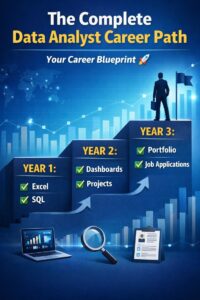
What Is the Data Analyst Career Path in Nigeria?
The Data Analyst Career Path in Nigeria is the progression a learner can follow from acquiring basic data skills to becoming capable of performing professional data analysis.
A typical progression can look like:
Beginner → Excel Analyst → SQL Analyst → BI/Data Visualization Analyst → Junior Data Analyst → Data Analyst → Senior Data Analyst → Analytics Specialist or Manager
However, this is not a rigid career ladder.
Some people move into business intelligence. Others specialise in product analytics, marketing analytics, financial analytics, operations analytics or data science.
The important thing is to develop skills progressively.
The Data Analyst Career Path in Nigeria can therefore be viewed as a combination of:
- Data literacy
- Excel and spreadsheet analysis
- SQL
- Statistics
- Data visualisation
- Power BI or another BI platform
- Python
- Data cleaning
- Business understanding
- Communication
- Portfolio development
- Workplace experience
- Continuous learning
Recent Nigerian career guides similarly emphasise Excel, SQL, visualisation, Python, projects and communication as important parts of preparing for data analyst work.
Why Is the Data Analyst Career Path in Nigeria Important?
Businesses in Nigeria operate with data every day.
Consider the amount of information generated by:
- Banks
- Fintech companies
- Telecommunications companies
- Supermarkets
- Hospitals
- Universities
- Logistics companies
- E-commerce businesses
- Oil and gas companies
- Insurance companies
- Government agencies
- Non-governmental organisations
- Small and medium-sized businesses
A business might collect information about sales, customers, payments, expenses, employees, inventory, marketing campaigns or service usage.
Raw data alone does not automatically create value.
Someone needs to organise it, analyse it, identify patterns and communicate what those patterns mean.
That is where data analysts come in.
The Data Analyst Career Path in Nigeria therefore connects technology with business decision-making.
What Does a Data Analyst Do in Nigeria?
A data analyst works with data to help answer business or organisational questions.
Typical responsibilities may include:
- Collecting data
- Cleaning data
- Checking data quality
- Writing SQL queries
- Analysing spreadsheets
- Creating reports
- Building dashboards
- Identifying trends
- Calculating key performance indicators
- Presenting findings
- Supporting business decisions
- Automating repetitive analytical tasks
For example, imagine a retail business in Port Harcourt.
Management might ask:
Which products generated the highest revenue this quarter?
The analyst could:
- Extract the sales data.
- Remove duplicate records.
- Correct inconsistent product names.
- Group sales by product.
- Calculate revenue.
- Compare different periods.
- Build a visual report.
- Explain the findings.
- Recommend possible actions.
That is data analysis in practice.
The Data Analyst Career Path in Nigeria: Step-by-Step
Understanding the stages of the Data Analyst Career Path in Nigeria can prevent beginners from becoming overwhelmed.
You do not have to learn every technology simultaneously.
A structured progression is usually more effective.
1. Develop Basic Data Literacy
The first stage of the Data Analyst Career Path in Nigeria is understanding data itself.
Before learning complicated tools, understand concepts such as:
- What is data?
- What is a dataset?
- What is a variable?
- What is a database?
- What is a record?
- What is a metric?
- What is a KPI?
- What is a trend?
- What is an outlier?
- What is data quality?
You should also understand basic numerical concepts.
These include:
- Percentages
- Ratios
- Averages
- Minimum and maximum values
- Median
- Growth rates
- Percent changes
For example, if a company’s revenue increases from ₦1 million to ₦1.2 million, an analyst should understand that the business experienced a 20% increase.
The ability to interpret numbers is more important than simply calculating them.
2. Learn Microsoft Excel
Excel is one of the most practical starting points in the Data Analyst Career Path in Nigeria.
Many businesses use spreadsheets for reporting, budgeting, sales tracking, inventory management and operational records.
Important Excel skills include:
- SUM
- AVERAGE
- COUNT
- COUNTA
- COUNTBLANK
- IF
- SUMIF
- SUMIFS
- COUNTIF
- COUNTIFS
- XLOOKUP
- INDEX and MATCH
- Sorting
- Filtering
- Conditional formatting
- PivotTables
- Charts
- Data cleaning
- Basic dashboards
Example Excel Project
Suppose you receive a fictional dataset containing 5,000 sales transactions.
You could use Excel to determine:
- Total revenue
- Average transaction value
- Best-selling product
- Best-performing location
- Monthly revenue
- Number of customers
- Products with declining sales
This teaches more than memorising formulas.
It teaches you how to ask questions of data.
3. Learn Statistics
Statistics forms an important part of the Data Analyst Career Path in Nigeria.
You do not need advanced mathematics to begin.
Start with:
- Mean
- Median
- Mode
- Range
- Percentage
- Standard deviation
- Distribution
- Correlation
- Sampling
- Variability
You should also learn to interpret statistics correctly.
For example, correlation between two variables does not automatically mean that one causes the other.
This type of reasoning helps prevent misleading conclusions.
4. Learn SQL
SQL is an important milestone in the Data Analyst Career Path in Nigeria.
SQL stands for Structured Query Language.
It allows analysts to interact with relational databases.
Important SQL concepts include:
- SELECT
- FROM
- WHERE
- ORDER BY
- GROUP BY
- HAVING
- COUNT
- SUM
- AVG
- MIN
- MAX
- JOIN
- CASE
- Subqueries
- Common Table Expressions
- Window functions
Example
Imagine a Nigerian e-commerce business has separate tables for:
- Customers
- Orders
- Products
- Payments
An analyst could use SQL to combine these tables and answer questions such as:
- Which products generate the most revenue?
- Which customers buy most frequently?
- Which locations have the highest sales?
- What is the average order value?
- How has monthly revenue changed?
This is why SQL becomes an important step as you progress through the Data Analyst Career Path in Nigeria.
5. Learn Power BI and Data Visualization
Once you have developed spreadsheet and SQL skills, data visualisation becomes an important next step.
Power BI is one option for creating interactive business intelligence reports.
Microsoft’s current Power BI Data Analyst certification framework covers preparing data, modelling data, visualising and analysing data, and managing Power BI environments.
A learner should understand more than how to create colourful charts.
You should learn:
- Data importing
- Power Query
- Data cleaning
- Relationships
- Data modelling
- DAX fundamentals
- Measures
- KPIs
- Dashboard design
- Filters
- Data storytelling
Example Power BI Project
Imagine a fictional logistics company operating between:
- Port Harcourt
- Lagos
- Abuja
- Enugu
- Benin City
You could create a dashboard showing:
- Number of deliveries
- Delivery success rate
- Average delivery time
- Revenue
- Customer locations
- Monthly performance
This would demonstrate practical analytical thinking.
6. Learn Python for Data Analysis
Python is another useful stage of the Data Analyst Career Path in Nigeria.
It does not necessarily have to be your first technical skill.
After developing Excel and SQL knowledge, Python can help you handle more advanced analytical tasks.
Important Python concepts for data analysts include:
- Variables
- Lists
- Dictionaries
- Loops
- Functions
- Conditional statements
- File handling
- Data manipulation
For data analysis, learners commonly encounter libraries such as:
- Pandas
- NumPy
- Matplotlib
Pandas, in particular, is widely used for manipulating and analysing tabular data.
Python can help with:
- Data cleaning
- Automation
- Exploratory analysis
- Repetitive workflows
- Larger datasets
- Data transformation
The goal is not to become a software engineer.
The goal is to use programming to make analytical work more efficient and flexible.
7. Learn Data Cleaning
Data cleaning is one of the most important but frequently underestimated parts of the Data Analyst Career Path in Nigeria.
Real datasets may contain:
- Missing values
- Duplicate records
- Incorrect spellings
- Inconsistent dates
- Incorrect data types
- Invalid entries
- Outliers
- Inconsistent categories
Imagine a customer location field contains:
- Port Harcourt
- Port-Harcourt
- Port Harcourt City
- PH
- P/H
If these represent the same location, the analyst needs to determine how they should be standardised.
Poor data quality can produce poor analysis.
Therefore:
Good analysis begins with good data preparation.
8. Develop Business Understanding
A strong analyst understands that data exists for a reason.
The Data Analyst Career Path in Nigeria should therefore include business knowledge.
For example, a retail analyst should understand:
- Revenue
- Profit
- Inventory
- Customer acquisition
- Average order value
- Sales volume
A fintech analyst might encounter:
- Transactions
- Customer activity
- Retention
- Fraud indicators
- Revenue
- Customer acquisition
An operations analyst might study:
- Delivery times
- Costs
- Productivity
- Capacity
- Efficiency
You become more valuable when you understand both the data and the business problem behind the data.
9. Build a Data Analytics Portfolio
Portfolio development is one of the most important stages of the Data Analyst Career Path in Nigeria.
A portfolio provides evidence of practical ability.
Instead of simply writing:
“I know Excel, SQL and Power BI.”
You can show:
“I used Excel to clean and analyse 5,000 sales records and built a Power BI dashboard identifying revenue trends and underperforming product categories.”
That is stronger evidence.
A beginner portfolio could contain three to five well-documented projects.
Each project should include:
- Business problem
- Dataset
- Tools used
- Data-cleaning process
- Analysis
- Visualisations
- Findings
- Recommendations
- Lessons learned
Quality is more important than the number of projects.
Data Analyst Career Path in Nigeria: Portfolio Project Ideas
Here are practical project ideas Nigerian learners can use.
1. Nigerian Retail Sales Dashboard
Analyse fictional supermarket transactions.
Study:
- Sales
- Products
- Locations
- Customers
- Monthly performance
Tools:
Excel + Power BI
2. Customer Analysis
Create a fictional customer dataset and investigate:
- Customer frequency
- Customer value
- Repeat purchases
- Customer segments
Tools:
SQL + Power BI
3. Logistics Performance
Analyse fictional delivery records.
Questions could include:
- Which routes experience delays?
- Which locations receive the most deliveries?
- What is the average delivery time?
- Which months experience higher demand?
Tools:
Excel + SQL + Power BI
4. Nigerian Business Expense Analysis
Analyse fictional business expenses.
Identify:
- Highest expense categories
- Monthly spending
- Cost trends
- Potential areas for efficiency
Tools:
Excel + Power BI
5. Student Performance Dashboard
Use fictional student information to analyse:
- Attendance
- Scores
- Subjects
- Performance trends
This can be particularly useful for learners because it connects data analysis with an environment they understand.
10. Develop Communication Skills
Technical knowledge is only part of the Data Analyst Career Path in Nigeria.
You also need to communicate findings.
Imagine that you discover that sales have fallen.
Simply saying:
“Sales declined by 15%.”
is not enough.
A stronger analyst asks:
- When did the decline begin?
- Which products were affected?
- Which locations were affected?
- Did customer numbers change?
- Did prices change?
- Was there a seasonal factor?
- What action should management consider?
The ability to explain this clearly is known as data storytelling.
11. Learn How to Use AI in Data Analytics
AI is becoming increasingly relevant to the modern Data Analyst Career Path in Nigeria.
AI tools can assist with tasks such as:
- Drafting SQL
- Explaining formulas
- Generating Python code
- Summarising data
- Suggesting analysis ideas
- Automating repetitive work
- Helping document analytical processes
However, analysts should not blindly trust AI-generated results.
You need enough technical knowledge to verify:
- SQL queries
- Calculations
- Data transformations
- Statistical interpretations
- Business conclusions
The future data analyst will increasingly need both traditional analytical skills and AI literacy.
12. Prepare for Your First Data Analyst Job
After developing skills and projects, you can begin preparing for employment.
Potential entry-level roles include:
- Junior Data Analyst
- Data Analyst
- Reporting Analyst
- Business Intelligence Analyst
- Operations Analyst
- Marketing Analyst
- Product Analyst
- Business Analyst
The exact job title and requirements vary between organisations.
Recent Nigerian career resources commonly identify banking, fintech, telecommunications, e-commerce, logistics and other sectors as areas where data analysis skills can be relevant.
Data Analyst Career Path in Nigeria by Career Level
The career progression can be broadly understood as follows.
Beginner
At this stage, you are learning:
- Excel
- Basic statistics
- Data cleaning
- Basic SQL
- Basic visualisation
Your priority is developing competence.
Junior Data Analyst
A junior analyst may work on:
- Reports
- Data cleaning
- SQL queries
- Dashboards
- Recurring analysis
- Basic business questions
Your priority is becoming reliable.
Mid-Level Data Analyst
At this level, you may:
- Own analytical projects
- Build more complex dashboards
- Work directly with stakeholders
- Analyse business performance
- Automate repetitive tasks
- Provide recommendations
Your priority is developing business impact.
Senior Data Analyst
A senior analyst may:
- Lead analytical projects
- Mentor junior analysts
- Influence business decisions
- Develop analytical strategies
- Work with complex datasets
- Communicate with senior stakeholders
Your priority becomes influence and strategic thinking.
Analytics Lead or Manager
At the leadership level, responsibilities can include:
- Managing analytics teams
- Setting analytical priorities
- Developing reporting strategies
- Working with executives
- Improving data culture
- Supporting organisation-wide decision-making
The exact career progression differs between organisations, so learners should view these levels as a framework rather than a guaranteed timetable.
Data Analyst Career Path in Nigeria: Alternative Career Directions
One advantage of developing data analysis skills is that the skills can lead to several related careers.
You could eventually explore:
Business Intelligence
Focuses heavily on reporting, dashboards and organisational decision-making.
Product Analytics
Focuses on how customers use digital products.
Marketing Analytics
Focuses on campaigns, customers and marketing performance.
Financial Analytics
Focuses on financial performance, costs, revenue and business planning.
Operations Analytics
Focuses on improving processes and efficiency.
Data Science
Moves further into statistics, predictive modelling and machine learning.
Data Engineering
Focuses more heavily on building the systems and infrastructure used to collect and process data.
The Data Analyst Career Path in Nigeria can therefore become a foundation for several technology and business careers.
Data Analyst Career Path in Nigeria for Students
Students can begin building relevant skills before graduation.
A student might start with:
Year 1: Computer and Excel fundamentals
Year 2: Statistics and SQL
Year 3: Power BI and practical projects
Year 4: Python, portfolio and internship preparation
This is only an example.
The important principle is to avoid waiting until graduation before acquiring practical skills.
A student who graduates with a degree plus several well-documented analytics projects may have more evidence of practical ability than someone who only has academic coursework.
Data Analyst Career Path in Nigeria for Career Changers
You do not necessarily need to begin your career in technology to move toward analytics.
For example:
Accountant → Data Analyst
Existing knowledge of financial records can be useful.
Marketer → Marketing Analyst
Existing knowledge of campaigns and customers can complement analytics skills.
Business Administrator → Business Analyst
Existing business-process knowledge can support analytical work.
Teacher → Education Data Analyst
Experience in education can provide valuable domain knowledge.
Engineer → Data Analyst
Quantitative and problem-solving skills can provide a useful foundation.
The key is to combine your existing knowledge with data skills.
Data Analyst Career Path in Nigeria for Learners in Port Harcourt
Port Harcourt provides a useful environment for learning data analytics because the city has businesses and organisations across different sectors.
A learner can create projects around scenarios involving:
- Oil and gas services
- Retail
- Logistics
- Education
- Healthcare
- Hospitality
- Small businesses
- Financial services
For example, an aspiring analyst could create a fictional oil-and-gas services dashboard showing equipment maintenance records.
Another learner could analyse a fictional Port Harcourt retail dataset.
The purpose is not to pretend that these projects are real company projects.
The purpose is to demonstrate that you understand how analytical methods can be applied to realistic business situations.
How Potenmunia Tech School Approaches the Data Analyst Career Path
Potenmunia Tech School in Port Harcourt approaches technology training with an emphasis on practical, hands-on learning.
For learners following the Data Analyst Career Path in Nigeria, this type of approach is important because analytics is a skill that becomes stronger through practice.
Rather than learning tools only as isolated topics, learners can benefit from connecting:
Concept → Tool → Project → Analysis → Presentation → Portfolio
For example, instead of simply learning how PivotTables work, a learner could use them to investigate a realistic sales problem.
Instead of only learning SQL syntax, the learner could use SQL to answer business questions.
Instead of only learning Power BI buttons, the learner could build a dashboard around a specific analytical problem.
Potenmunia’s approach also places emphasis on:
- Hands-on practical learning
- Real-world projects
- Capstone experience
- Portfolio development
- Mentorship
- Career preparation
- AI integration
- Future-focused skills
- Innovation and entrepreneurship
This approach is particularly useful for learners who want to move from knowing about data analytics to demonstrating what they can actually do.
Common Mistakes on the Data Analyst Career Path in Nigeria
1. Learning Too Many Tools
You do not need to master ten tools immediately.
Build depth gradually.
2. Ignoring Excel
Some beginners believe that professional analysts should immediately jump to Python.
Excel remains useful for many everyday analytical tasks.
3. Avoiding SQL
If you want to work with database-driven organisations, SQL is an important skill to develop.
4. Building Only Attractive Dashboards
A dashboard should answer a question.
A beautiful dashboard with no useful insight is still a weak analytical project.
5. Copying Tutorials Without Understanding Them
Following a YouTube tutorial can help you learn.
But after completing it, try rebuilding the project independently.
Change the dataset.
Change the questions.
Explain your findings in your own words.
6. Ignoring Communication
You may find an important pattern but still struggle professionally if you cannot explain it.
7. Depending Completely on AI
AI can accelerate your work, but you remain responsible for checking the accuracy of your analysis.
How Long Does the Data Analyst Career Path in Nigeria Take?
There is no fixed period.
A learner studying consistently might structure their development like this:
Months 1–2
- Data fundamentals
- Excel
- Basic statistics
Months 3–4
- SQL
- Data cleaning
- More advanced Excel
Months 5–6
- Power BI
- Data modelling
- Dashboard development
Months 7–8
- Python
- Pandas
- Portfolio projects
Months 9+
- Advanced projects
- Interview preparation
- Applications
- Specialisation
These are learning milestones rather than guarantees.
Your actual progress depends on your background, study time, practice, learning environment and ability to apply what you learn.
Data Analyst Career Path in Nigeria: A Practical Checklist
Use this checklist to monitor your progress.
Foundation
- Understand basic data concepts
- Learn percentages and averages
- Understand basic statistics
- Develop computer skills
Excel
- Learn formulas
- Learn lookup functions
- Learn PivotTables
- Learn charts
- Practise data cleaning
- Build a simple dashboard
SQL
- SELECT
- WHERE
- GROUP BY
- ORDER BY
- JOIN
- CASE
- Subqueries
- CTEs
- Window functions
Power BI
- Import data
- Clean data
- Create relationships
- Build data models
- Learn basic DAX
- Create dashboards
- Practise data storytelling
Python
- Learn Python fundamentals
- Learn Pandas
- Learn NumPy basics
- Explore data visualisation
- Practise automation
Portfolio
- Build a sales project
- Build a customer project
- Build a business dashboard
- Document your findings
- Explain recommendations
Career
- Create a professional CV
- Prepare a portfolio
- Practise SQL interview questions
- Practise explaining projects
- Develop communication skills
- Look for internships and entry-level opportunities
Frequently Asked Questions About the Data Analyst Career Path in Nigeria
Can I become a data analyst without a computer science degree?
Yes.
People enter data analytics from backgrounds including economics, accounting, mathematics, engineering, business, statistics and other disciplines.
What matters is developing the required analytical and technical competencies.
What should I learn first?
For many beginners, Excel and basic data concepts are a practical starting point.
You can then progress to SQL, Power BI and Python.
Is SQL important for the Data Analyst Career Path in Nigeria?
Yes.
SQL is particularly useful when working with data stored in relational databases.
Is Python compulsory?
Not necessarily for every entry-level role.
However, learning Python can expand your analytical capabilities, especially for automation and more advanced data work.
Is Power BI worth learning?
Power BI is a useful business-intelligence and visualisation platform and can be valuable for analysts who need to create interactive reports and dashboards.
Do I need advanced mathematics?
No.
You should understand basic quantitative concepts and gradually learn statistics that are relevant to your work.
How many portfolio projects should I build?
There is no magic number.
Three to five strong, well-documented projects can provide a useful starting portfolio.
Can I learn data analytics in Port Harcourt?
Yes.
You can combine self-study, online resources, academic education and structured practical training.
For learners who prefer face-to-face guidance and project-based learning, a technology school such as Potenmunia Tech School can provide a structured environment for developing practical skills.
Can data analytics lead to other careers?
Yes.
Data analytics can provide foundations for areas such as business intelligence, product analytics, financial analytics, marketing analytics, data science and analytics management.
Conclusion on the Data Analyst Career Path in Nigeria
The Data Analyst Career Path in Nigeria is best understood as a continuous learning journey rather than a single course.
You can start with basic data literacy and Excel.
Then progress to:
Excel → Statistics → SQL → Power BI → Python → Projects → Portfolio → Professional Experience → Specialisation
The order can change depending on your background, but the principle remains the same: develop skills progressively and apply them to realistic problems.
Do not focus only on collecting certificates.
Build evidence.
Do not focus only on learning software.
Learn how to solve problems.
Do not focus only on creating attractive dashboards.
Learn how to communicate insights.
And do not treat AI as a replacement for analytical thinking. Learn how to use AI responsibly while maintaining the ability to verify your results.
For learners in Port Harcourt, Potenmunia Tech School provides a practical environment for developing technology skills through hands-on learning, real-world projects, portfolio development, mentorship and career preparation.
If you are beginning the Data Analyst Career Path in Nigeria, you do not need to master everything at once.
Start with one skill.
Practise it.
Build a project.
Learn from it.
Then move to the next stage.
That is how a beginner gradually develops into a professional data analyst.
If you are searching for a Data Science Course in Port Harcourt, you are probably interested in learning how data can be used to solve problems, make predictions, understand business performance and support better decisions.
A Data Science Course in Port Harcourt can provide a structured path for students, graduates, professionals and technology enthusiasts who want to develop practical skills in programming, statistics, data analysis, machine learning and artificial intelligence.
Data science is a multidisciplinary field that combines areas such as statistics, computing, algorithms, data analysis and scientific methods to extract knowledge and insights from data.
However, learning data science is not simply about learning Python or memorising machine learning algorithms. A useful Data Science Course in Port Harcourt should help learners understand how to approach real problems, work with datasets, communicate findings and build projects that demonstrate practical competence.
For learners in Port Harcourt and other parts of Nigeria, this makes choosing the right learning approach especially important.
What Is a Data Science Course in Port Harcourt?
A Data Science Course in Port Harcourt is a structured programme designed to teach learners how to work with data using statistical, computational and analytical techniques.
Depending on the programme, a Data Science Course in Port Harcourt may cover:
- Data science fundamentals
- Statistics
- Mathematics for data science
- Python programming
- SQL
- Excel
- Data cleaning
- Exploratory data analysis
- Data visualisation
- Machine learning
- Artificial intelligence
- Model evaluation
- Data storytelling
- Real-world projects
- Portfolio development
The depth of each topic depends on whether the course is designed for beginners, intermediate learners or experienced professionals.
For beginners, the most important thing is to have a logical progression from basic concepts to practical applications.
Why Consider a Data Science Course in Port Harcourt?
Port Harcourt is an important commercial and professional centre in Nigeria. Businesses and organisations in the city operate across sectors such as energy, finance, healthcare, education, logistics, retail, hospitality and professional services.
These organisations generate data through everyday activities.
For example, a Port Harcourt business could collect data about:
- Customer purchases
- Product inventory
- Employee performance
- Marketing campaigns
- Expenses
- Website traffic
- Customer enquiries
- Sales
- Operational activities
A person who learns data science can develop the skills needed to examine this information and identify useful patterns.
This is one reason a Data Science Course in Port Harcourt can be relevant to people who want to connect technology skills with real business and organisational problems.
What Will You Learn in a Data Science Course in Port Harcourt?
The curriculum should depend on the level of the learner, but several core areas are particularly important.
1. Data Science Fundamentals
Before learning advanced techniques, students need to understand what data science is and how data moves through a typical workflow.
A basic workflow might look like:
Problem → Data Collection → Data Cleaning → Exploration → Analysis → Modelling → Evaluation → Communication
Understanding this process helps learners see how individual tools fit together.
2. Statistics
Statistics is an important part of data science.
A Data Science Course in Port Harcourt may introduce concepts such as:
- Mean
- Median
- Mode
- Variance
- Standard deviation
- Probability
- Correlation
- Distributions
- Sampling
- Hypothesis testing
- Regression
Statistics helps learners interpret data rather than simply manipulate numbers.
3. Python Programming
Python is widely used in the data science ecosystem.
A beginner Data Science Course in Port Harcourt should ideally introduce programming gradually.
Learners may study:
- Variables
- Data types
- Operators
- Conditional statements
- Loops
- Functions
- Lists
- Dictionaries
- File handling
- Basic programming logic
After learning Python fundamentals, learners can move into libraries used specifically for data work.
4. Pandas and NumPy
Pandas is useful for working with tabular data, while NumPy provides tools for numerical computing.
With these tools, learners can practise tasks such as:
- Loading datasets
- Filtering information
- Removing duplicates
- Handling missing values
- Creating calculated fields
- Grouping data
- Combining datasets
- Performing numerical calculations
5. SQL
SQL is another valuable skill for data professionals.
Many organisations store information in databases, so understanding how to retrieve and manipulate data is important.
A Data Science Course in Port Harcourt may teach:
- SELECT statements
- Filtering
- Sorting
- Aggregation
- GROUP BY
- JOIN
- CASE statements
- Subqueries
- Common table expressions
For example, a learner could use SQL to answer:
“Which products generated the highest revenue during the last six months?”
That is more meaningful than simply learning SQL syntax without applying it.
6. Data Cleaning
Real-world data often contains errors.
A dataset may include:
- Missing information
- Duplicate records
- Incorrect spellings
- Invalid values
- Different date formats
- Inconsistent categories
Data cleaning is therefore an important part of a practical Data Science Course in Port Harcourt.
Students should learn not only how to clean data but also how to identify why a problem exists.
7. Data Visualisation
Data visualisation allows findings to be communicated more clearly.
Learners may work with:
- Bar charts
- Line charts
- Scatter plots
- Histograms
- Box plots
- Heatmaps
- Interactive dashboards
The goal is not to create attractive charts for their own sake. A good visualisation should help the audience understand an important finding.
Data Science Tools Beginners Should Learn
A good Data Science Course in Port Harcourt does not need to teach every technology available.
Instead, beginners should develop strong foundations in a manageable set of tools.
Python
Used for programming, data analysis, automation and machine learning.
SQL
Used for interacting with relational databases.
Pandas
Used for data manipulation and analysis.
NumPy
Used for numerical operations.
Jupyter Notebook
Useful for combining code, analysis, explanations and visualisations in one environment.
Power BI
Power BI is primarily a business intelligence and data visualisation platform, but it can complement data science skills by helping learners communicate analytical findings.
Git and GitHub
These tools can help learners organise projects and demonstrate their work to others.
Data Science Course in Port Harcourt: Practical Learning Matters
One of the most important factors to consider when selecting a Data Science Course in Port Harcourt is how much practical work is included.
There is a major difference between:
Learning what a machine learning algorithm is
and
Using a dataset to build, evaluate and explain a machine learning model.
Practical learning helps bridge that gap.
A learner should have opportunities to:
- Receive a problem
- Find or receive relevant data
- Clean the data
- Explore the dataset
- Analyse patterns
- Build a model where appropriate
- Evaluate results
- Explain findings
- Present recommendations
This type of practice makes the learning process more realistic.
Real-World Data Science Projects in Port Harcourt
A strong Data Science Course in Port Harcourt can use projects that reflect realistic Nigerian scenarios.
1. Retail Sales Analysis
Imagine a retail company operating in Port Harcourt.
Students could analyse:
- Monthly sales
- Product categories
- Customer purchases
- Revenue
- Inventory
- Seasonal patterns
The final result could be a report explaining which products perform well and where improvements may be needed.
2. Customer Churn Prediction
A telecommunications or subscription business could be interested in identifying customers who may stop using its service.
Students could explore:
- Customer tenure
- Usage
- Service plans
- Customer complaints
- Payment behaviour
They could then develop a basic predictive model and evaluate its performance.
3. Demand Forecasting
A business could use historical sales data to estimate future demand.
This can introduce learners to:
- Time-series data
- Trends
- Seasonality
- Forecasting concepts
- Model evaluation
4. Nigerian Business Dashboard
Learners could combine SQL, Python or spreadsheet data with a dashboarding tool to create a business performance report.
The project could display:
- Revenue
- Expenses
- Sales
- Customers
- Product performance
- Monthly trends
These projects make a Data Science Course in Port Harcourt more connected to practical problem-solving.
Data Science Course in Port Harcourt and Portfolio Building
A portfolio is one of the most useful outcomes of practical technology training.
Instead of telling an employer:
“I have learned Python.”
A learner can demonstrate:
“Here is a Python project where I cleaned a dataset, analysed customer behaviour and communicated the results.”
A good beginner portfolio could contain:
- Python data analysis project
- SQL project
- Data visualisation project
- Machine learning project
- Business case study
- Capstone project
Each project should explain:
The problem → The data → The process → The findings → The conclusion
This makes the portfolio easier for someone else to understand.
Data Science vs Data Analytics
People searching for a Data Science Course in Port Harcourt often also encounter data analytics courses.
Although the fields overlap, they are not exactly the same.
Data analytics commonly focuses on examining data to understand performance, trends and business questions.
Data science generally covers a broader collection of methods involving programming, statistics, data analysis, machine learning and predictive modelling.
For example:
Data analytics question:
“What were our highest-selling products last month?”
Data science question:
“Can historical customer and product data help us predict future purchasing behaviour?”
Both approaches are valuable, and data analytics can provide a useful foundation for people who later want to progress into data science.
Career Opportunities After Data Science Training
Completing a Data Science Course in Port Harcourt does not automatically guarantee employment. However, developing relevant technical skills can prepare learners to explore different roles within the wider data and technology ecosystem.
Possible career directions include:
Data Analyst
Data analysts examine data and communicate insights that support organisational decisions.
Junior Data Scientist
Junior data scientists may assist with data preparation, analysis, experimentation and modelling.
Machine Learning Engineer
Machine learning engineers focus on developing and deploying machine learning systems.
Business Intelligence Analyst
BI analysts work with business data, reporting systems and dashboards.
Data Engineer
Data engineers help build systems and infrastructure for collecting, transforming and providing access to data.
Research and Quantitative Roles
Learners with strong mathematical and statistical foundations may also explore research-oriented data roles.
Data Science Career Opportunities in Nigeria
Data science can be applied across many Nigerian industries.
Examples include:
- Banking
- Fintech
- Telecommunications
- Healthcare
- Energy
- Insurance
- Logistics
- Retail
- Education
- E-commerce
- Technology companies
- Professional services
For learners in Port Harcourt, this creates opportunities to think beyond a single industry.
A person could develop data skills and later apply them to business, finance, technology, energy or another field where data is important.
How AI Fits Into Data Science
Artificial intelligence is increasingly connected with modern data workflows.
AI tools can assist with activities such as:
- Code development
- Data exploration
- Documentation
- Text analysis
- Automation
- Pattern identification
- Predictive modelling
However, AI does not eliminate the need for fundamental knowledge.
Someone taking a Data Science Course in Port Harcourt should still understand statistics, data quality, programming logic and model evaluation.
AI should be treated as a tool that supports good technical work rather than a replacement for understanding.
How to Choose a Data Science Course in Port Harcourt
Before enrolling in a Data Science Course in Port Harcourt, ask several practical questions.
Does the Course Include Practical Exercises?
Find out how much time is spent actually working with data.
Does the Curriculum Include Python and SQL?
These are important foundations for many data-related roles.
Are Real-World Projects Included?
Projects help turn theoretical knowledge into practical experience.
Will You Build a Portfolio?
Ask whether learners complete projects that they can organise and present professionally.
Is Mentorship Available?
Beginners often need help understanding errors and difficult concepts.
Does the Programme Include Career Preparation?
Consider whether the training covers topics such as project presentation, professional communication, interview preparation and workplace expectations.
Does the Programme Address AI?
Modern data professionals should understand how AI is changing data-related workflows.
How Potenmunia Tech School Approaches Data Science
For learners considering a Data Science Course in Port Harcourt, Potenmunia Tech School approaches technology education with an emphasis on practical application and career preparation.
The learning approach focuses strongly on hands-on practice rather than relying only on classroom theory. Students can work through exercises and practical projects designed to help them understand how technology skills apply to real problems.
Real-world projects and capstone experiences are particularly important because data science requires more than knowing definitions. Learners need opportunities to work through complete problems from data preparation to analysis and communication.
Portfolio building is another important part of the approach. Students can use completed projects as evidence of their developing technical abilities.
Mentorship provides learners with guidance as they encounter challenges, while career and job-readiness support can help them understand how to present their skills and projects professionally.
Potenmunia also incorporates AI and future-focused skills, helping learners understand how emerging technologies can complement traditional data science techniques.
The school additionally encourages innovation and entrepreneurship, giving learners an opportunity to think about how technology and data can be used to create solutions, products or services.
For someone comparing options for a Data Science Course in Port Harcourt, these practical considerations can be more useful than choosing a programme based only on its title.
A Beginner’s Data Science Learning Roadmap
If you are completely new to data science, you can follow a gradual learning path.
1. Learn Computer and Data Fundamentals
Understand files, folders, spreadsheets, databases and basic data concepts.
2. Learn Excel
Practise formulas, sorting, filtering, tables, PivotTables and basic charts.
3. Learn Statistics
Build an understanding of descriptive statistics, probability and relationships between variables.
4. Learn SQL
Practise retrieving and summarising data from databases.
5. Learn Python
Start with programming fundamentals before moving into data science libraries.
6. Learn Pandas and NumPy
Practise manipulating and analysing datasets.
7. Learn Data Visualisation
Learn how to communicate findings using appropriate charts and dashboards.
8. Learn Machine Learning
Start with basic supervised and unsupervised learning concepts.
9. Build Projects
Apply your knowledge to realistic datasets and business problems.
10. Build Your Portfolio
Document your projects and organise them so that other people can understand your work.
How Long Does a Data Science Course in Port Harcourt Take?
There is no single answer because course duration varies between programmes and learners.
Someone studying full-time may progress faster than someone learning part-time.
More importantly, learners should measure progress by competence rather than simply counting weeks.
For example, ask:
- Can I clean a dataset?
- Can I write useful SQL queries?
- Can I analyse data using Python?
- Can I create meaningful visualisations?
- Can I explain my findings?
- Can I build and evaluate a basic model?
- Can I document a project?
Being able to answer these questions provides a better indication of progress.
Is Data Science Suitable for Beginners?
Yes.
A beginner does not need to know advanced programming before starting a Data Science Course in Port Harcourt.
However, learners should expect to encounter mathematics, statistics and programming.
The learning process becomes easier when students progress gradually.
Instead of attempting to learn Python, SQL, statistics, machine learning and artificial intelligence simultaneously, beginners can build one foundation before moving to the next.
Common Mistakes to Avoid When Learning Data Science
Focusing Only on Certificates
A certificate can document completion, but practical skills and projects help demonstrate competence.
Learning Too Many Tools
It is better to understand a small number of relevant tools deeply than to know the names of dozens of technologies.
Copying Portfolio Projects
Learners should understand the projects they present rather than simply copying tutorials.
Ignoring Statistics
Statistics is an important foundation for interpreting data and understanding machine learning.
Avoiding Practice
Data science is a practical field. Regular practice is essential.
Expecting Instant Results
Becoming comfortable with data science takes time. Consistent practice is more useful than rushing through topics.
Who Should Take a Data Science Course in Port Harcourt?
A Data Science Course in Port Harcourt may be suitable for:
- University students
- Recent graduates
- Working professionals
- Data analysts
- Technology enthusiasts
- Business professionals
- Entrepreneurs
- People changing careers
- Learners interested in artificial intelligence
The ideal starting point depends on your current skills and career goals.
Someone with a statistics background may progress differently from someone who is completely new to technology.
Frequently Asked Questions About Data Science Course in Port Harcourt
What is a Data Science Course in Port Harcourt?
A Data Science Course in Port Harcourt is a structured programme that teaches learners how to work with data using programming, statistics, data analysis, visualisation and machine learning techniques.
Can beginners take a Data Science Course in Port Harcourt?
Yes. Beginners can start with fundamental computer, programming, mathematics and statistics concepts before progressing into more advanced areas.
What programming language should I learn for data science?
Python is an important language to consider because it has a large ecosystem of libraries for data analysis, visualisation and machine learning.
Is SQL important for a Data Science Course in Port Harcourt?
Yes. SQL is useful for accessing and analysing information stored in relational databases.
Do I need mathematics to study data science?
You do not need to be an advanced mathematician to start, but mathematics and statistics become increasingly important as you progress into advanced data science and machine learning.
Can I learn data science without a computer science degree?
Yes. People enter data-related careers from different academic and professional backgrounds. Practical skills, projects and continued learning are important.
What should I look for in a Data Science Course in Port Harcourt?
Look for a programme with a clear curriculum, practical exercises, real-world projects, portfolio development, mentorship and appropriate career preparation.
Can a Data Science Course help me build a portfolio?
A practical programme can provide projects that become part of a portfolio. Learners should document those projects clearly and understand the work they present.
Is data science the same as data analytics?
No. They overlap, but data science generally encompasses a broader range of programming, statistics, machine learning and predictive modelling techniques.
Can data science skills be used in Nigeria?
Yes. Data-related skills can be applied across sectors including finance, telecommunications, healthcare, energy, logistics, retail, education and technology.
Learn More About Data Science
For an additional general reference, readers can explore Wikipedia’s overview of Data Science, which provides background on the field, its interdisciplinary nature and related concepts.
Conclusion
Choosing a Data Science Course in Port Harcourt is an important first step, but the course itself is only part of the learning journey.
The most valuable approach is to combine foundational knowledge with continuous practice.
A strong learning path should help you develop skills in:
- Statistics
- Python
- SQL
- Data cleaning
- Data analysis
- Data visualisation
- Machine learning
- Artificial intelligence
- Problem-solving
- Communication
Most importantly, you should have opportunities to apply these skills to realistic projects.
For learners in Port Harcourt, a practical Data Science Course in Port Harcourt can provide a structured environment for developing these capabilities while building a portfolio and preparing for future opportunities.
Potenmunia Tech School provides a practical, career-focused technology learning environment in Port Harcourt, with an emphasis on hands-on training, projects, portfolio development, mentorship, AI integration and career preparation.
If you are considering learning data science, take time to compare the curriculum, practical experience, project opportunities and support available before choosing a programme. The right course should help you move beyond simply learning about data science toward actually using data science skills to solve problems.
If you are searching for Data Science in Port Harcourt, you may be wondering what Data Science actually involves, what skills you need, which tools you should learn, and whether you can build a career in the field without an advanced technical background.
This guide provides a practical introduction to Data Science in Port Harcourt, especially for beginners in Port Harcourt and other parts of Nigeria.
Data Science is an interdisciplinary field that combines areas such as statistics, mathematics, computer science, programming, data analysis, visualization, and machine learning to extract useful knowledge and insights from data.
For someone beginning a Data Science Port Harcourt learning journey, the field may initially appear overwhelming because it combines several different disciplines. The good news is that you do not need to learn everything at once.
You can start with fundamental data concepts, Excel and statistics, then progress to SQL, Python, data analysis, visualization, and eventually machine learning and AI.
This article explains what Data Science means, why it matters in Port Harcourt, what beginners should learn, useful tools, project ideas, career possibilities, and how to develop practical skills.
What Is Data Science?
Data Science is the process of using data, scientific methods, programming, statistics and computational techniques to discover patterns, generate insights, make predictions and solve problems.
A simple Data Science workflow can be represented as:
Data Collection → Data Cleaning → Data Analysis → Modelling → Evaluation → Insights → Decision
According to Wikipedia’s current overview, Data Science combines statistics, scientific computing, scientific methods, visualization, algorithms and systems to extract or extrapolate knowledge from structured and unstructured data.
You can explore the subject further through Wikipedia’s Data Science article.
For example, imagine a business in Port Harcourt that records thousands of transactions.
The business might want to know:
- Which products sell most frequently?
- Which months generate the highest revenue?
- Which customers purchase most often?
- Which locations generate the most sales?
- Can future demand be predicted?
- Which customers may stop using the service?
Data Science provides techniques that can help answer questions like these.
Why Data Science Port Harcourt Is Becoming an Important Skill
The phrase Data Science Port Harcourt represents more than simply a search for a training programme.
It also reflects a broader question:
How can people and organizations in Port Harcourt use data to solve real problems?
Port Harcourt has economic activity across industries including energy, logistics, retail, education, healthcare, finance, hospitality and professional services.
Each of these areas can generate data.
For example, a logistics company may collect:
- Delivery locations
- Delivery times
- Vehicle information
- Fuel consumption
- Customer orders
- Distance travelled
- Failed deliveries
A Data Science approach could help the organization investigate patterns in those records.
A retailer could analyse customer purchases.
A school could examine student performance.
A hospital could study appointment patterns.
A financial organization could analyse transactions and customer behaviour.
This demonstrates why Data Science in Port Harcourt should not be viewed as a skill limited to software companies.
Who Should Learn Data Science in Port Harcourt?
Data Science can be suitable for different types of learners.
You may want to explore Data Science Port Harcourt if you are:
- A university student
- A recent graduate
- A professional interested in technology
- A business owner
- A data analyst who wants to advance
- A programmer interested in machine learning
- A researcher
- Someone changing careers
- Someone interested in AI
- A beginner looking for a technical skill
You do not necessarily need to begin as an expert programmer.
What matters is having the willingness to learn, practise and solve problems.
What Should You Learn for Data Science in Port Harcourt?
A beginner should avoid trying to learn Python, machine learning, artificial intelligence, SQL and advanced statistics simultaneously.
A more manageable path is:
Computer Fundamentals → Excel → Statistics → SQL → Python → Data Analysis → Visualization → Machine Learning → AI → Projects
The exact sequence can vary, but the important principle is progressive learning.
1. Computer Fundamentals
Before beginning advanced Data Science Port Harcourt training, you should be comfortable using a computer.
Important skills include:
- Managing files and folders
- Installing software
- Using browsers
- Managing documents
- Using keyboard shortcuts
- Working with spreadsheets
- Searching for information
- Using cloud-based applications
Strong computer fundamentals make later technical learning easier.
2. Excel for Data Science Beginners
Excel is a useful starting point for many people exploring Data Science in Port Harcourt.
It allows beginners to understand datasets without immediately having to write code.
You can learn:
- Data entry
- Sorting
- Filtering
- Formulas
- Functions
- Conditional formatting
- Charts
- PivotTables
- Data cleaning
- Basic statistics
Useful Excel functions include:
SUM, AVERAGE, COUNT, COUNTA, COUNTBLANK, IF, SUMIF, COUNTIF, ROUND, ROUNDUP and ROUNDDOWN.
For example, a beginner studying Data Science Port Harcourt could create a fictional dataset of monthly sales from businesses in different areas of Port Harcourt.
The learner could then use Excel to identify:
- Highest-selling products
- Monthly sales trends
- Average transaction values
- Sales by location
- Product categories with the strongest performance
This provides an excellent introduction to thinking analytically.
3. Statistics for Data Science Port Harcourt
Statistics is one of the foundations of Data Science.
You should understand concepts such as:
- Mean
- Median
- Mode
- Range
- Variance
- Standard deviation
- Probability
- Percentages
- Correlation
- Sampling
- Distributions
- Hypothesis testing
You do not need to become an advanced mathematician before starting.
However, as your Data Science skills grow, your understanding of statistics should grow as well.
Example
Suppose two businesses each report average monthly revenue of ₦2 million.
That information alone does not tell the whole story.
One business might generate nearly ₦2 million every month.
The other might generate ₦500,000 one month and ₦4 million the next.
Statistics can help describe the difference in their patterns.
4. SQL for Data Science in Port Harcourt
SQL stands for Structured Query Language.
It is used to retrieve and manipulate information stored in relational databases.
SQL is an important skill for people learning Data Science Port Harcourt because organizations frequently store large amounts of information in databases.
Beginners should learn:
- SELECT
- WHERE
- ORDER BY
- GROUP BY
- HAVING
- JOIN
- CASE
- Aggregate functions
- Subqueries
- Common Table Expressions
- Window functions
For example, imagine a company has 500,000 customer transactions stored in a database.
Instead of manually searching the records, SQL can help answer questions such as:
Which products generated the highest revenue?
Which customers purchased most frequently?
What were the monthly sales totals?
SQL therefore becomes an important bridge between databases and Data Science.
5. Python for Data Science Port Harcourt
Python is one of the most widely used programming languages in Data Science.
For someone beginning Data Science in Port Harcourt, Python can become an important long-term skill.
Start with:
- Variables
- Strings
- Numbers
- Lists
- Dictionaries
- Conditional statements
- Loops
- Functions
- Modules
- File handling
- Error handling
After learning Python fundamentals, move into Data Science libraries.
Important Python Libraries
Pandas
Pandas is widely used for manipulating and analysing structured data.
It can help you:
- Load datasets
- Filter records
- Clean information
- Handle missing values
- Group data
- Combine datasets
- Transform columns
NumPy
NumPy provides tools for numerical computing and forms an important part of the Python data ecosystem.
Matplotlib
Matplotlib can be used to create data visualizations.
Seaborn
Seaborn provides tools for statistical visualization.
Scikit-learn
Scikit-learn provides tools for machine-learning tasks such as classification, regression, clustering and model evaluation.
Data Cleaning: One of the Most Important Data Science Skills
A dataset collected from the real world is rarely perfect.
You may encounter:
- Missing values
- Duplicate records
- Incorrect spellings
- Wrong data types
- Inconsistent dates
- Outliers
- Invalid values
- Inconsistent location names
For example, a dataset could contain:
Port Harcourt
port harcourt
PH
P/H
Port-Harcourt
If these values represent the same location, they may need to be standardized before analysis.
This is why data cleaning should be an important part of any practical Data Science Port Harcourt learning programme.
Data Visualization and Data Science in Port Harcourt
Data visualization makes patterns easier to understand.
Common visualization types include:
- Bar charts
- Line charts
- Histograms
- Scatter plots
- Box plots
- Heatmaps
- Dashboards
For example, if you want to understand how sales change from January to December, a line chart may make the trend easier to see.
If you want to compare product categories, a bar chart may be more suitable.
The purpose of visualization is not simply to make a report attractive.
It is to communicate information clearly.
Data Science vs Data Analytics
Many people searching for Data Science in Port Harcourt also encounter Data Analytics.
The two fields overlap but are not identical.
Data Analytics
Data Analytics generally focuses on analysing existing data to discover patterns and answer questions.
A Data Analyst may ask:
- What happened?
- Why did it happen?
- Which products performed well?
- What trends can we identify?
Data Science
Data Science can include analytics but may extend into:
- Programming
- Statistical modelling
- Machine learning
- Predictive modelling
- Automation
- Artificial intelligence
A Data Scientist may ask:
- What might happen next?
- Can we predict customer behaviour?
- Can we automatically classify new information?
- Can we build a model that supports decision-making?
For many beginners, Data Analytics can provide a useful foundation before moving into more advanced Data Science.
Artificial Intelligence and Data Science Port Harcourt
AI is increasingly connected with Data Science.
However, Data Science and Artificial Intelligence are not the same thing.
Data Science focuses on extracting useful knowledge from data.
AI focuses on building systems that can perform tasks associated with intelligent behaviour.
Machine learning is one of the major areas connecting Data Science and AI.
For example, historical customer data could be used to train a model that predicts whether a customer may be likely to purchase a particular product.
For learners interested in Data Science Port Harcourt, understanding AI alongside strong foundations in statistics, programming and data analysis can be valuable.
Machine Learning for Data Science Beginners
Machine learning allows computers to learn patterns from data and use those patterns to make predictions or classifications.
Supervised Learning
The algorithm learns from labelled examples.
Applications include:
- Price prediction
- Customer churn prediction
- Classification
- Fraud-related pattern detection
Unsupervised Learning
The algorithm works with data without predefined labels.
Applications include:
- Customer segmentation
- Clustering
- Pattern discovery
Model Evaluation
A beginner should also learn how to evaluate models.
Important concepts include:
- Training data
- Testing data
- Validation
- Accuracy
- Precision
- Recall
- F1 score
- Overfitting
- Underfitting
Simply creating a machine-learning model does not mean the model is useful.
It must be evaluated appropriately.
Practical Data Science Port Harcourt Project Ideas
Projects are one of the most effective ways to turn theoretical knowledge into practical ability.
Here are several project ideas suitable for learners.
Port Harcourt Sales Analysis Project
Create a fictional sales dataset containing:
- Product
- Quantity
- Price
- Date
- Customer location
- Salesperson
Then analyse:
- Monthly revenue
- Best-selling products
- Sales by location
- Average order value
- Product performance
This project can introduce Excel, SQL, Python and visualization.
Port Harcourt Customer Analysis Project
Create a customer dataset and investigate:
- Customer age groups
- Purchase frequency
- Average spending
- Product preferences
- Customer segments
The project can introduce exploratory data analysis and clustering concepts.
Nigerian Business Dashboard
Create a dashboard showing:
- Revenue
- Expenses
- Profit
- Product performance
- Monthly trends
- Customer segments
This project can combine Data Science, Data Analytics and visualization skills.
Delivery Analysis Project
Create a fictional delivery dataset containing:
- Delivery location
- Distance
- Delivery time
- Vehicle
- Fuel consumption
- Delivery status
Then investigate factors associated with delivery delays.
This demonstrates how Data Science can be connected to practical operational problems.
Building a Data Science Portfolio in Port Harcourt
Completing a course is only one part of developing technical competence.
A portfolio allows you to demonstrate what you can actually do.
Your portfolio could include:
- Excel analysis
- SQL projects
- Python notebooks
- Data-cleaning projects
- Power BI dashboards
- Statistical analysis
- Machine-learning projects
- Business case studies
For every project, explain:
- The problem
- The dataset
- The tools used
- Data-cleaning steps
- Analysis
- Results
- Recommendations
- Limitations
This is much more useful than simply uploading a screenshot of a chart without explaining the work behind it.
Data Science Career Opportunities in Port Harcourt and Nigeria
Data Science skills can be applied across different sectors.
Energy
Data can support:
- Forecasting
- Operational analysis
- Maintenance planning
- Performance monitoring
Finance
Possible applications include:
- Customer analysis
- Risk analysis
- Fraud-pattern detection
- Forecasting
Retail
Retail businesses can analyse:
- Sales
- Inventory
- Customer behaviour
- Product performance
- Pricing
Healthcare
Data can support:
- Operational planning
- Appointment analysis
- Resource management
- Research
Education
Schools and educational organizations can analyse:
- Student performance
- Attendance
- Engagement
- Learning outcomes
Logistics
Logistics businesses can use data to examine:
- Routes
- Delivery times
- Vehicle performance
- Fuel usage
- Customer demand
This wide range of applications is one reason Data Science in Port Harcourt can be relevant to learners with different career interests.
Skills You Need to Develop for Data Science
Technical skills are important, but Data Science requires more than programming.
Problem-Solving
Learn how to turn a real-world problem into a data problem.
Critical Thinking
Do not automatically assume that every dataset tells the truth.
Ask:
- Where did the data come from?
- Is it complete?
- Could there be bias?
- Are there errors?
- Does the conclusion make sense?
Communication
A Data Scientist must often explain technical findings to people who are not technical.
Business Understanding
Understanding the purpose behind an analysis helps you focus on useful questions.
Attention to Detail
Small mistakes in data preparation can affect an entire analysis.
How Potenmunia Tech School Approaches Data Science
For someone researching Data Science Port Harcourt, the learning method is worth considering alongside the subjects being taught.
Potenmunia Tech School approaches technology education with an emphasis on practical application and career preparation.
The goal is to help learners move beyond simply knowing definitions and toward actually using technology to solve problems.
100% Practical, Hands-On Learning
Learners can spend time working directly with tools, datasets and technical workflows rather than relying entirely on theory.
Real-World Projects
Projects provide opportunities to apply concepts to realistic problems.
For example, instead of only learning data cleaning as a definition, a learner can work through a messy dataset and document how it was prepared.
Portfolio Building
Completed projects can become portfolio pieces that demonstrate practical ability.
Mentorship
Guidance can help learners understand difficult concepts, improve projects and develop better problem-solving habits.
Career and Job Readiness
The learning process can also include practical preparation such as project presentation, professional communication, CV development and interview preparation.
AI Integration
Modern Data Science increasingly interacts with AI.
Learners can explore how appropriate AI tools can support coding, research, analysis and productivity while still developing the foundational skills required to verify results and make sound decisions.
Innovation and Entrepreneurship
Data skills can also support entrepreneurship.
A learner may identify a business problem, analyse available information and develop a technology-based solution.
How to Start Data Science in Port Harcourt
If you are completely new, use a gradual approach.
1. Understand Data
Learn about datasets, variables, records and data types.
2. Learn Excel
Practise formulas, sorting, filtering, PivotTables and charts.
3. Learn Statistics
Study averages, percentages, probability, correlation and basic distributions.
4. Learn SQL
Practise querying, filtering, grouping and joining database information.
5. Learn Python
Begin with Python fundamentals.
6. Learn Pandas and NumPy
Use Python to work with datasets.
7. Learn Visualization
Create charts and dashboards that communicate insights.
8. Learn Machine Learning
Move into predictive modelling after developing strong foundations.
9. Build Projects
Create realistic projects based on problems that interest you.
10. Build a Portfolio
Document your work and explain your methodology and findings.
Common Data Science Mistakes Beginners Should Avoid
Trying to Learn Everything Immediately
Data Science is broad. Learn progressively.
Focusing Only on Certificates
Certificates can document learning, but practical ability is equally important.
Avoiding Projects
You need practice to turn concepts into skills.
Ignoring Statistics
Statistics is important for understanding data and evaluating models.
Copying Projects
A copied project does not demonstrate your ability to solve problems independently.
Ignoring Communication
A great analysis is less useful if you cannot explain its meaning.
Is Data Science Difficult?
Data Science can be challenging because it combines several areas.
You may need to learn:
- Mathematics
- Statistics
- Programming
- Databases
- Visualization
- Machine learning
But beginners do not need to master all these subjects immediately.
The better approach is to learn one concept, practise it and then build upon it.
A person beginning Data Science Port Harcourt training can start with simple datasets and progressively work toward more complex projects.
How Long Does It Take to Learn Data Science?
There is no single answer.
Your progress depends on:
- Your previous computer experience
- Mathematics background
- Programming experience
- Study schedule
- Practice
- Learning environment
- Project experience
Instead of asking only how many months it will take, ask:
What can I actually do after each stage of learning?
For example:
Foundation: Work confidently with spreadsheets.
Data Skills: Query and clean datasets.
Programming: Use Python to manipulate data.
Analysis: Find and communicate meaningful patterns.
Machine Learning: Build and evaluate basic predictive models.
Career Preparation: Complete projects and present a portfolio.
Data Science Port Harcourt Beginner’s Checklist
Use this checklist to measure your progress:
- Understand basic data concepts
- Work confidently with Excel
- Understand basic statistics
- Write basic SQL queries
- Understand Python fundamentals
- Use Pandas
- Use NumPy
- Clean a dataset
- Create useful charts
- Explain analytical findings
- Understand machine-learning fundamentals
- Complete a Data Science project
- Build a portfolio
- Present your work professionally
You do not have to complete everything immediately.
Think of the checklist as a roadmap.
Frequently Asked Questions About Data Science Port Harcourt
What is Data Science Port Harcourt?
Data Science Port Harcourt refers broadly to learning, practising, applying and building careers around Data Science within Port Harcourt and its surrounding technology and business environment.
Where can I learn Data Science in Port Harcourt?
You can research technology training providers in Port Harcourt and compare their curriculum, practical projects, mentorship, portfolio opportunities and career preparation. Potenmunia Tech School is one option for learners looking for a practical technology-training environment.
Can beginners learn Data Science in Port Harcourt?
Yes. Beginners can start with computer fundamentals, Excel and statistics before progressing to SQL, Python, data analysis and machine learning.
What should I learn first for Data Science?
Start with fundamental data concepts and statistics. Excel can provide an accessible introduction before progressing to SQL and Python.
Is Python important for Data Science?
Yes. Python is widely used for data manipulation, analysis, visualization and machine learning.
Is SQL important for Data Science?
Yes. SQL is particularly useful for accessing and manipulating information stored in relational databases.
Is Data Science the same as Data Analytics?
No. They overlap, but Data Science generally has a broader scope that can include programming, statistics, machine learning and predictive modelling.
Can Data Science be useful for Nigerian businesses?
Yes. Data-driven methods can be applied across areas such as finance, retail, logistics, healthcare, education, telecommunications and energy.
Do I need advanced mathematics?
You do not need advanced mathematics to begin. However, mathematical and statistical knowledge becomes increasingly important as you progress into advanced Data Science and machine learning.
Can I learn Data Science without programming experience?
Yes. You can begin with basic computer and data skills and gradually learn programming.
What projects can I build as a Data Science beginner?
You could build sales-analysis projects, customer segmentation projects, business dashboards, delivery-analysis projects, forecasting projects and other projects based on realistic datasets.
How can I become job-ready?
Develop practical skills, complete projects, build a portfolio, learn to communicate your findings and practise solving realistic business problems.
Conclusion on Data Science Port Harcourt
Data Science Port Harcourt is not simply about learning Python or memorizing machine-learning algorithms.
It is about learning how to use data to understand problems, discover patterns, make predictions, communicate insights and support better decisions.
A practical learning journey can look like:
Excel → Statistics → SQL → Python → Data Analysis → Visualization → Machine Learning → AI → Projects → Portfolio
The most important part is not trying to learn everything immediately.
Start with the fundamentals.
Practise regularly.
Work with realistic datasets.
Build projects.
Learn how to explain your findings.
Then gradually move toward advanced Data Science and AI.
For learners exploring Data Science in Port Harcourt, Potenmunia Tech School provides a practical, career-focused technology learning environment that emphasizes hands-on experience, real-world projects, portfolio development, mentorship, career preparation, AI integration and innovation.
If you are considering Data Science as a career or professional skill, take time to compare learning paths, understand the skills involved and choose an environment where you can practise what you learn.
The goal should not simply be to say that you have studied Data Science.
The goal should be to demonstrate that you can use data to solve problems.